

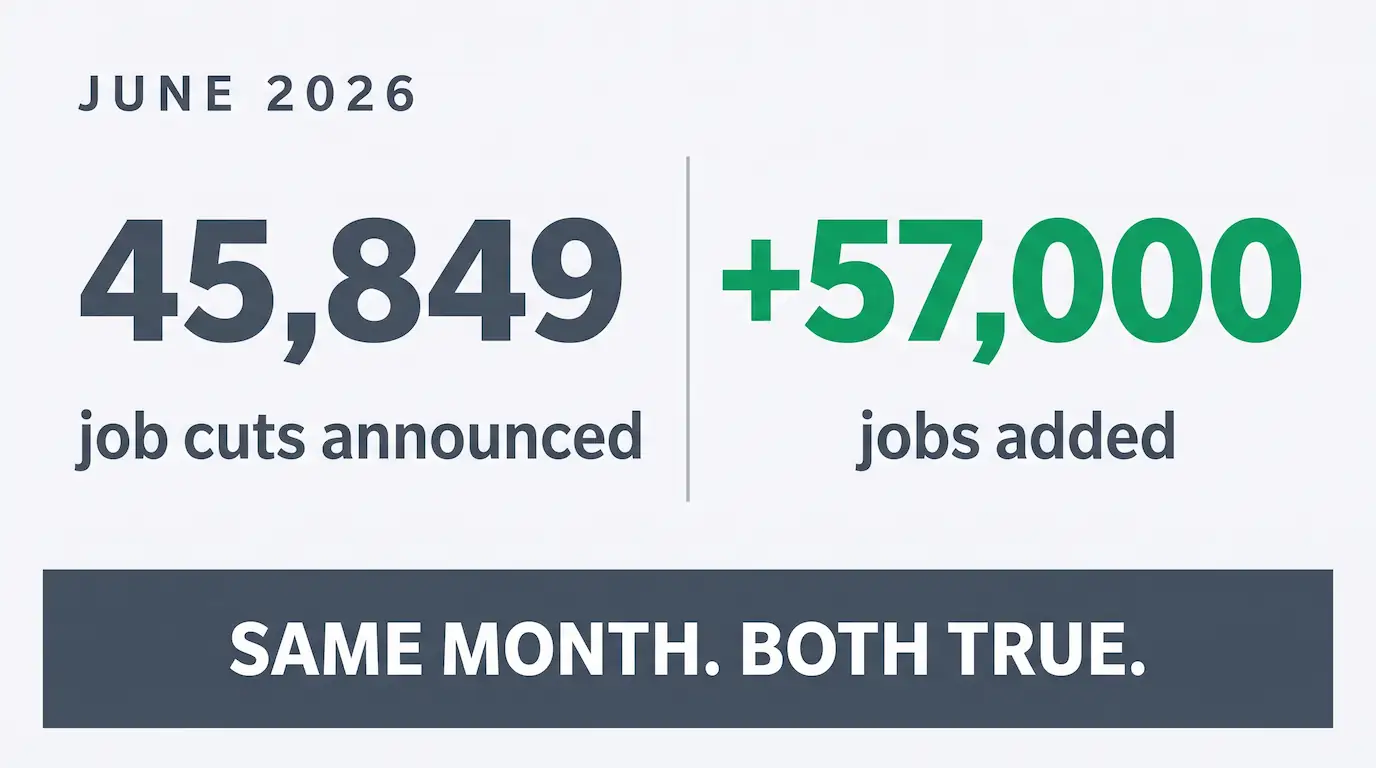
If you’ve been trying to work out whether AI will take my job is a question with a real answer, that pair is most of the reason you can’t get one. The evidence isn’t unclear so much as it’s read off three different instruments measuring three different things. Almost nobody tells you which one they’re using.
In June 2026, US employers announced 45,849 job cuts. Artificial intelligence was the most-cited reason, for the fourth month running. That same month, US payrolls grew by 57,000. Both numbers are correct. Neither is spin.
This article is about explaining the data. Not a forecast, because nobody credible is offering one. A way to read the next headline yourself.
Three outlets, three weeks, three conclusions
In July 2026 the Wall Street Journal reported that tech leaders had suddenly reversed their message on AI job losses. Days later the Guardian argued that the AI jobs apocalypse probably isn’t coming anytime soon. The Financial Times ran AI isn’t destroying entry-level jobs, it’s changing them.
Three serious newsrooms, one month, three different conclusions. It’s tempting to read that as one of them being wrong, or all of them guessing.
They’re mostly looking at different data.
The three instruments
Almost every claim you’ll read about AI and employment comes from one of three sources. They are not equally reliable, and the gap between them is wide enough to explain most of the apparent contradiction.
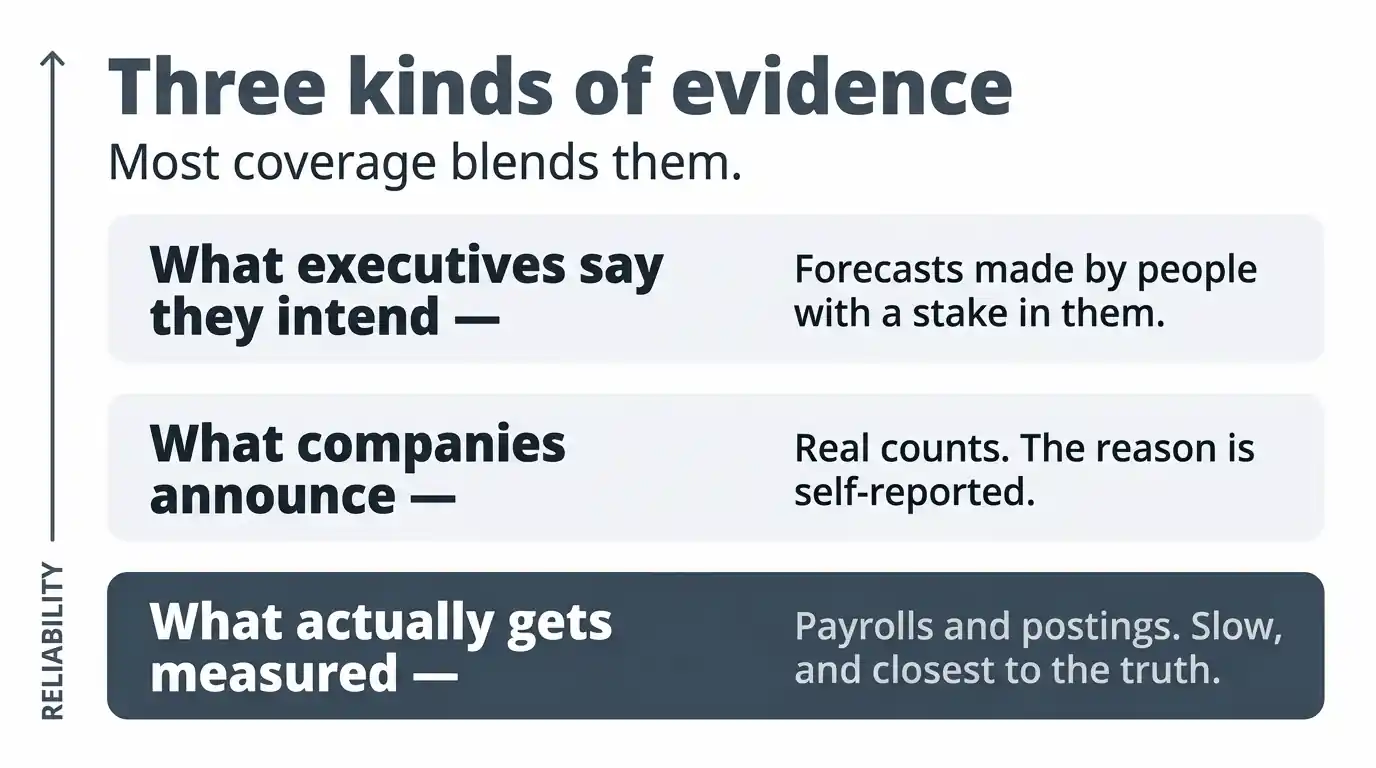
What executives say they intend to do
The weakest evidence, and by far the most quoted.
Executive statements about future headcount are forecasts made by people with a stake in how the forecast lands. A CEO saying AI will let them run leaner is talking to investors as much as to the labor market. A CEO saying AI will make everyone more productive is talking to customers and regulators.
You don’t have to assume anyone is lying to notice that the incentive changes with the audience, or that several of the same people have now said both things. That reversal is the story the Journal was reporting.
Surveys of employer intent have the same problem in aggregate form. “X% of leaders plan to replace workers with AI by 2027” measures stated plans on the day of the survey. Plans are cheap.
What companies announce
Better, and this is where most of the alarming numbers come from.
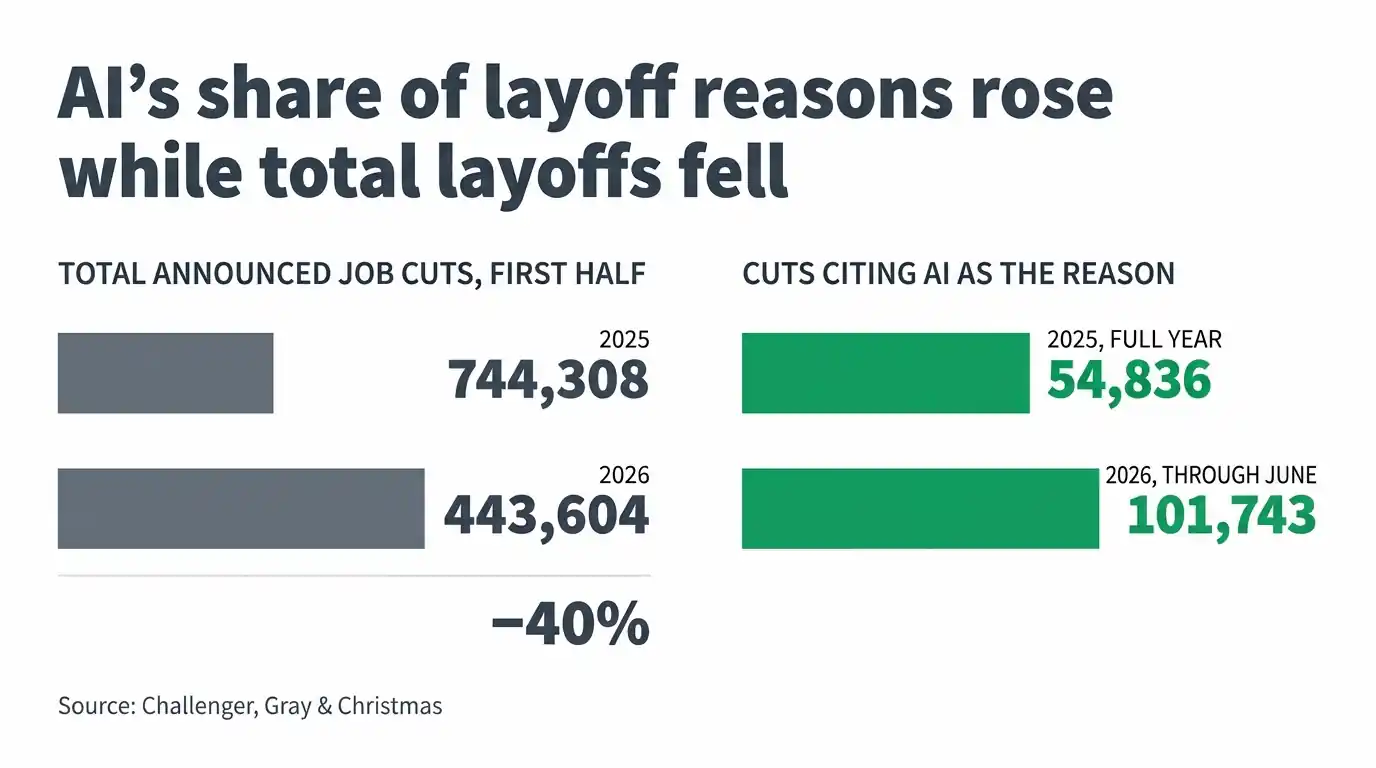
Challenger, Gray & Christmas publishes a monthly count of announced US job cuts, along with the reason employers gave. Their 2026 figures are striking. In May, AI was cited in 38,579 announced cuts – “the highest monthly total ever recorded for the reason since Challenger began tracking it in 2023,” and 40% of all cuts that month. Through June, AI had been cited in 101,743 announcements, roughly 23% of the year’s total, against 54,836 for all of 2025.
Those are real counts of real announcements. Three things about them rarely survive the trip into a headline.
The reason is self-reported. Challenger records what the employer said. “AI” in a layoff announcement is a company’s account of its own decision, given at a moment when sounding technologically ahead of schedule is worth something. Restructuring you were going to do anyway can be filed under AI at no cost. The category is honest reporting of what companies claim, which is a different measurement from why the cuts happened.
The denominator is missing. Announced cuts in the first half of 2026 came to 443,604 – down 40% from the 744,308 announced in the first half of 2025. So AI’s share of layoff reasons rose sharply during a period when total layoffs fell by nearly half. Both facts are in the same report. Only one of them travels.
The series is volatile. June’s total was 45,849, down 53% from May’s 97,006. AI-attributed cuts went from 38,579 in May to 14,029 in June. A measure that moves like that within a quarter is not tracking a steady structural process.
Worth noting who supplies the caveat. Andy Challenger, whose firm produces the number, said in the same release: “AI isn’t yet the jobpocalypse some predicted.” The most-cited source for AI layoffs does not think the figure means what it gets used to mean.
What actually gets measured
The slowest, most reliable, least quotable evidence.
The Bureau of Labor Statistics counts jobs that exist. In June 2026, total nonfarm payrolls rose by 57,000 and unemployment was 4.2%. The information sector – which contains much of the software and media work where AI displacement is most often claimed – lost 9,000.
Hold those against Challenger’s 45,849 announced cuts in the same month. Announcements are not the same as separations, separations are not the same as net change, and net change is what determines whether there are jobs.
The other measured source is job postings, which move faster than payrolls. That’s where this stops being tidy.
One dataset, two true headlines
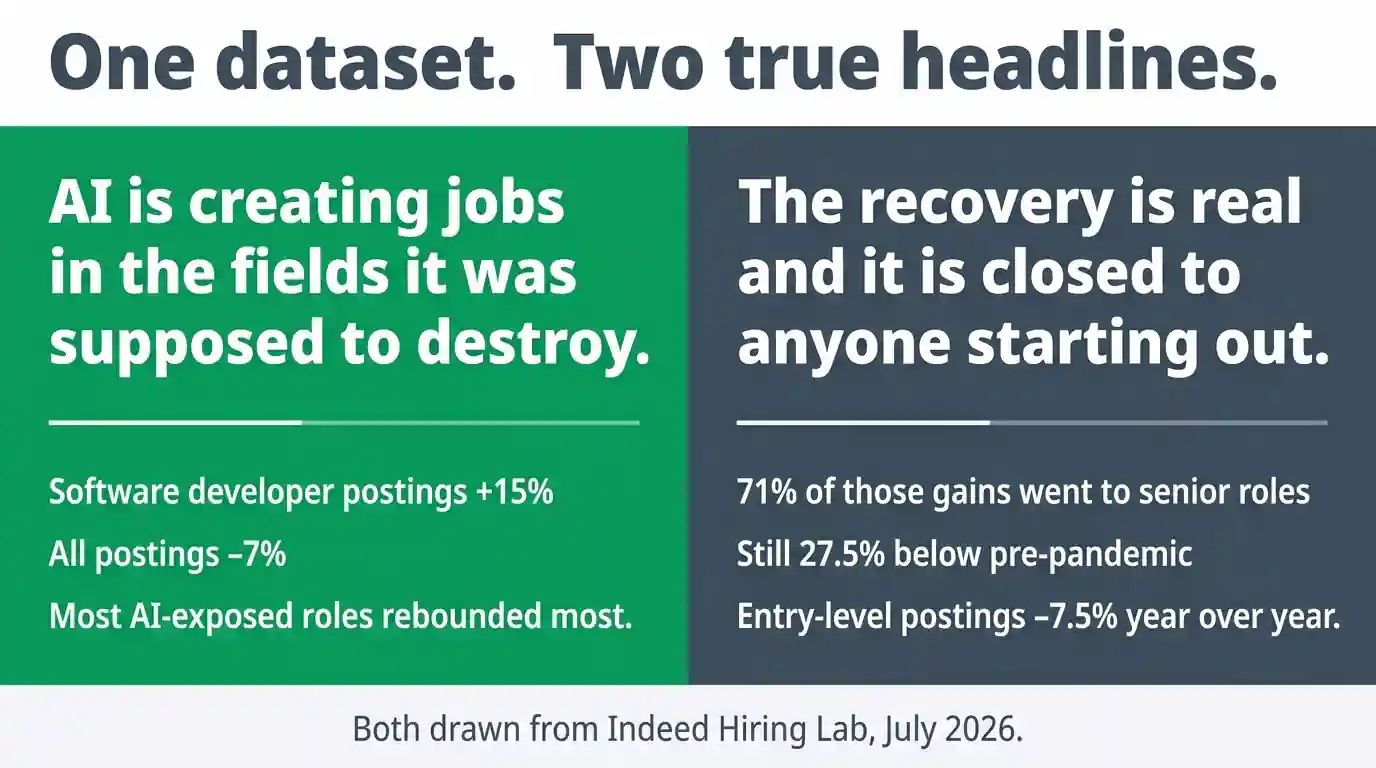
In July 2026, Indeed’s Hiring Lab published a finding that reads like good news. Since the release of agentic coding tools in February 2025, US software developer postings have risen almost 15% while postings overall fell 7%. More than that: “the more exposed to AI an occupation is, on average, the more it rebounded.”
You could write “AI is creating jobs in the fields it was supposed to destroy” off that, and it would be defensible.
Now the same post, further down. 71% of the increase in software development postings between May 2025 and May 2026 came from senior roles. 37% came from postings with AI in the title. And software development postings remain about 27.5% below their pre-pandemic level.
So you could also write “the recovery is real and it is closed to anyone starting out,” and that would be defensible too.
A second Hiring Lab piece, published two weeks later by Felix Aidala and Sneha Puri, sharpens it. Entry-level postings have been falling since 2022 and were down 7.5% year over year as of May 2026, while senior postings rose 14.7%. They point out that starting a career in a weak hiring market can depress earnings for up to a decade.
One organization, one dataset, two weeks apart. Both headlines are supported. Which one you meet depends entirely on which article found you.
Hiring Lab flags the limit on its own finding, in as many words: “correlation does not imply causation.” Many things changed in the labor market between 2025 and 2026, and agentic AI is one of them, not the only one.
If you want the third measured strand – payroll records showing what happened specifically to workers aged 22 to 25 in AI-exposed roles – we covered that research, and the authors’ own later revision of it, in the piece on what actually makes work durable.
What you feel is not what’s measured
There’s a fourth thing in circulation that gets mistaken for evidence: how worried people are.
Pew Research Center found that 52% of US workers were worried about the future impact of AI in the workplace, 32% expected it to mean fewer job opportunities for them long term, and 6% expected more. That’s a large, well-run survey of 5,273 employed adults. Read it for what it is: it was fielded in October 2024 and published in February 2025, so it’s a snapshot of a mood that has had nearly two years to move since.
Worry is real and it has real effects. People stay in jobs they’ve checked out of, avoid moves they’d otherwise make, and retrain into fields chosen out of fear rather than fit. None of that makes worry a forecast. A survey of how anxious people are tells you about people, not about the labor market.
Keeping that separate from the measured data is most of the work. It’s also the thing coverage does least, because sentiment and displacement blend into a smoother story than either supports alone.
How to read the next headline
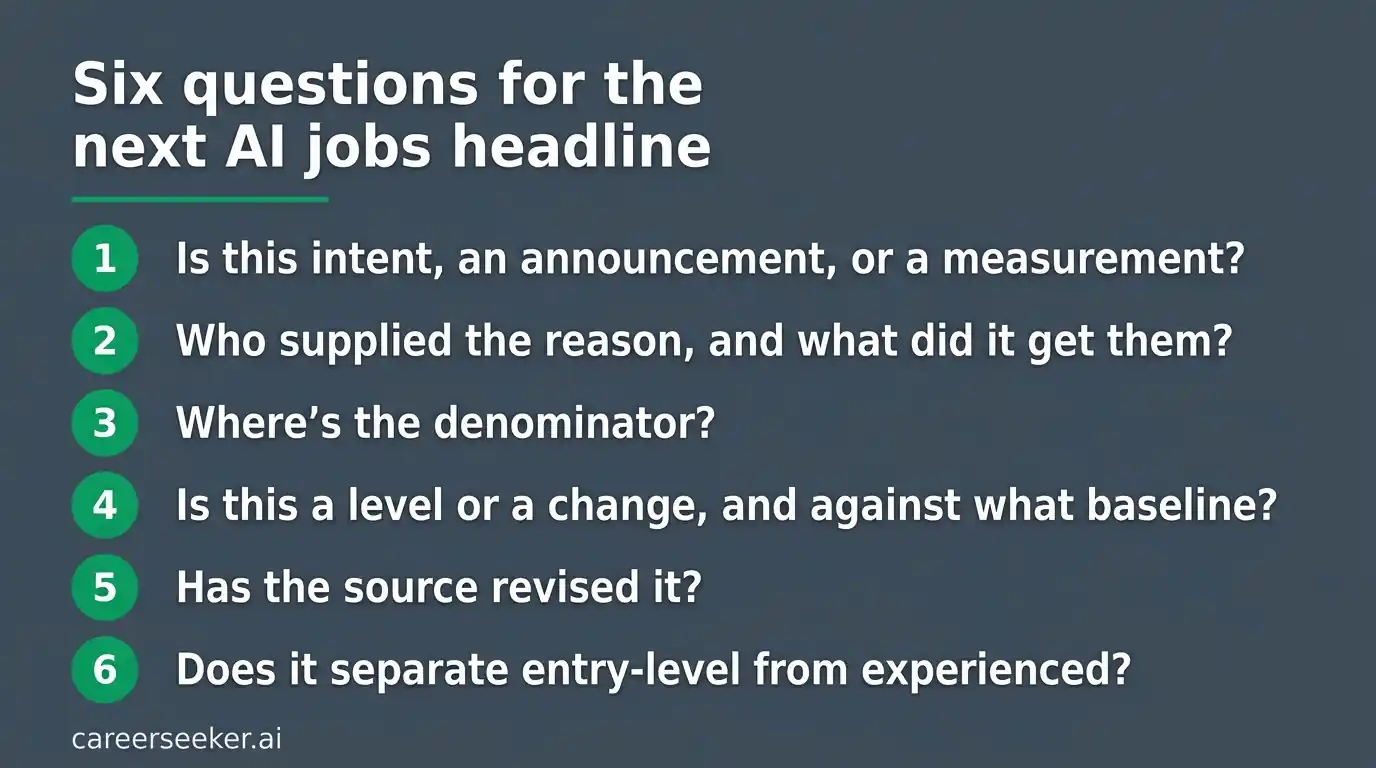
You will see another one this week. Six questions, in order:
- Is this intent, an announcement, or a measurement? If the piece doesn’t make that obvious, that’s information about the piece.
- Who supplied the reason, and what did it get them? Self-reported causes are data about what companies want understood.
- Where’s the denominator? A number of AI-attributed cuts means very little without the total, and the direction of the total.
- Is this a level or a change, and against what baseline? “Down 27.5% from pre-pandemic” and “up 15% since February 2025” describe the same series.
- Has the source revised it? Careful researchers walk things back when better controls arrive. That correction almost never gets the coverage the original did.
- Does it separate entry-level from experienced? This is the split where the evidence is sharpest and where blended figures mislead most.
Run those on the piece you read last week. Most of them fail two or three.
What holds either way
Suppose the displacement case is right and the next decade is rough. Your move is to know which parts of your work a machine can already do, where your judgment is the product, and what you’d move toward if you had to.
Now suppose the augmentation case is right and this looks like every previous technology scare. Your move is exactly the same.
The action doesn’t change based on the answer. Which is worth sitting with, because if you’ve been waiting for the macro question to resolve before making a decision, you’ve been waiting on something that wasn’t blocking you. You can’t time a labor market. Nobody in this article can, and several of them are paid to try.
What you can do is get specific about your own position: which tasks, and what you’d tolerate doing instead. If you’re actively hedging, building income across several streams is a structural answer to an unresolved forecast. If it already happened to you, the post-layoff piece is a more useful read than this one. And if your instinct is to just ask a chatbot, we wrote about why that produces a confident answer with nothing behind it.
If the honest answer is that you don’t know what you’re good at in enough detail to reason about any of this, that’s the actual bottleneck, and it’s solvable. It’s what we built CareerSeeker for. It works from your traits, values and experience, suggests directions with the reasoning shown, and takes about ten minutes anonymously. Suggestions, not verdicts. It won’t tell you whether AI is coming for your job, because nothing can.
The bottom line:
- Executive statements, announced layoffs, and measured employment are three different kinds of evidence with three different reliabilities. Most coverage blends them.
- Challenger’s AI-attributed cuts are self-reported reasons, and they rose as a share while total layoffs fell 40% year over year.
- Indeed’s postings data supports “AI is creating work” and “entry-level is closing” at the same time, from the same dataset.
- Worker anxiety is well measured and is not a forecast.
- The individual’s best move is the same under either scenario, which means the macro question was never the one blocking you.
The next headline will sound as certain as the last one. You now have enough to check it – which is more than most of the people writing them bothered to do.
Frequently asked questions
Nobody can tell you, and the sources that sound most certain are usually the least reliable. What the measured data currently shows is uneven: overall US payrolls were still growing modestly through mid-2026, some AI-exposed occupations are adding postings again, and entry-level hiring has been weakening since 2022. Your exposure depends on which of your daily tasks a machine can already do, not on your job title.
Both, and they’re hard to separate. Challenger, Gray & Christmas recorded 101,743 job cuts citing AI through June 2026, which is a real count of real announcements. But the reason is supplied by the company announcing the cut, and there are commercial reasons to attribute restructuring to AI. Announced cuts also aren’t the same as net job losses – total announcements in the first half of 2026 were down 40% from 2025.
The measured evidence points at a seniority pattern rather than a list of occupations. Entry-level postings have fallen since 2022 while senior postings grew, and in software development 71% of the recent posting gains went to senior roles. That says more about who gets hired than about which jobs still exist, which is why “which jobs are disappearing” tends to be the wrong question.
“Collapsing” overstates it. Indeed’s Hiring Lab found entry-level postings down 7.5% year over year as of May 2026, continuing a decline that started in 2022 – before current AI tools existed. Entry-level still made up roughly 46% of US postings. The concerning finding is the direction and the fact that recoveries are landing in senior roles.
Something other than waiting for the forecast to resolve, because it won’t in a useful timeframe. The practical version is to work out which parts of your work are procedure a machine could follow and which parts genuinely need you, then decide based on where you’d want to be either way. That answer is stable whichever way the macro question lands. Our piece on what makes work durable goes through the properties to check for.