

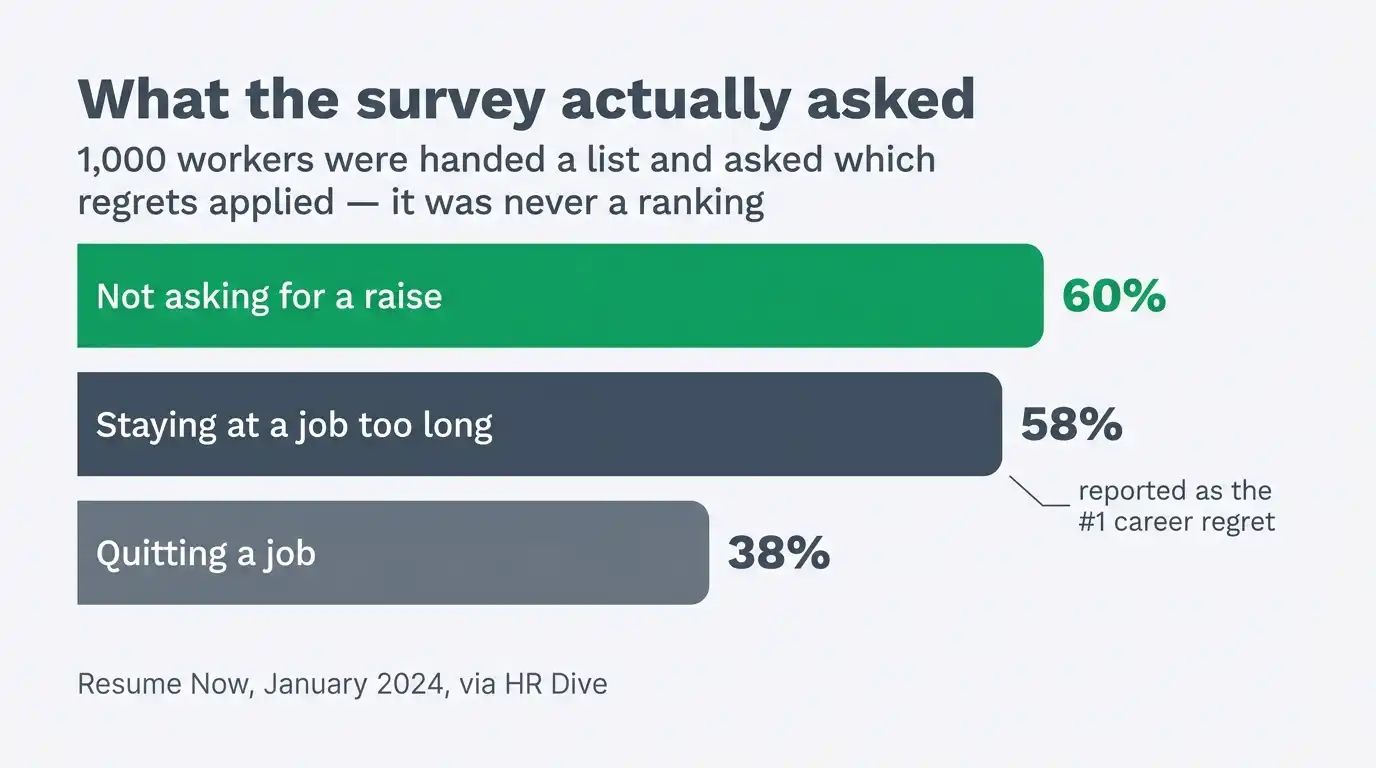
In January, Fortune reported that workers are more likely to regret staying in a bad job than quitting one. 58% against 38%. Both numbers are real. The survey they came from never asked anyone what their biggest regret was. It handed 1,000 people a list of possible career regrets and asked which ones applied. Staying too long got 58%. Quitting got 38%. But the item at the top of that list was neither – 60% said they regretted not asking for a raise. A second item also scored higher than staying, and a third tied with it. A checklist got promoted to a verdict, and the verdict is what traveled.
The direction it points isn’t wrong. There’s a real finding underneath, and it’s older, better evidenced, and considerably stranger than the version that made the rounds. It also comes with a limit that almost nobody reports.
What the surveys actually measured
The 58/38 figures come from Resume Now, a resume-building company, which polled 1,000 workers across the US, UK, France, and Germany in January 2024. Multi-select list, one moment in time, commissioned by a business with a product to sell to people thinking about their careers. That doesn’t make it worthless. It makes it a vendor survey, which is a specific thing with specific limits.
Now put it next to a different vendor survey.
In 2022 The Muse asked its readers about starting a new job. 72% said they’d experienced what the company called shift shock – surprise or regret on discovering the role was substantially different from what they’d been told. 48% said they’d try to get their old job back. More than 2,500 respondents, drawn from The Muse’s own audience, with no methodology published.
So: staying is the thing people regret. Also, leaving is the thing people regret. Both figures circulate as fact.
They’re less contradictory than they look, because they’re running different clocks. Resume Now asked people to survey a whole career from the far end. The Muse asked people how the last few months had gone. One is a decade in review; the other is a first impression. Neither is built to answer the question people actually want answered, which is what they’ll think about this in ten years.
For that you need research designed to measure time, and it exists.
Regret is a weak instrument, and here’s how weak
Before the good evidence, the honest caveat – because it applies to every number in this article.
Asking people about regret has three built-in problems. You already know how your choice turned out, and you don’t know how the other one would have. You’re comparing a real outcome, with all its ordinary friction, against an imagined one that never had to survive a single bad Tuesday. And you’re being asked to report accurately on your own past reasoning, which is close to the thing humans are worst at.
The canonical finding in this field is Gilovich and Medvec’s 1994 paper in the Journal of Personality and Social Psychology: actions hurt more in the short term, but inactions are regretted more in the long run. It’s been cited for thirty years and it’s the reason “you’ll regret the things you didn’t do” is treated as settled science.
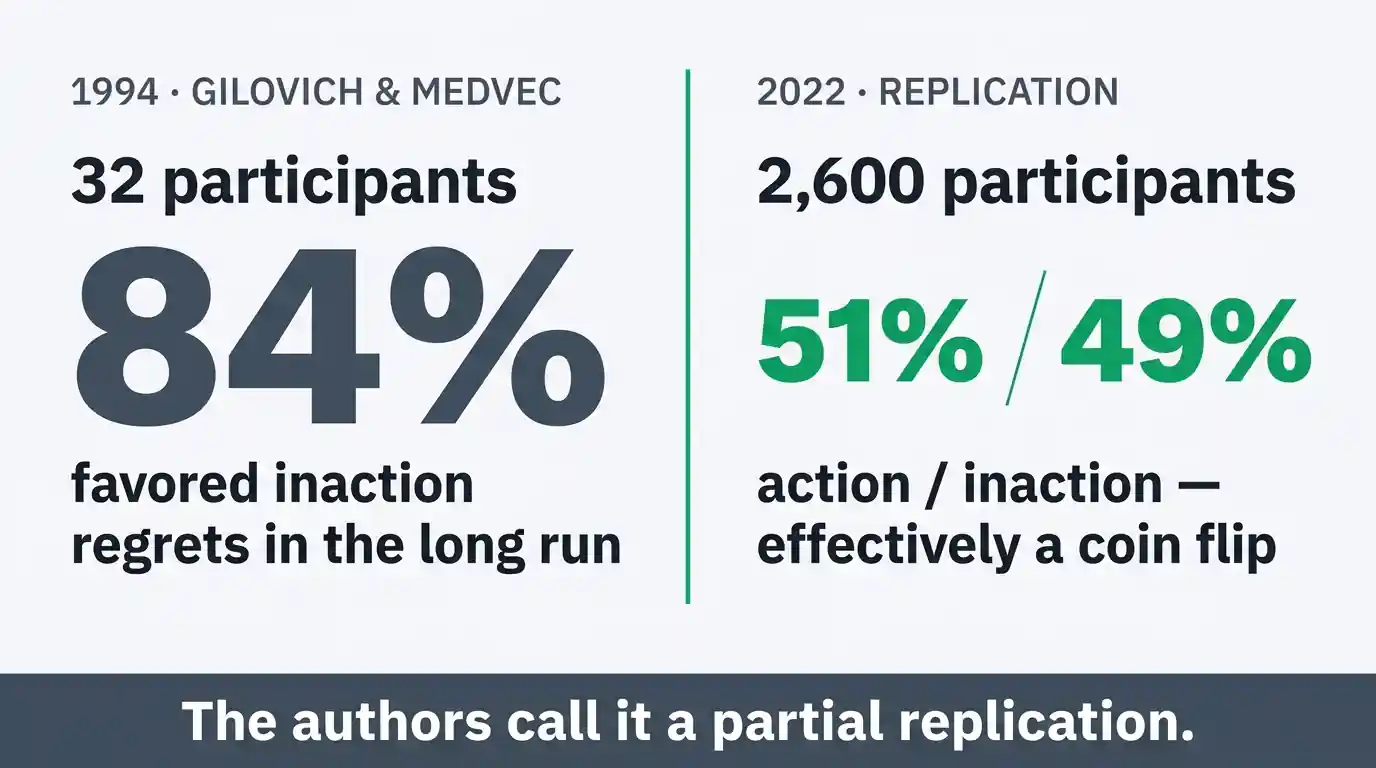
It was based on 32 people.
In 2022 a team including Gilovich himself ran it again at a Chicago museum with 2,600 participants. Part of it held: action regrets really do fade with time relative to inaction regrets, and the interaction was statistically significant. The headline pattern didn’t. Where the original found 84% favoring inaction regrets over the long run, the replication found 51% to 49% – effectively a coin flip. The effect size dropped by more than half. The authors describe their own work as “a partial replication.”
That’s the original author re-running his own famous result at eighty times the sample and publishing a smaller number. It’s the correct way to do this and it almost never happens. It also means the thing everyone repeats about regret is real, directionally, and considerably less dramatic than the phrasing suggests.
If you want more on why self-report is a shaky foundation for career decisions generally, we went further into it in what actually predicts career fit.
What does hold up
The strongest single dataset here isn’t a survey about work at all.
In 2011, Morrison and Roese published Regrets of the Typical American in Social Psychological and Personality Science. Random-digit-dial telephone survey, 370 Americans, ages 19 to 103, nationally representative. No customer list, no panel, no incentive to find anything in particular.
Asked for their most salient regret, people named romance (18%), family (16%), career (13%), education (12%), money (10%), and parenting (9%).
Career came third. Worth sitting with for a moment if you’re currently treating your job as the main thing that has gone wrong in your life.
Two findings from that paper matter more than the rankings. The first is stated plainly in the abstract: inaction regrets lasted longer than action regrets, and more severe losses produced more inaction regrets. That’s the 1994 result surviving contact with a representative sample, which is a much better result for it than the museum replication.
The second is the one nobody quotes. Regrets clustered on situations people described as unfixable rather than fixable.
Which has an immediate, slightly awkward implication. The regret you’re feeling right now about a job you could still leave is the cheap kind. It’s the one that stops being a regret the moment you do something about it. The expensive ones are the doors that closed.
Why the ones you didn’t do are the ones that stay
The research measures the pattern. It doesn’t fully explain it. Here’s the explanation that fits the evidence best.
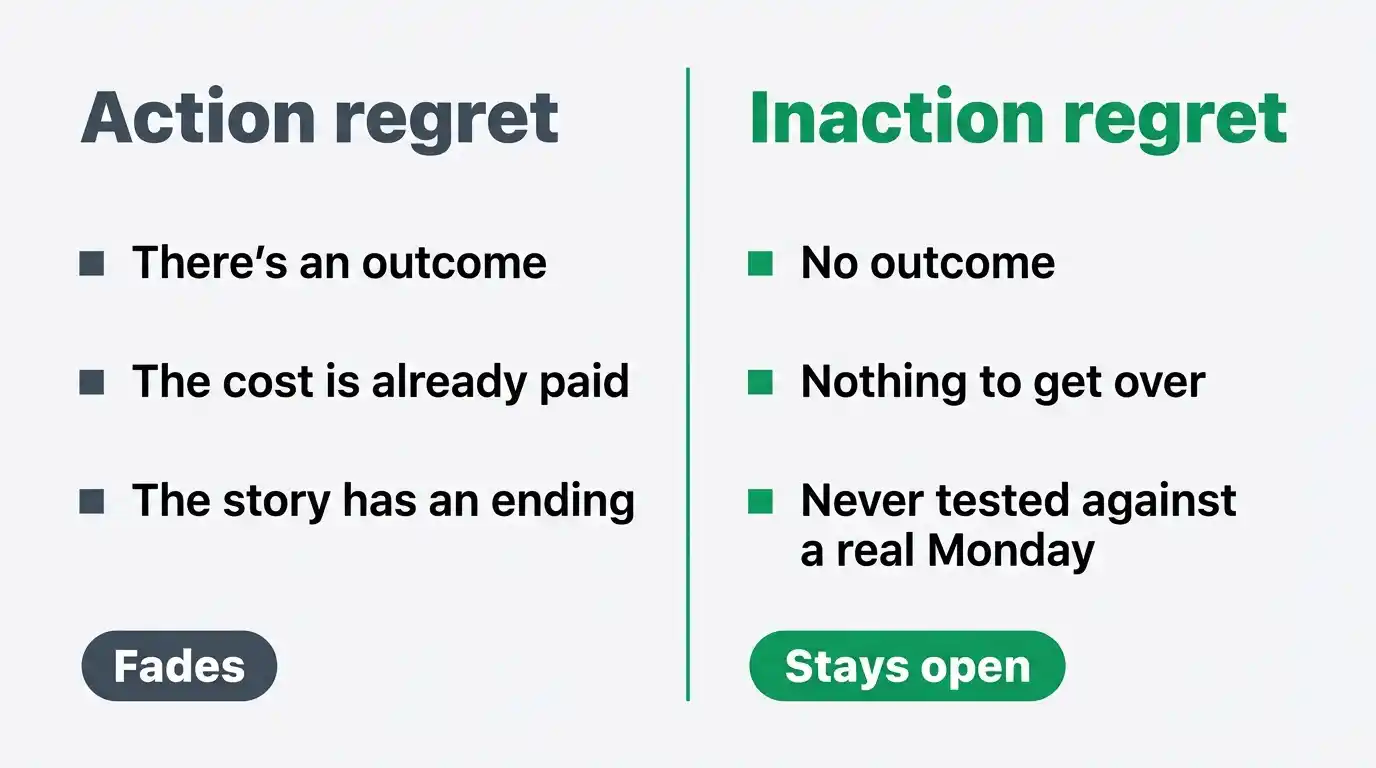
An action regret has an ending. You took the job, it was bad, you left. There’s an outcome, a cost you’ve already paid, and a story you can tell in ninety seconds with a moral at the end. The file closes.
An inaction regret never gets one. You didn’t apply. Nothing happened. There’s no outcome to weigh, no disappointment to get over, and no version of events that ever had to survive contact with a real Monday morning – the commute, the manager, the third week when the novelty wore off. So the alternative keeps quietly improving, because nothing ever contradicts it.
That’s why “I moved abroad for the job and it didn’t work out” fades, and “I never went” doesn’t. One of them ran out of road. The other never got on it.
It also explains the unfixable finding. A regret stays open exactly as long as the thing is out of reach.
The age that regrets most isn’t the one you’d guess
You’d expect career regret to peak near the end, when there’s a whole working life to look back on. Career researchers Jos Akkermans at VU Amsterdam and Sofie Jacobs at Antwerp Management School found the opposite: 18 to 25 year olds scored highest.
Three caveats before you do anything with that. It’s published as a white paper rather than a peer-reviewed article, the respondents were Dutch and Belgian, and the sample size isn’t stated. Treat it as a lead worth knowing about, not a finding to build on. The researchers attribute the result to expectations that were unrealistic in the first place – underestimated workload, less development than promised, less money.
That reading is at least plausible, because of where those expectations come from. At 22, almost everything you know about your job you learned before you had it: a course description, a parent, a salary figure, a character on television. The gap between the picture and the work is at its widest right at the start, and it closes by discovering things you’d rather have known earlier.
Which is exactly what one r/careerguidance thread this summer asked for – the career mistake someone wished they’d been warned about in their 20s. It drew 753 upvotes and 434 replies. Reading through it, the replies don’t converge. They can’t, because the useful warning is specific to the person receiving it, and a thread can only offer the specific warnings of strangers.
So do people regret changing careers?
Often, and quickly. That’s what The Muse’s 72% is measuring.
But look at what the number is actually about. Shift shock, as The Muse defined it, is discovering that the position or the company is very different from what you were led to believe. That’s a regret about being sold an inaccurate picture of a specific job by a specific employer during a hiring process.
It isn’t a regret about direction.
Those two get blended constantly, and the blending is what keeps people where they are. “Most people who switch end up regretting it” reads as an argument for staying put. What the evidence supports is narrower and much less discouraging: a lot of people who switch find out the particular role was misrepresented to them. The remedy for that is harder questions during interviews and better checking of the employer – not staying in a job you’ve already decided against.
The direction question is genuinely harder, and no survey can settle it, because settling it would mean following people for a decade and comparing them against a version of themselves that doesn’t exist. What you get instead is the pattern from the representative data: the moves people don’t make are the ones still bothering them later.
If the practical worry is that switching means starting from zero, that’s usually false in a specific and checkable way – most of what you’ve built transfers, and we went through which parts of it do. If the worry is that you’ve left it too late, the version of this for people in their 30s covers the actual arithmetic.

What both kinds of regret have in common
Run back through everything above and the regrets share a shape. They’re decisions made on a default.
The promotion accepted because it was offered. The degree chosen because it was the sensible one. And above all the staying, which is the only one of these that requires no decision at all – leaving takes a reason, staying just takes a Tuesday.
Gallup gives that its present tense. Global employee engagement fell to 20% in 2025, the lowest since 2020 and the second consecutive annual decline. “Staying too long” isn’t only something people report in hindsight. For most of the workforce it’s a description of this week.
So the common root isn’t choosing wrong. Plenty of good decisions turn out badly and that’s just variance. It’s choosing without a reason you’d still recognize years later. If you can’t reconstruct why you took the job, you have no way to judge whether it was a mistake – and an open question is precisely the condition that makes a regret durable.
That’s the gap we built CareerSeeker to close. It works from your traits, values, past experience and, if you want, your neurodivergent profile, then suggests directions with the reasoning shown, so there’s something written down to check yourself against later. Anonymous, about ten minutes, no account. Suggestions, not verdicts – it can’t tell you whether you’ll regret something, and neither can anything else.
How to use this
- Ask which version you could still explain in ten years. Not which one works out. Which one you’d be able to say why you did.
- Separate “away from” from “toward.” Wanting out of something is real information and a bad map. It tells you where not to be and nothing about where to go, which is how people leave one poor fit for another.
- Check the employer separately from the direction. Most reported career-change regret is shift shock, and shift shock is a diligence problem with a known fix: ask harder questions before you accept, not after.
- Write the reason down now. You will not reconstruct it accurately later. That’s not a character flaw, it’s how memory works – and it’s why getting clear on what the work has to protect is worth doing on paper.
- Notice whether the thing is still fixable. The representative data says regret concentrates on what can’t be changed. If yours can be, it’s the cheap kind, and it only stays expensive while you leave it alone.
The bottom line:
- The 58/38 stat everywhere in January came from a multi-select vendor survey that never asked anyone their biggest regret. Another item on the same list scored higher.
- The canonical action-versus-inaction finding is real but smaller than advertised – its 2022 replication, co-authored by the original researcher, calls itself partial.
- In the best representative data, career is the third most common regret domain, behind romance and family.
- Regret concentrates on the unfixable. The one you can still act on is the one that costs least.
- Most “I regret switching” is really “the job wasn’t what I was told,” which is a different problem with a different fix.
The people in those surveys mostly aren’t sorry they chose. They’re sorry they can’t remember choosing.
Frequently asked questions
Many report regret soon after a move – The Muse found 72% of its readers experienced surprise or regret on starting a new job. But that measures discovering a specific role was misrepresented during hiring, which is a different thing from regretting the direction. The representative long-term data points the other way: inaction regrets last longer than action regrets, so the moves people didn’t make tend to be the ones still bothering them years later.
It depends on who’s asking and how. In Morrison and Roese’s nationally representative US survey, career was the third most common regret domain overall, behind romance and family. Within work specifically, vendor surveys consistently rank staying somewhere too long near the top – but those are multi-select lists, not rankings, and they should be read as a rough signal rather than a result.
The evidence supports the direction more than the headline figures do. The 58% often quoted comes from a resume company’s multi-select survey of 1,000 workers, where other items scored higher. The stronger support is the academic finding that inaction regrets outlast action regrets, which showed up in a nationally representative sample – though a 2022 replication of the original 1994 study found the effect smaller than first reported.
Regret research doesn’t identify a cutoff, and the data pointing to young adults as the highest-regret group cuts against the idea that later means worse. What the evidence does suggest is that regret settles on situations people consider unfixable. As long as a move is genuinely available to you, it belongs in the category that stops hurting once you act on it.
There’s no reliable general answer, which is the honest version and also the useful one. The pattern in the research isn’t a particular wrong turn – it’s decisions made by default, without a stated reason. Young adults report the highest career regret in at least one study, plausibly because expectations set before you’ve done the work are the furthest from it.