

On Reddit’s r/careerguidance this summer, someone asked for an office job AI wouldn’t take for the next twenty to forty years. The thread drew more than 500 replies. Reading it back, the reason it kept going is easy to spot: the same person mentioned, almost in passing, that they weren’t passionate about anything in particular. That’s two questions stacked on top of each other. Every article about AI-proof careers answers the first one. Almost none of them touch the second.
Here’s the short version. Nobody can tell you which jobs are safe for forty years, and the organizations with the best data on this don’t even try – they publish multiple scenarios instead of one forecast. What you can identify are the properties that make work hard to automate. But those properties show up in wildly different jobs suiting wildly different people, which is why a list of “safe” titles narrows nothing useful on its own. This article covers what durability actually consists of, where the evidence currently sits, and how to work out which of that durable work fits you.
What does “AI-proof” actually mean?
An AI-proof career is shorthand for work whose core tasks are expensive or impossible to automate with current technology. It’s a useful search term and a bad promise. No occupation carries a guarantee, and the honest version of the claim is resistant, not proof.
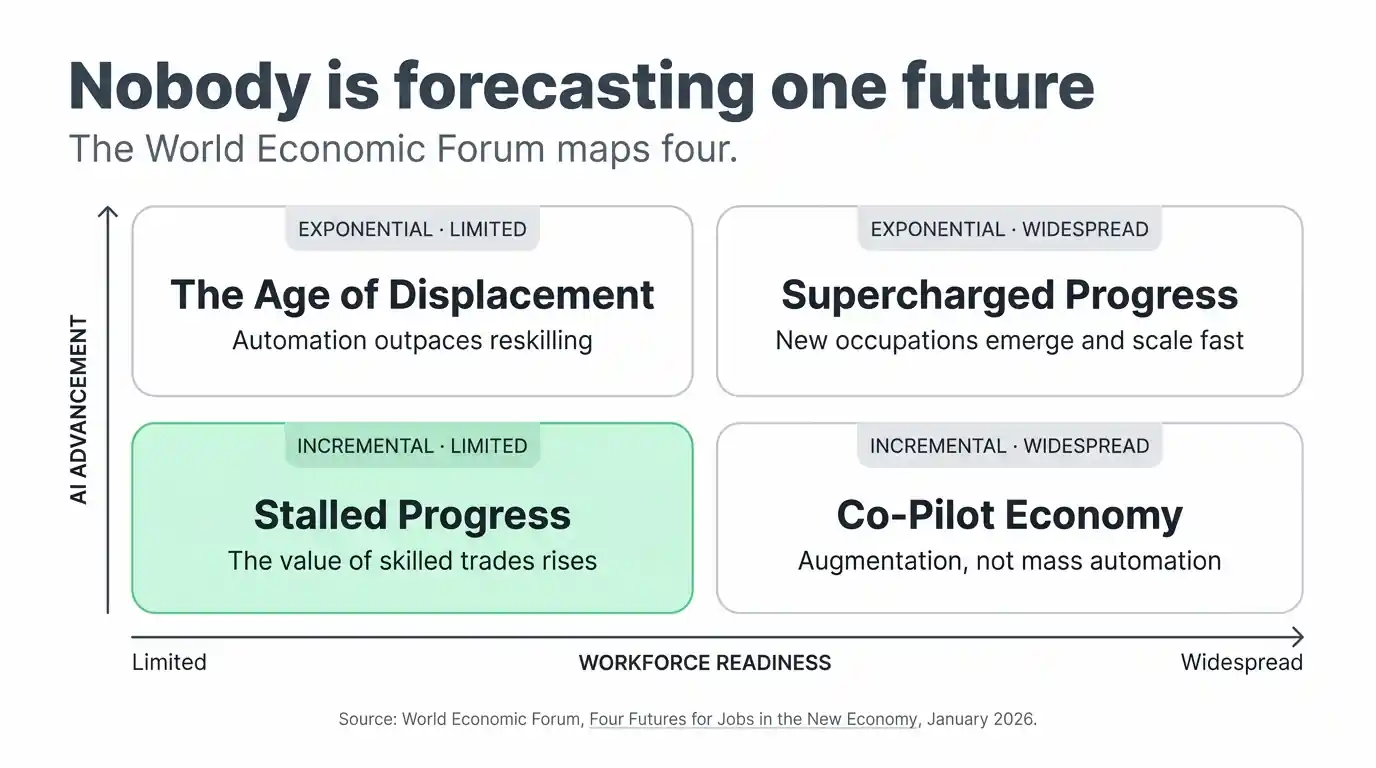
The forecasting problem is worth sitting with, because it’s the thing every list quietly skips. In January 2026 the World Economic Forum published Four Futures for Jobs in the New Economy, a white paper mapping how AI and workforce skills might play out by 2030. Not by 2060. By 2030, four years away.
It describes four scenarios, built from two uncertainties: how fast AI capability advances, and whether workers have the skills to keep up.
- Supercharged Progress – rapid AI breakthroughs, widespread readiness. Many jobs vanish, new ones scale fast.
- The Age of Displacement – rapid AI, unprepared workforce. Automation outpaces reskilling; unemployment spikes.
- Co-Pilot Economy – gradual AI, ready workforce. Augmentation rather than mass automation.
- Stalled Progress – steady AI, missing skills. Routine roles take the hit, and the value of skilled trades and manual work goes up.
The report notes that the direction of travel it sketches is “illustrative and for scenario-building purposes only.” That is the most authoritative body on this subject declining to name a single future four years out.
So when a blog ranks thirty careers as safe through 2045, it isn’t working from better information. It’s working from less caution.
Why job titles are the wrong unit
AI doesn’t consume occupations whole. It takes tasks, and every job is a bundle of them. So the useful question isn’t whether your job title survives. It’s what fraction of your day a machine can already do.
There’s now measured evidence on this rather than projection. In November 2025, researchers at the Stanford Digital Economy Lab published Canaries in the Coal Mine?, built on payroll records from the largest payroll software provider in the US. Their headline finding: workers aged 22 to 25 in the most AI-exposed occupations saw roughly a 16% relative decline in employment. More experienced workers in those same occupations held steady. So did workers in less-exposed, hands-on fields.
The detail that matters most is buried in the mechanism. The declines concentrated in roles where AI automates the work rather than augments it. Same technology, same occupation category, opposite outcome depending on which of those two things it does to the daily tasks.
Worth saying plainly: the authors have since revised parts of this. A February 2026 follow-up ruled out interest rates as the driver, but conceded that under stricter controls the decline only becomes clear from 2024 onward, not 2022. They state directly that they don’t believe AI is always and everywhere the sole cause. That’s what careful research looks like, and it’s a reasonable model for how confidently anyone should be talking about this.
Four properties that make work durable
If titles are the wrong unit, properties are the right one. The four below come from what the automate-versus-augment evidence points at, mapped onto attributes that O*NET, the US Department of Labor’s public occupational database, already measures for every occupation in the American economy.
That last part matters. You can check any job against these yourself, for free, without taking anyone’s ranking on trust.
| Property | What it means | Where to check it on O*NET |
|---|---|---|
| Physical presence | The work needs a body in a specific place, often at an unpredictable moment | Work Context → Physical Work Conditions; Physical Proximity |
| Licensed judgment | A named human has to sign off, and the credential is the barrier | Job Zone (preparation required) |
| Carried accountability | Someone bears the consequences when it goes wrong | Work Context → Responsibility for Others’ Health and Safety; Responsibility for Work Outcomes and Results of Other Workers |
| Trust built over time | The value sits in the relationship, not the transaction | Work Context → Interpersonal Relationships |
Physical presence
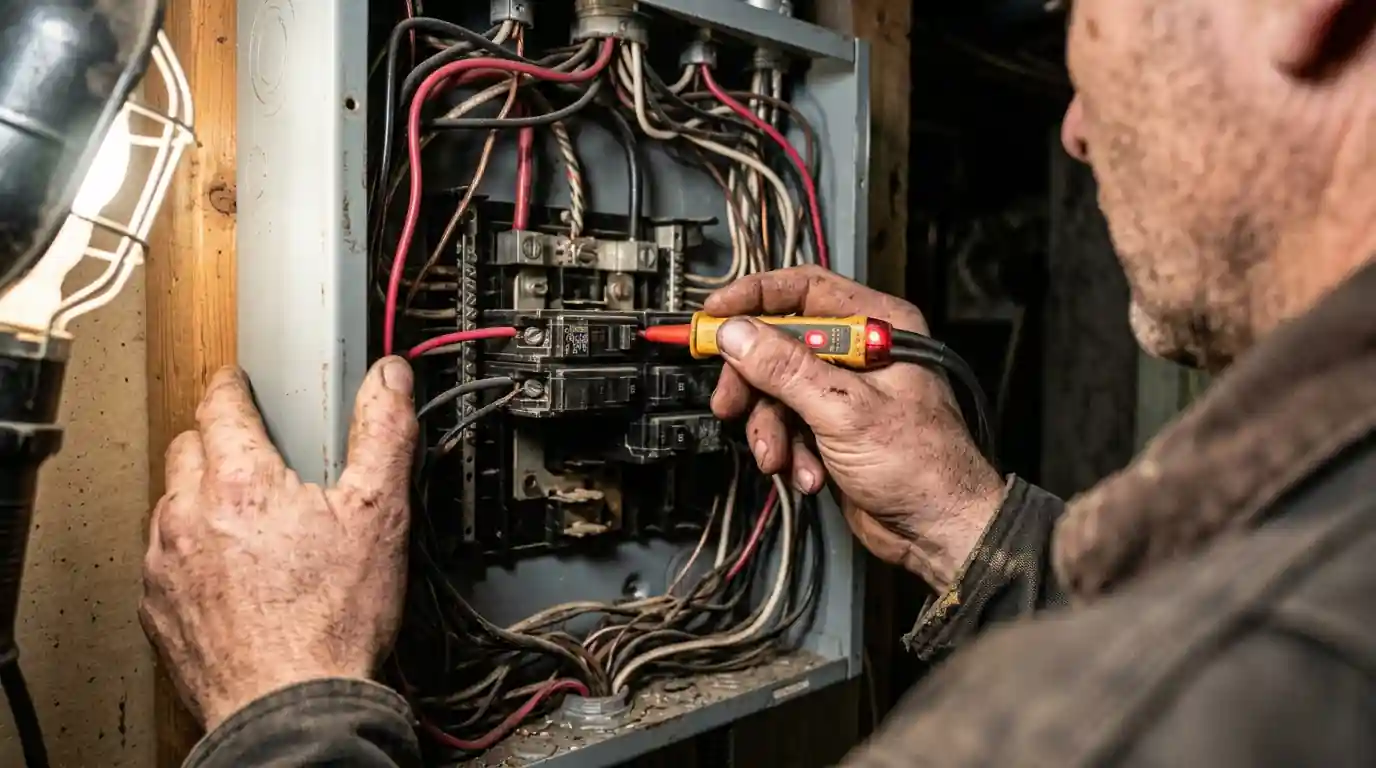
A machine can diagnose a fault. It still can’t crawl into the crawlspace. Work that happens in unpredictable physical environments – other people’s homes, a patient’s bedside, a building site – carries a cost of automation that has nothing to do with how clever the software gets.
O*NET rates this directly. On physical proximity, 45% of registered nurses report working “very close (near touching)” to other people. That’s not a soft skill. It’s a body in a room.
Licensed judgment
Some decisions legally require a person to attach their name. Not because the reasoning is beyond a machine, but because accountability has to land somewhere a regulator can reach.
O*NET’s Job Zones capture the preparation involved. Registered nursing sits in Job Zone Four, considerable preparation. Licensure is slow to acquire, which makes it a genuine barrier, though it’s worth remembering that licensing regimes are political and can loosen.
Carried accountability
Related but distinct: who absorbs the cost of failure. O*NET measures this too, and the numbers get high fast. Two thirds of registered nurses report very high responsibility for the health and safety of other workers.
Consequence-bearing is difficult to delegate to a system that can’t be sued, fired, or held to account. That’s a durable position, and also a heavy one.
Trust built over time
Some work is valuable precisely because a specific person did it, over years, with a track record behind them. The transaction isn’t the product; the relationship is.
This is the property most often claimed and least often earned. Plenty of “relationship” roles are actually transaction-processing with a friendly voice on top, and those automate quickly.
The filter the lists skip
Here’s where the lists run out of road. Run two occupations through those four properties and both score well. Then look at who each one actually suits.
| Registered nurse | Electrician | |
|---|---|---|
| O*NET interest profile (RIASEC) | Social, Conventional, Investigative | Realistic, Conventional |
| Preparation | Job Zone Four | Job Zone Three |
| Signature work context | 45% very close physical proximity; 66% very high responsibility for others’ health and safety | 96% continually handling tools; 95% wearing safety equipment daily |
| Durable because | Physical presence, licensed judgment, carried accountability, trust | Physical presence, licensed judgment, unpredictable environments |
Both are hard to automate. They are also close to opposite jobs for close to opposite people. One is built around sustained contact with distressed strangers; the other around hand skill, tools, and problems that hold still while you solve them. The shared trait is Conventional: both reward following procedure exactly. After that they diverge completely.
A person who is drained rather than energized by other people’s emergencies can absolutely become a nurse. It’s durable work and the training is well-defined. They’ll also spend years paying a tax they didn’t know they’d signed up for.
That’s the real risk the lists create. It isn’t that you’ll pick a job that gets automated. It’s that you’ll pick one that lasts, and spend two decades in it wishing it hadn’t. If you want the underlying frameworks, we’ve written up how interest types map to career families and how personality traits relate to specific roles.
You’ll notice this article contains no salary tables. That’s deliberate. Pay and growth figures shift with each Bureau of Labor Statistics release, and plenty of the numbers circulating in this genre are several projection cycles out of date. Look them up fresh when you’re narrowing down.
What if you’re not passionate about anything?
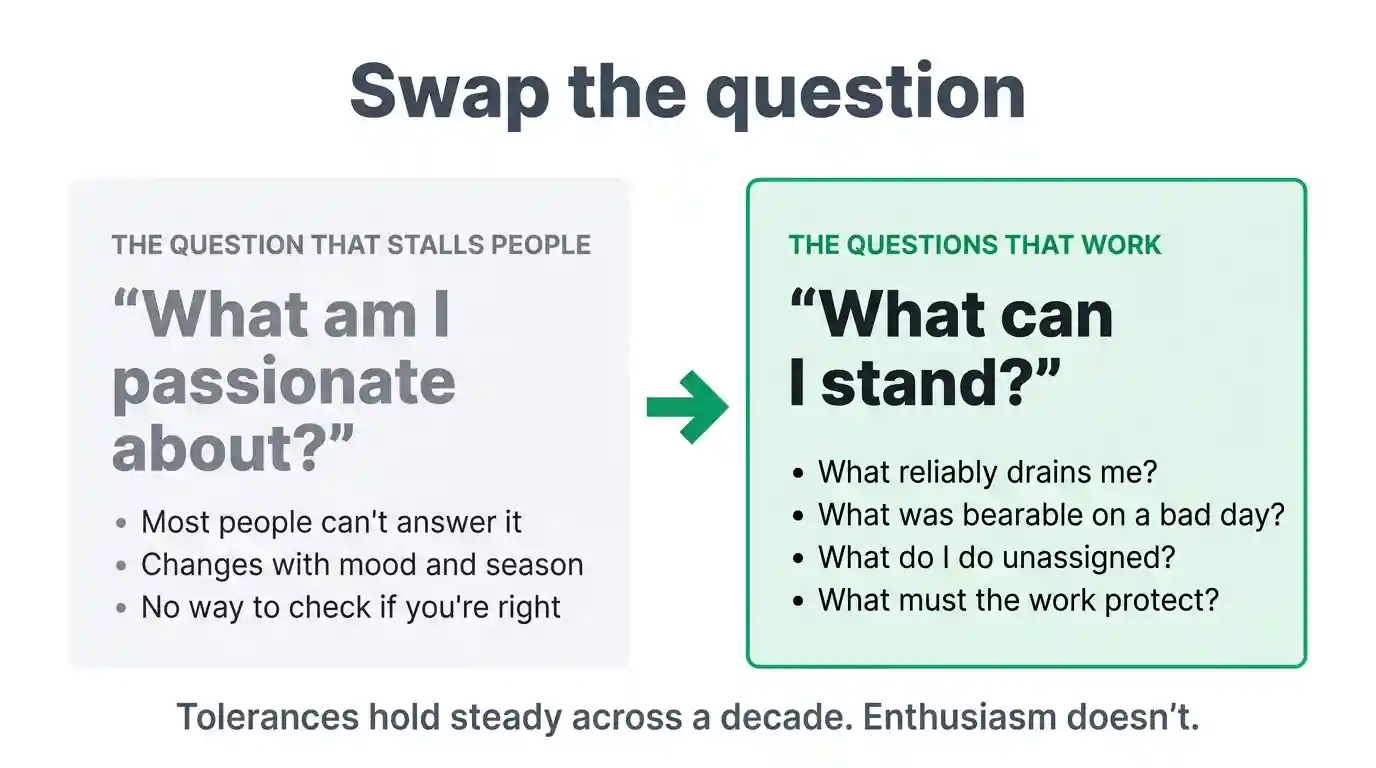
Then you’re in the majority, and you can still do this. Passion isn’t the input a career decision actually runs on. Interests and tolerances are, and everyone has those whether or not anything has ever felt like a calling.
This was the unanswered half of that Reddit thread, and it’s the part that gets skipped everywhere, probably because “find what you love” is easier to write than the truthful version.
The truthful version: you don’t need to love something to choose well. You need to know what you can stand.
Ask what reliably drains you rather than what excites you – most people can answer that instantly and it’s far more stable than enthusiasm. Notice which parts of jobs you’ve already had were tolerable on a bad day, because a bad day is the honest test. Pay attention to what you do when nobody’s assigning it. And get clear on what the work has to protect: autonomy, predictable hours, being left alone, being useful to someone specific. Values do more work than passion here, and unlike passion they tend to hold steady across a decade.
Passion is a nice-to-have that some people get and some don’t. Fit is available to everyone.
How to actually use this
- Drop the title-first search. Start with the four properties, not with a list of jobs.
- Check candidates on O*NET yourself. Pull up the work context and interest profile for anything you’re considering. It’s public data and it takes ten minutes.
- Score fit and durability separately. A job needs to clear both bars. High durability plus low fit is a trap that takes years to spring.
- Verify the numbers fresh. Pay and outlook come from the BLS Occupational Outlook Handbook, at the point you need them.
- Hedge where you can. Durability is a portfolio property as much as a job property, which matters if you’re combining several income streams.
If you want help with the fit half, that’s what we built CareerSeeker to do. It works from your traits, values, past experience and, if you want, your neurodivergent profile, then suggests directions with the reasoning shown including: which AI tools use today to gain an edge and augment your career with AI. It’s anonymous, takes about ten minutes, and no account is involved.
It gives you suggestions, not verdicts. No tool can tell you a job is safe for forty years, and one that claims to is selling you something.
The bottom line:
- “AI-proof” is a search term, not a property any job actually has.
- Durability lives in tasks and work context, not in job titles.
- Four properties do most of the work: physical presence, licensed judgment, carried accountability, and trust built over time.
- Two jobs can be equally durable and suit completely opposite people.
- If nothing feels like a passion, use interests and tolerances instead. They’re better inputs anyway.
The list can tell you which work is likely to last. It can’t tell you which of it you could stand to do for twenty years – and that second question is the one that was always yours to answer.
Frequently asked questions
No. “AI-proof” overstates what anyone can know. Some work is genuinely resistant, because it requires physical presence, licensed judgment, or accountability a system can’t carry. But resistance is a matter of degree and cost, not a guarantee. Treat any article promising a forty-year safe list with suspicion.
Four properties, mostly. Work that needs a body in an unpredictable place, work where a licensed human must sign off, work where someone bears the consequences of failure, and work whose value comes from a long-standing relationship. You can check any occupation against these using O*NET, the US Department of Labor’s free occupational database.
They’re among the more resistant options, and one of the WEF’s four 2030 scenarios has the value of skilled trades and manual occupations rising. That’s a scenario, not a forecast. Trades score well on physical presence and unpredictable environments, but they suit a specific profile: typically Realistic interests and comfort with hands-on, tool-based work.
Use tolerances instead of passion. Identify what reliably drains you, what parts of past jobs were bearable on bad days, and what the work needs to protect – autonomy, predictable hours, quiet. Those are more stable inputs than enthusiasm and everyone has them, which makes them a workable basis for a decision.
Not automatically. Moving into AI work is a legitimate direction, but it’s a different question from durability. The Stanford research found that early-career workers in the most AI-exposed occupations were the group losing ground, and that the finding held even after tech firms were excluded. Choose on fit and evidence, not on which field currently sounds future-proof.