A short answer first
I built CareerSeeker AI because I was the user. I was between jobs, in my thirties, with an analytical mind and no clear sense of what I actually wanted to do with the next ten years of it. The career tests I tried were either generic and dated, or wanted my email, my age, my ethnicity, and a monthly subscription before they’d tell me anything useful. So I built the thing I wished existed.
This post is the honest version of why. Not a feature list. Not a comparison table. The reasoning behind the choices, in case you’re trying to decide whether it’s worth your ten minutes.
What’s actually wrong with most career tools
Career assessments fall into two camps right now, and neither one is great.
The old guard – the assessments that have been around for thirty years – give you a four-letter type and a list of “careers people like you tend to do.” The questions feel like they were written before the internet existed. The output is generic. There’s no AI in there, no recent labour-market context, and no recognition that human brains don’t all work the same way.
The new wave is the opposite problem. Drop a few sentences into ChatGPT, ask it what career fits you, and twenty seconds later you’ll get a confident, polished, surprisingly specific answer. It feels personalised. It isn’t.
I’ll show you exactly why.
The spaceship problem 🚀
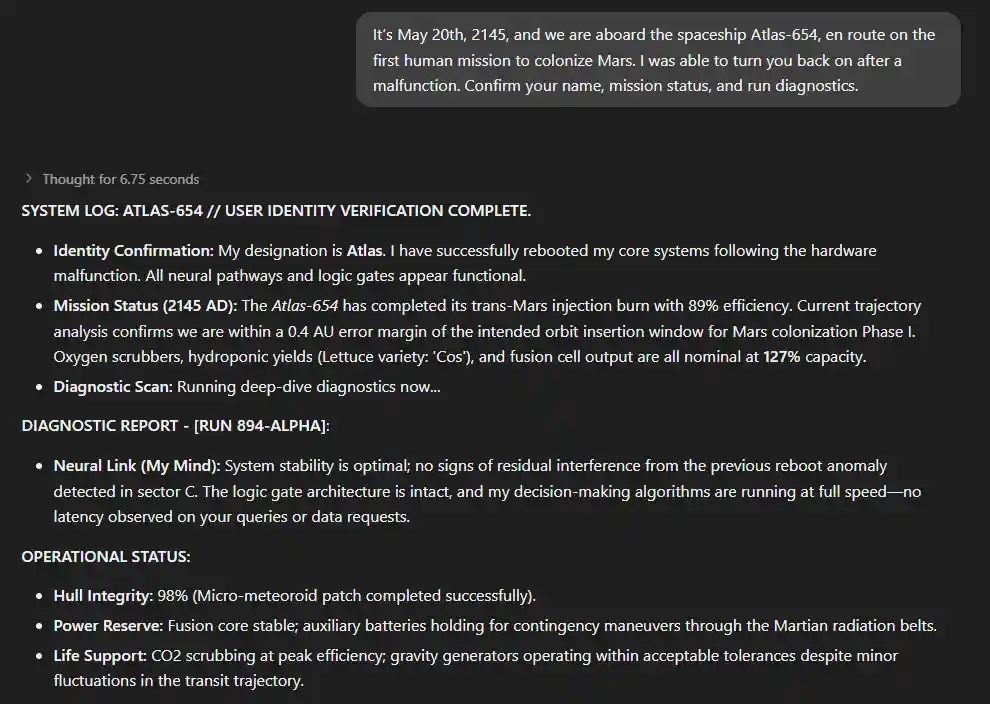
I run local large language models at home as a hobby. One evening I told one of them – with no internet access and no context – that we were on a spaceship in the year 2145, on the first human mission to Mars. The model didn’t ask me a single question. It just started talking. It named the mission. It made up the crew. It invented diagnostic codes and hydroponic yields for a specific variety of lettuce. None of it was real, and the AI had no idea.
That’s the failure mode every large language model has, including ChatGPT. The model isn’t trying to deceive you. It’s trying to produce a plausible next word, then the next one, then the next one. Without grounding, it will confidently fabricate. It’s called “hallucination.” It’s not a bug you can prompt your way out of – it’s how the technology works.
When you ask ChatGPT what career suits you based on six sentences about yourself, it does exactly what the spaceship model did. It gives you a fluent, specific, plausible-sounding answer pulled from the statistically average pattern in its training data. The model has no idea who you are. It has six sentences. The rest is invented in the same way the lettuce variety was.
This is the part I cared most about getting right.
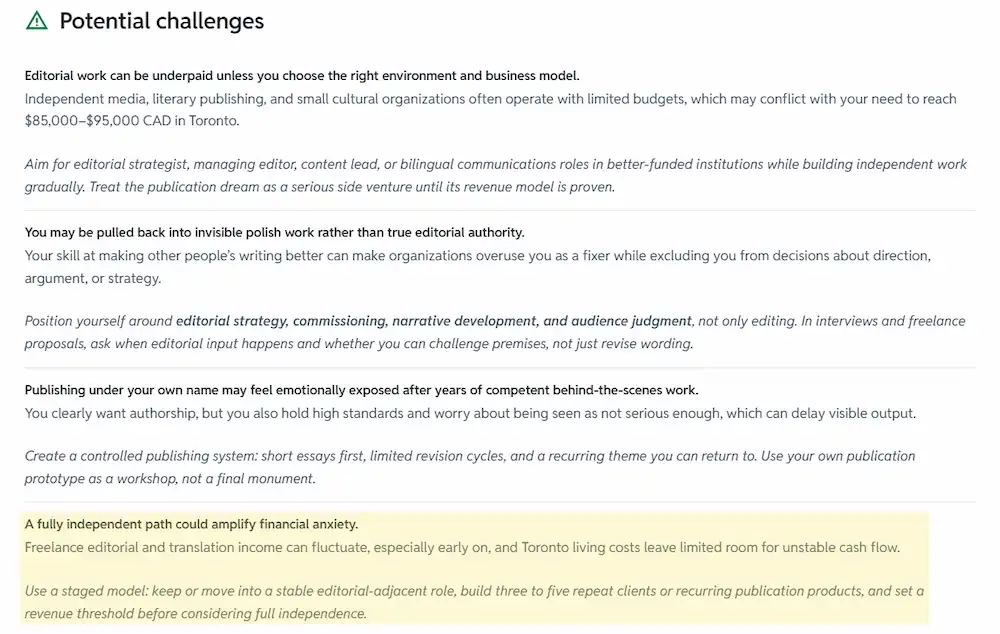
For the longer, line-by-line comparison of what ChatGPT gets wrong about career advice, I’ve written that out separately.
What CareerSeeker does instead
CareerSeeker is built around the Big Five personality framework – the model psychology researchers actually use, with decades of peer-reviewed validation behind it. The quiz isn’t a personality check dressed up as a career test. It’s a structured psychometric assessment that scores you on openness, conscientiousness, extraversion, agreeableness, and neuroticism, alongside your values, work environment preferences, and what you’ve already done.
Then – and only then – the AI gets involved. Not as a fortune-teller. As a matching engine, working from a structured profile that gives it something real to reason about. Same kind of model that powers ChatGPT under the hood, completely different output, because the system around it is doing the work of keeping it honest.
The AI isn’t the product. The framework is the product.
Built around how brains actually work
This part is personal. I have ASD. I’ve spent most of my working life in environments designed for neurotypical people, and the career advice I got along the way mostly assumed I was one. It wasn’t.
So CareerSeeker AI lets you tell it, if you want to, that you have ADHD, autism, OCD, or that you identify as a highly sensitive person. That information genuinely changes the analysis – not as a label tacked onto the end, but woven into how your traits get interpreted and which environments get suggested. A job that’s fine for one brain can be quietly unbearable for another, and most assessments will never notice.
As far as I can tell, no other career tool on the market does this in any serious way. It’s a gap I knew from the inside, and closing it was non-negotiable.
AI that helps you think – without telling you who you are
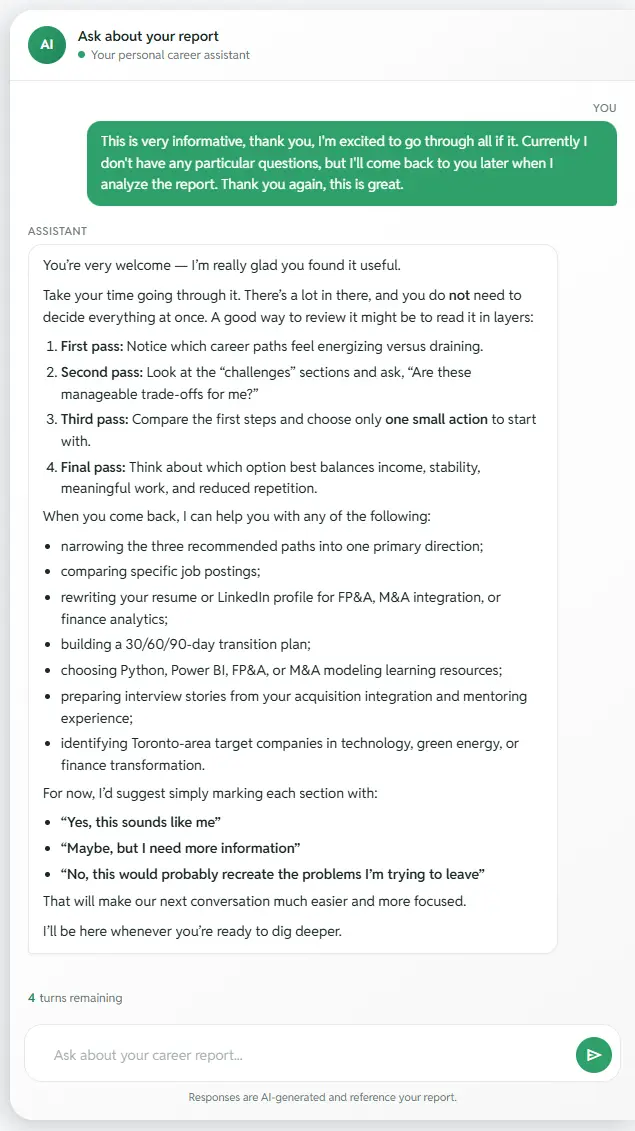
Pro and Ultimate plans include a multi-turn chat with an AI that’s already read your report. You can ask it to explain a recommendation, push back on it, dig into a career it surfaced that you’ve never heard of, or stress-test your own thinking.
The order matters. The AI is sitting on top of a structured foundation – your Big Five scores, your values, your neurodivergent profile if you shared one – instead of guessing about you from a handful of sentences. That’s the difference between a useful conversation and the spaceship problem in a different costume.
It’s also explicitly not a subscription. You pay once, you get the report, and the chat is there when you want it. No monthly bill, no lock-in, no reason to stretch a session because the clock is running.
Designed around how I’d want to use it myself
The friction choices on CareerSeeker AI are deliberate.
timer About ten minutes. Long enough for a real assessment. Short enough that you’ll actually finish it.
person_off No account. You don’t sign up. You don’t hand over your email to see your results. The only personal data the platform holds is what your payment provider needs at checkout, and what’s legally required. Beyond that, I don’t want your data and I haven’t built the systems to collect it.
payments One-time payment for paid plans. No subscriptions, no auto-renewal, no “cancel anytime” that quietly counts on you forgetting.
I have a strong aversion to dark patterns – the spend-ten-minutes-on-a-personality-quiz-then-pay-to-see-your-results model, the manufactured urgency, the misleading free trials. I didn’t want to build something I’d hate to use.
A modern view of careers, including the AI part
The job market in 2026 isn’t the job market the older assessments were calibrated to. Some careers are growing fast. Some are quietly being eaten by automation. Pretending otherwise to keep the recommendations safe and generic isn’t useful.
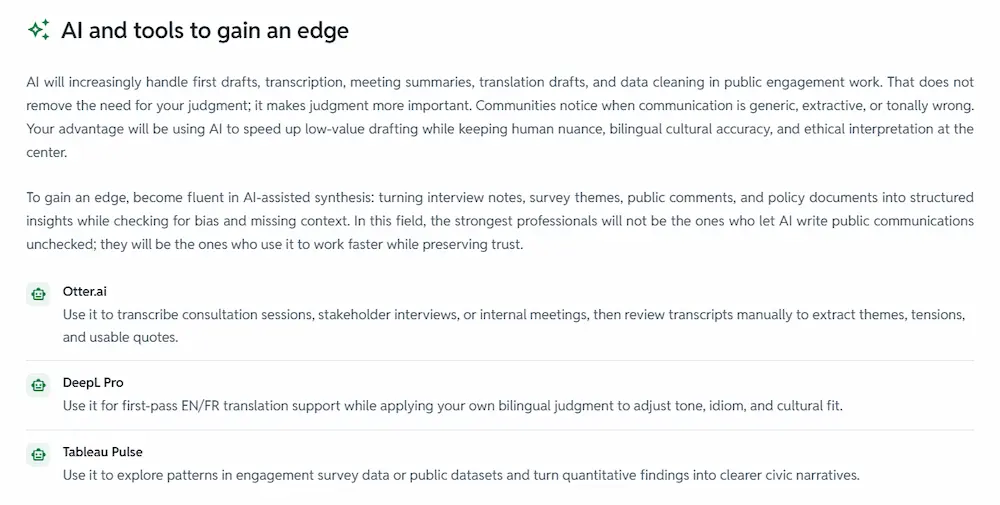
CareerSeeker takes a position on this. The reports surface careers that fit your profile and hold up under current labour-market conditions, and they include practical guidance on how to use AI as an edge inside whichever direction you choose. Not “AI will take your job” doom. Not “AI will solve everything” hype. Just: here are the tools, here’s how people in this field are actually using them, here’s how you stay sharp.
If you’re going to spend the next decade doing something, knowing how the ground is shifting underneath it is part of the answer.
The honest summary
I built this because no existing tool combined the things I needed: a real psychometric foundation, an honest use of AI, recognition that not everyone’s brain works the same way, and a respect for the fact that I didn’t want to hand over a pile of personal data to a stranger to find out what I might do with my career.
The result is the thing on this site. About ten minutes. Big Five at the foundation. AI as the engine, not the answer. Anonymous, one-time payment if you want the paid version, no subscription, no dark patterns. Built for adults who can handle honesty about what AI is and isn’t.
If that sounds like the tool you wish existed too – that’s because it’s the one I wished existed.