

A large US health system runs a 22-week program, out of its Florida campuses, that turns its own employees into surgical technologists. Tuition is zero. You stay on the payroll at $15.15 to $22.73 an hour while you train, and you come out on a higher base rate.
That isn’t a scholarship or a scheme. It’s a staffing decision, made by an employer who needs surgical techs and has worked out that growing them is cheaper than bidding for them.
Jobs that pay for your training are real, more common than they look, and funded through four separate mechanisms that almost nobody explains in one place. This covers all four, what each one costs you, and then the part the brochures leave out – which is what happens to the people who don’t finish.
Everything below is US-specific. The occupations travel; the funding does not.
Who actually pays for job training?
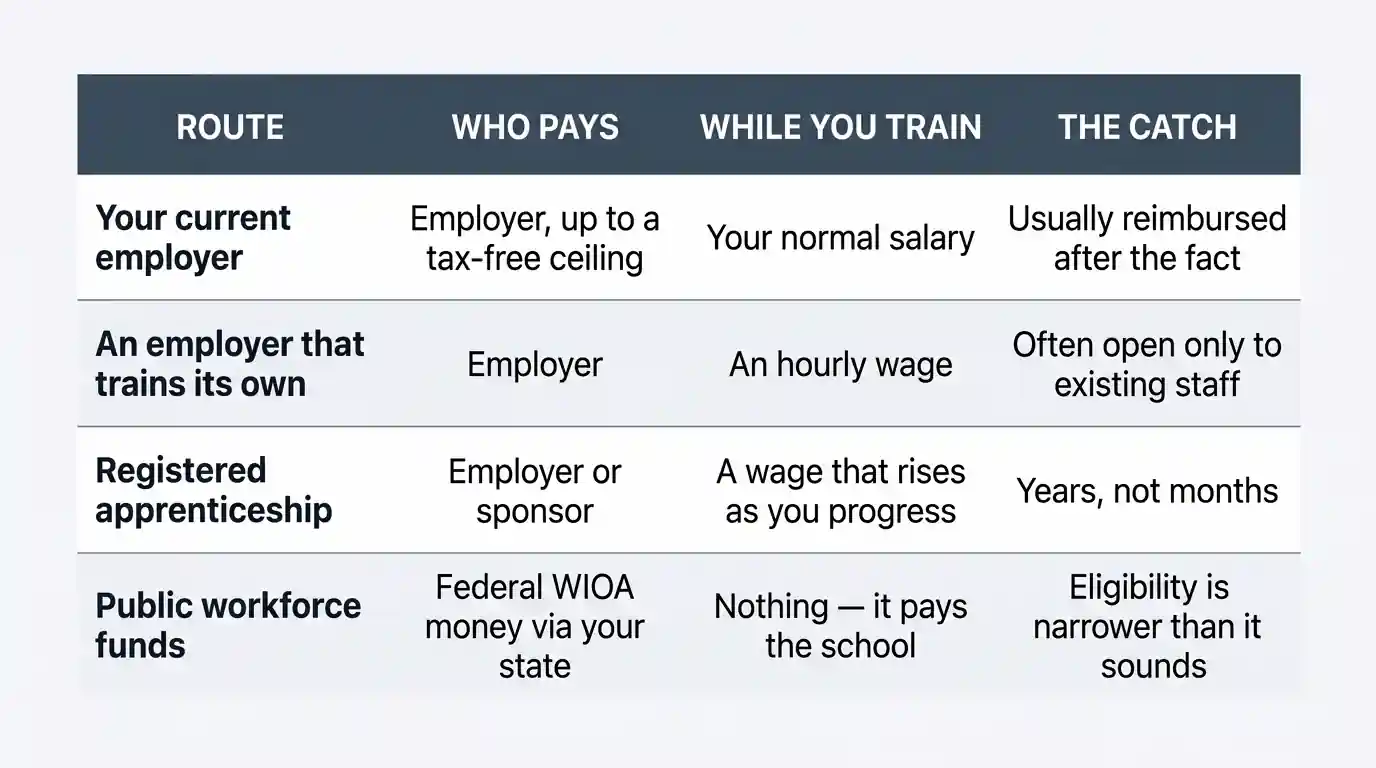
Four sources, in practice: an employer you already work for, an employer willing to hire and train you from scratch, a registered apprenticeship that pays you a wage from the first day, and public workforce funds administered through your state. Each has a different entry requirement and a different catch.
Route 1 – the employer you already have
This is the most widely available and least used of the four.
Under Section 127 of the tax code, an employer can give you up to $5,250 a year in educational assistance without it counting as taxable income. That covers tuition, fees, books, supplies and equipment, and since 2020 it can also go toward principal or interest on qualified education loans. For tax years after 2026 the ceiling starts adjusting for cost of living.
The $5,250 figure is why so many tuition benefits land on exactly that number. It isn’t your employer being precise about your worth. It’s the line above which they’d have to start withholding.
One detail in the IRS guidance is worth more than the rest of it combined. The benefits “do not have to be for work-related courses.”
Read that again if you’re currently in a job you intend to leave. The tax code does not require your employer’s education benefit to be spent on your current role. Company policy might, and plenty of policies do – but the constraint is theirs, not the law’s, and it’s worth reading your actual policy before assuming.
The catch is structural: most tuition assistance is a reimbursement. You pay first and get it back on completion, which means you need the money up front. Many programs also carry a service commitment, where leaving inside twelve or twenty-four months means paying it back.
Route 2 – an employer that trains its own
This is the route the internet keeps rediscovering, and it’s the one the AdventHealth program above belongs to. Health systems, in particular, run structured programs that take someone with no clinical credential and produce a certified one, at zero tuition, on the payroll throughout.
The condition people miss is that a lot of these are internal. AdventHealth’s surgical tech program is open to current team members, which means the entry point isn’t the program at all. It’s getting hired by the organization first.
That reframes the search. You’re not looking for a training program. You’re looking for an employer with a training program, and then for any open door into that employer.
Worth being sober about the numbers. On that particular program, base pay after training runs $21.56 to $25.32 an hour against $15.15 to $22.73 during it. That’s a real raise and a portable credential, funded by someone else. It is not a transformation, and any article implying otherwise is selling something.
Route 3 – a registered apprenticeship
An apprenticeship inverts the usual arrangement: you’re an employee from day one, earning a wage that steps up as you hit skill milestones, with classroom instruction attached and a nationally recognized credential at the end. No tuition, no debt, and the search tool is public – the Department of Labor runs an apprenticeship finder you can filter by occupation and state.
The trade-off is time and concentration. Apprenticeships run years rather than months, and while the official industry list spans healthcare, IT, energy, finance and hospitality, the volume is still weighted toward construction and the traditional trades.
It’s also the route with the best public data, which is how we know the next thing.
Route 4 – public workforce funds
The Workforce Innovation and Opportunity Act pays for occupational training through state and local workforce boards. The money reaches an approved school as a voucher rather than reaching you as cash, and you access it through a local American Job Center.
Here the lead-gen sites are quietly misleading. WIOA is not a general-purpose training grant. CareerOneStop’s own eligibility page frames it around barriers to employment – you may qualify if you’ve been laid off and are unlikely to find work in your former industry, have a low income or a family member receiving public assistance, are justice-involved, are disabled, are an English language learner, are pregnant or parenting and under 24, have been in foster care or homeless, or were self-employed and are now unemployed because of economic conditions.
That’s a real list and a lot of people are on it. It is not everybody, and “get your training paid for by the government” articles that skip the list are wasting your afternoon.
Two adjacent pots are worth knowing about if they apply to you: veterans’ education benefits through the VA, and SNAP Employment & Training if you receive food benefits.
There’s one more constraint that matters for a direction decision. WIOA money flows to programs on your state’s eligible-provider list, and those lists are built around occupations the state considers in demand locally. The funding doesn’t just pay for a direction. To some extent it picks the menu.
The number the fact sheet doesn’t put in the headline
The Department of Labor publishes a career-seeker fact sheet on apprenticeship. It carries one statistic, in large type:
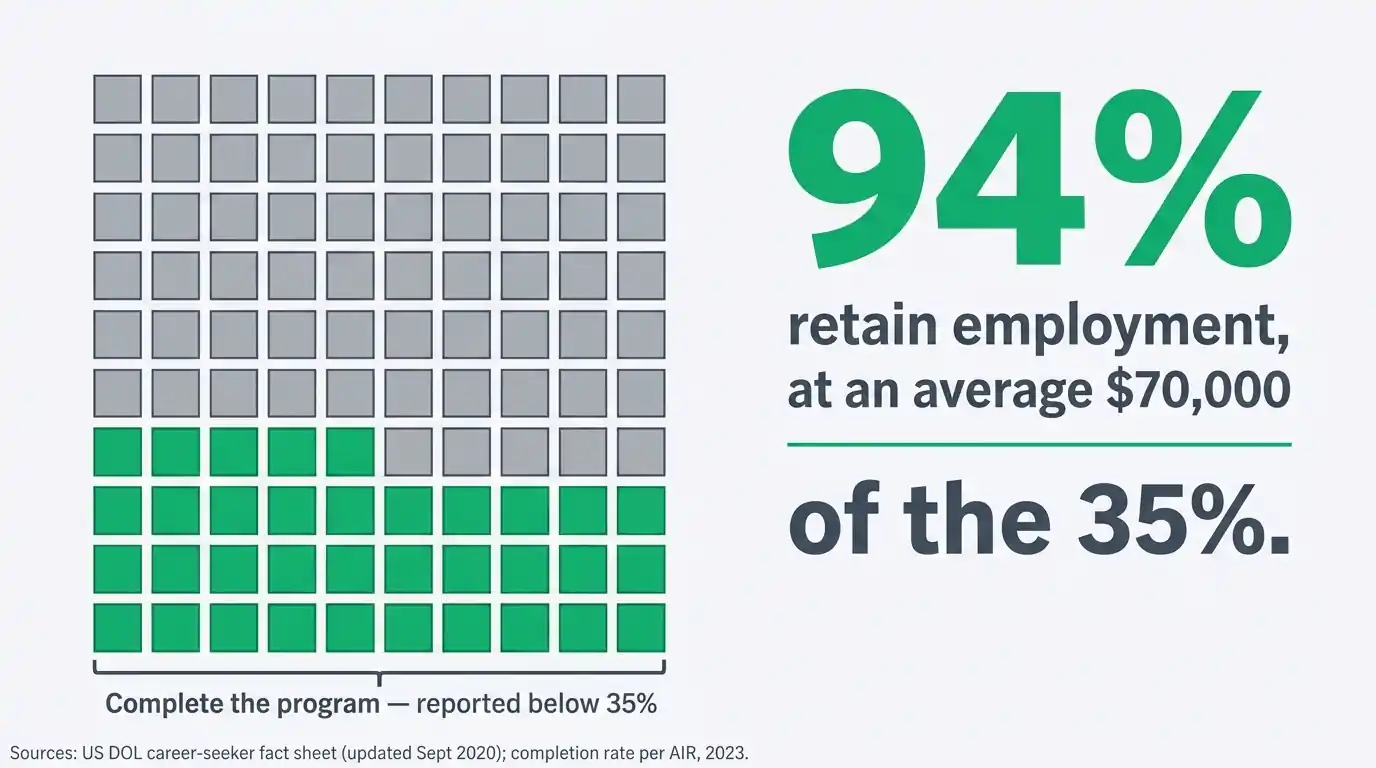
“94% of apprentices who complete an apprenticeship program retain employment, with an average annual salary of $70,000”
That number is everywhere. It gets quoted as “94% of apprentices get jobs paying $70,000,” which is not what it says. The conditional is right there in DOL’s own sentence, and it falls off in transit almost every time.
So how many complete?
In a 2023 review of apprentice retention research, the American Institutes for Research reported that “In 2021, the United States Department of Labor reported that overall apprenticeship completion rates were below 35%.” The same passage notes completion was lower still for Black apprentices, at 24%, against 33% for White and 30% for Asian peers. That review was prepared with the electrical training ALLIANCE, an industry body, and it draws heavily on construction programs – worth knowing, though an industry partner publishing an unflattering completion figure is not the direction that bias usually runs.
Put the two together and the headline statistic describes the outcome for roughly a third of the people who start.
That isn’t an argument against apprenticeships. It’s an argument against reading a completer-only number as if it applied to you on day one. The fact sheet carrying it, incidentally, was last updated in September 2020, and it cites no source for the figure at all.
There is now a better place to look. A DOL circular issued in March 2026 set out how completion rates are calculated – the share of a cohort receiving a completion certificate within one year of their projected completion date – and announced a public data portal publishing national average completion and cancellation rates, broken down by state and industry, back to 2013. If you’re weighing a specific trade in a specific state, that’s a far better input than any national average, and it didn’t exist in usable form until this year.
Why people leave, according to the people who studied it
The obvious explanation for a sub-35% completion rate is that the training is hard and people aren’t tough enough. The research doesn’t support that as the main story.
Be clear on what the evidence can and can’t do here. Completion is measured well; reasons for leaving are not recorded systematically, so what follows is a literature review of smaller studies, not a national count. Read it as the best available account rather than a settled one.
The AIR review sorts the causes into workplace environment, classroom factors, financial security, and personal circumstances. Money and life events do real damage, and nothing below is a substitute for being able to pay rent.
But the first workplace factor on their list is this: “Incomplete information on the nature of the job leads to unrealistic expectations.” Apprentices arrive, the review says, lacking “a realistic understanding of the nature of the actual job or its pay structure, work culture, or cost and travel requirements.”
Their recommendation to program sponsors follows directly. Offer candidates a realistic preview during selection, so they gain an accurate understanding of the job and the industry before they commit.
That recommendation is aimed at the programs. Nobody is obliged to wait for them to take it.
The review also notes that the factors driving people out are best understood at the occupational level – they’re specific to the work and its culture, not general to training. Which is another way of saying that the thing predicting whether you finish is largely whether the daily work suits you, and that this is knowable in advance.
Month nine is where this gets decided. By then the funding has stopped being the interesting part and the work is just the work. Anyone can tolerate an unfamiliar job for two weeks because it’s free. Very few can tolerate the wrong one for a year.
It’s worth noticing what kind of decision this makes it. We’ve written before about how career regret concentrates on the things you can no longer change – and by that standard a funded short credential is the cheap kind of bet. You’re spending time rather than savings, and the credential is portable. What it costs, if it’s wrong, is the nine months.
Two short healthcare paths, opposite people
Say you’ve narrowed to healthcare and you want something short. Two obvious candidates: sterile processing and dental assisting. Both are short paths, both get funded, both sit inside the same industry.
They also suit close to opposite people, and O*NET – the Department of Labor’s free occupational database – shows exactly where they diverge.
| Sterile processing (medical equipment preparers) | Dental assistants | |
|---|---|---|
| Interest profile (RIASEC) | Realistic, Conventional, Investigative | Conventional, Realistic, Social |
| Physical proximity | 47% “moderately close (at arm’s length)” | 88% “very close (near touching)” |
| Exposed to disease or infections | 88% every day | 54% every day |
| Importance of being exact | 70% extremely important | 56% extremely important |
| Preparation (Job Zone) | 1–2, little to some | 3, medium |
Note which way the biohazard row runs. The job with far less human contact carries the higher daily exposure – sterile processing is where contaminated instruments go. The quieter option is not the safer or softer one, it’s just the one where the difficulty is in the procedure rather than in the person in the chair.
Social appears in one interest profile and not the other, and that single difference is most of the lived experience. One role is precision work on objects, to a standard, largely away from patients. The other is hands inside the mouth of a nervous stranger, all day, while staying pleasant about it.
Someone who finds the second draining can absolutely qualify for it. The training is short and it is funded. They will also be the person the completion statistics are describing.
If you want the frameworks underneath that table, we’ve written up how interest types map onto career families and how values do the work that passion is usually given credit for.

Where short credentials actually go wrong
The funding question is the easy one. The harder question is whether the credential is worth holding, and here the evidence is genuinely mixed.
New America’s review of short-term credential outcomes is the least promotional summary available. Its findings, briefly:
- Earnings gains from short-term credentials run roughly 10 to 20 percent on average, with the largest gains for adults who previously held a GED or less.
- For programs under a year, there is “no clear conclusion as to the labor-market value.” Some studies find positive returns, some find none, some find negative.
- Returns depend heavily on the field. Education, fine arts, and cosmetology showed consistently negative returns in California data, while automotive technology showed strong positive ones.
- The gap between fields is enormous. Certificate holders in healthcare were found earning up to $50,000 a year less than certificate holders in construction trades.
- Benefits can fade. California data showed short-term certificate gains flattening within about seven years, where associate degree gains held.
- One Washington State study found negative returns for women specifically, and gaps by race and gender show up repeatedly across this literature.
None of that says don’t. Plenty of people get a genuinely better job out of a nine-month program, and the ones who pick a field with real local demand tend to do fine. What it says is that the field you pick matters far more than the fact of holding a certificate – which is precisely the variable a “6-month certifications that pay well” listicle is least equipped to help you with, because it’s the variable that changes by person and by state.
A certification existing is not evidence that anyone gets hired. Where completion-to-employment data isn’t published, the honest reading is that it isn’t published, not that it’s fine.
How to check any of this before you commit
- Read your current employer’s education policy before assuming it’s for other people. Look for the annual cap, whether it’s paid up front or reimbursed, and the service commitment.
- Search the employer, not the program. Look up “[health system name] tuition reimbursement” and “[system name] training program.” If the good programs are internal, the move is getting in the door first.
- Check the apprenticeship data for your state and trade, not the national headline, using DOL’s completion-rate portal. Cancellation rates are published alongside completion rates now – read both.
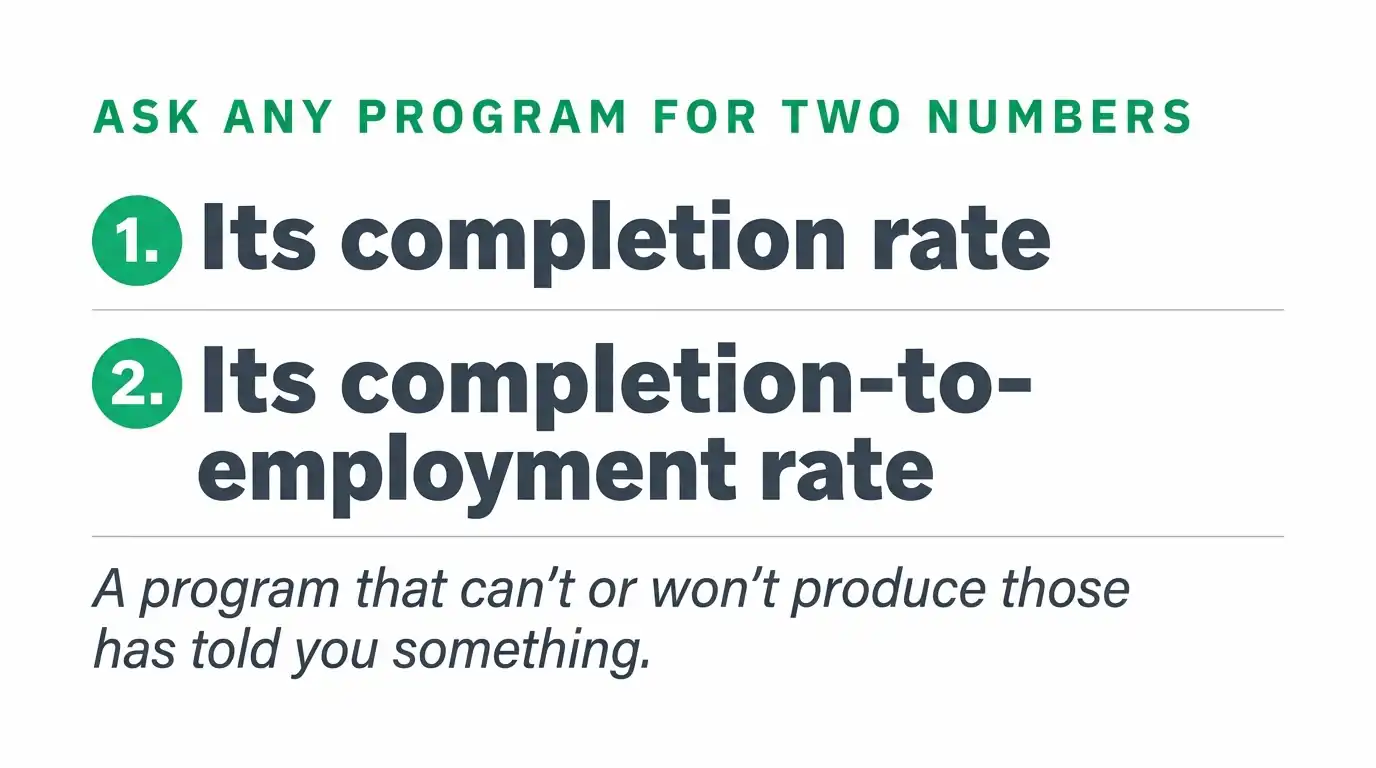
- Ask any program for two numbers: its completion rate, and its completion-to-employment rate. Ask what happens to the people who leave. A program that can’t or won’t produce those has told you something.
- Check the occupation on O*NET before the program. Work context takes ten minutes and it’s free. You are looking for the daily conditions you’d still accept in month nine.
- Look up current pay at the BLS Occupational Outlook Handbook at the moment you need it. Salary figures in training-provider marketing go stale quietly.
- Call the American Job Center before ruling out public funding, and check your state’s eligible-provider list – it tells you which directions your state will actually finance.
If the honest blocker is that you haven’t settled the direction yet, that’s the thing to fix first, because every route above is cheap once you know what you’re aiming at and expensive when you don’t. It’s what we built CareerSeeker for. It works from your traits, values, past experience and, if you want, your neurodivergent profile, then suggests directions with the reasoning shown. Anonymous, about ten minutes, no account. Suggestions, not verdicts – it can’t tell you whether you’ll finish a program, and neither can anything else.
And if the worry is that a short credential means throwing away what you’ve already built, that’s usually false in a checkable way. We went through which parts of your experience actually transfer separately. Short paths also cluster in exactly the kind of work that’s hard to automate – physical presence, licensed judgment, consequences someone has to carry – which is a point in their favor that has nothing to do with speed.
The bottom line:
- Four routes fund training: your current employer, an employer that trains its own, a registered apprenticeship, or public workforce money. They have different entry requirements, not different amounts of merit.
- Section 127 lets an employer give you $5,250 a year tax-free, and the IRS does not require it to be spent on work-related courses. Your company policy might.
- “94% of apprentices retain employment at $70,000” is DOL’s own wording and it says who complete. Completion has been reported below 35%.
- The best-documented reason people leave isn’t difficulty. It’s arriving without an accurate picture of the work.
- Across short credentials, the field you choose explains far more of the outcome than the credential itself.
Someone else will cover the tuition. That part has a form, an eligibility list, and an office you can call. The money is the part someone else can solve – the direction is the part they can’t.
Frequently asked questions
Healthcare systems are the most common – hospitals routinely fund training for surgical technologists, nursing assistants, sterile processing technicians and medical assistants. Registered apprenticeships pay a wage from day one across construction, manufacturing, energy, IT and healthcare. Many large employers outside healthcare also offer tuition assistance to existing staff, which is worth checking before you assume it doesn’t apply to you.
Yes, and the tax code encourages it. Section 127 lets an employer provide up to $5,250 per year in educational assistance without it being treated as taxable income, covering tuition, fees, books and equipment. Most programs reimburse after completion rather than paying up front, and many attach a service commitment requiring repayment if you leave within a year or two.
It depends far more on the field than on the length. Research summarized by New America puts average earnings gains from short-term credentials at roughly 10 to 20 percent, but finds no clear conclusion on the value of programs under a year – some fields show strong returns, others consistently negative ones. Check local demand and completion-to-employment data for the specific program.
Contact your local American Job Center, which administers WIOA training funds through state workforce boards. Eligibility is based on barriers to employment – being laid off with poor prospects in your former industry, low income, justice involvement, disability, and several other categories. Funding goes to schools on your state’s eligible-provider list, which is built around locally in-demand occupations.
Usually one of three. Reimbursement rather than up-front payment, so you need the cash first. A service commitment, meaning you repay if you leave too soon. Or an eligibility rule requiring you to already be an employee, which makes getting hired the real entry point. None of these are hidden – they’re in the policy document, and reading it is the whole diligence step.