


There’s a small lie buried in the way most people describe their work. “I’m a marketing manager.” “I’m an accountant.” “I’m a teacher.” A single noun, a single employer, a single track. The problem is that the noun usually describes a fraction of the actual labor – and an even smaller fraction of the skills doing the work. A portfolio career is what you get when you stop pretending otherwise.
This guide explains what a portfolio career actually is, why the shape is becoming normal in the AI economy, how to identify your own skills portfolio, and the real trade-offs no one mentions in the LinkedIn version. By the end you’ll have a working method for composing your work forward – whether you stay in one job, run three at once, or land somewhere in between.
What is a portfolio career?
A portfolio career is one composed of multiple skills, engagements, or income streams rather than a single full-time job tied to a single title. The term was popularized by management writer Charles Handy in The Age of Unreason (1989), where he predicted that the traditional employment contract would fragment and that workers would increasingly hold a mix of paid work, freelance work, and skill-based projects in parallel.
In practice, “portfolio career” gets used in two overlapping ways:
- The structural sense. Multiple parallel engagements – a part-time role, two freelance contracts, a side product, occasional teaching. The composition is visible from the outside.
- The mindset sense. Whether or not your week looks fragmented on a calendar, you treat your career as a portfolio of skills that can be re-composed into different roles – rather than a single title tied to a single track.
Both senses point at the same operational move: stop pricing yourself in job titles, start pricing yourself in skills. The structural version is what the outside world sees. The mindset version is what makes the structural version survivable – and what makes a single-title career less fragile if you decide to keep one.
Why portfolio careers are becoming normal
Three forces are pushing the single-title career toward extinction at the same time, and the combination is what makes this moment different from any of the previous “the workplace is changing” cycles.
1. AI is dissolving the boundaries of traditional roles. Tasks that used to define entire job titles – drafting, summarising, basic analysis, mid-level coding, first-pass design – are increasingly absorbed by language models and agents. The roles aren’t disappearing wholesale; the boundaries are. A “marketing manager” in 2026 routinely does work that would have been three separate jobs in 2018, because the tools collapsed the gaps. The work shifts toward judgement, taste, integration – skills that don’t fit neatly under one title.
2. Lifetime employment was already over. It’s been over for decades, but the cultural script lagged behind. Median tenure with a single employer has been falling across most developed economies for thirty years. The expectation of “one job, one career, one retirement” was built for a labour market that no longer exists, and the people clinging to it hardest tend to be the people most exposed when their single employer restructures.
3. Knowledge work fragments naturally. Modern knowledge work doesn’t need to be done in 40-hour blocks at a single desk for a single firm. The infrastructure for splitting it – async tools, contracts, payments rails, talent marketplaces – is now boring and ubiquitous. The friction that used to make portfolio work expensive has collapsed.
None of this means everyone should rush to freelance. It means the default shape of a career is shifting, and the people composing deliberately tend to outperform the people defaulting into whatever shape arrives by accident.

The skills portfolio mindset works even if you stay in one job
Here’s the part that gets lost in most portfolio-career writing: the mindset version is more valuable than the structural version, and you don’t need to quit anything to start using it.
The mindset move is small. Instead of describing what you do as “I’m a [title],” describe it as a small set of skills you happen to be deploying in your current role. “I translate technical work to non-technical people, I run cross-functional projects, and I’m the person other teams send their messy data to when they need it cleaned up.” That sentence works whether you stay where you are for another decade or leave next month. It also names assets that an AI tool can’t easily replicate, because they live at the intersections.
The reason this matters: a job title is a fragile asset. It’s defined by your employer, mostly portable only within your industry, and re-priced any time the market shifts. A skill portfolio is a durable asset. It’s defined by you, portable across industries, and re-prices upward when the underlying skills become rarer – which happens constantly as AI absorbs the more mechanical parts of every role.
Even if you never run a single freelance project, thinking in skills changes three things almost immediately:
- How you talk about your work. “I do X, Y, and Z” beats “I’m a [title]” in any conversation where the listener isn’t already inside your industry.
- What you protect on your calendar. You stop saying yes to work that doesn’t build the skills you actually want compounding.
- How you read the market. Job listings stop being targets – they become signal about which skill combinations are getting paid.
The companion piece on identity capital covers the retrospective half of this – auditing what you’ve already built. This article is about composing forward. Both are useful; neither replaces the other.
How to identify your own skills portfolio
The audit is the part everyone wants to skip. Don’t skip it. Open a blank page – not your CV – and do this in four passes.
Pass 1 – Strip the title vocabulary. Write down what you actually do in a normal week, but ban yourself from using your job title or any of its standard verbs. “I review marketing copy” is title-thinking. “I notice when language is trying too hard” is skill-thinking.
Pass 2 – Name the skills in plain English. Use the verbs a smart friend would use, not the ones in a job description. A few examples of the translation move:
| Title-thinking | Skills-thinking |
|---|---|
| Marketing manager | I find the angle that makes a product make sense to a stranger |
| Customer success lead | I read what people aren’t saying when they’re frustrated |
| Operations manager | I see where a process is about to break before it breaks |
| Software engineer | I take a vague idea and make it real enough to argue with |
| Lawyer | I find the load-bearing argument inside a mess |
| Teacher | I find the shape of an idea that lets it actually land |
| Accountant | I find the gap between the story the numbers tell and the story the company tells |
Notice that the skills-thinking column is portable across industries in ways the titles aren’t. Finding the load-bearing argument inside a mess is useful in law, product, policy, journalism, and consulting. Lawyer is only useful at a law firm.
Pass 3 – Group skills into clusters. Most portfolios have three to five durable skill clusters. More than seven is usually a sign you’re describing tasks rather than skills. Fewer than three is usually a sign you’re collapsing distinct things into one.
Pass 4 – Mark which skills are AI-resistant. Not because AI is the enemy, but because AI-resistant skills are the ones that re-price upward as everything else gets cheaper. The pattern: skills that require taste, judgement, accountability, or trust – the parts of work where being wrong has consequences someone has to own – survive longest.
You now have a working skills portfolio. It’s the input for everything that follows.

How to build a portfolio career deliberately
If you want the structural version – multiple engagements running in parallel – the math is more practical than it sounds. Three things have to hold.
1. One anchor, two satellites (or some variation). Most working portfolio careers run one engagement that pays the rent – a part-time employer, a long-term retainer, a stable contract – and two or three smaller engagements layered around it. The anchor reduces the income volatility that kills portfolio careers in year two. The satellites compound new skills and contacts that the anchor wouldn’t.
2. The skills have to overlap, not multiply. A portfolio where every engagement uses the same core skills compounds. A portfolio where every engagement uses different skills doesn’t – it just makes you tired. The freelance writer who writes for three different industries is compounding. The freelance writer who also drives Uber and runs an Etsy store is just stacking unrelated work.
3. The math has to actually work. Portfolio work costs more than employed work – you pay your own benefits, your own taxes, your own software, your own equipment, your own pension. A useful rule: a portfolio income needs to be roughly 1.3–1.5× the equivalent full-time salary to leave you in the same place financially. If it doesn’t, the structural version is a salary cut, not a career upgrade.
There’s no single right composition. Some portfolio careers are 60-20-20. Some are 40-30-30. Some are seasonal – a six-month-on, six-month-off cycle around a creative project. The shape follows the skills and the life, not a template.

What portfolio careers actually cost you
The honest section, because the LinkedIn version of this idea consistently skips it.
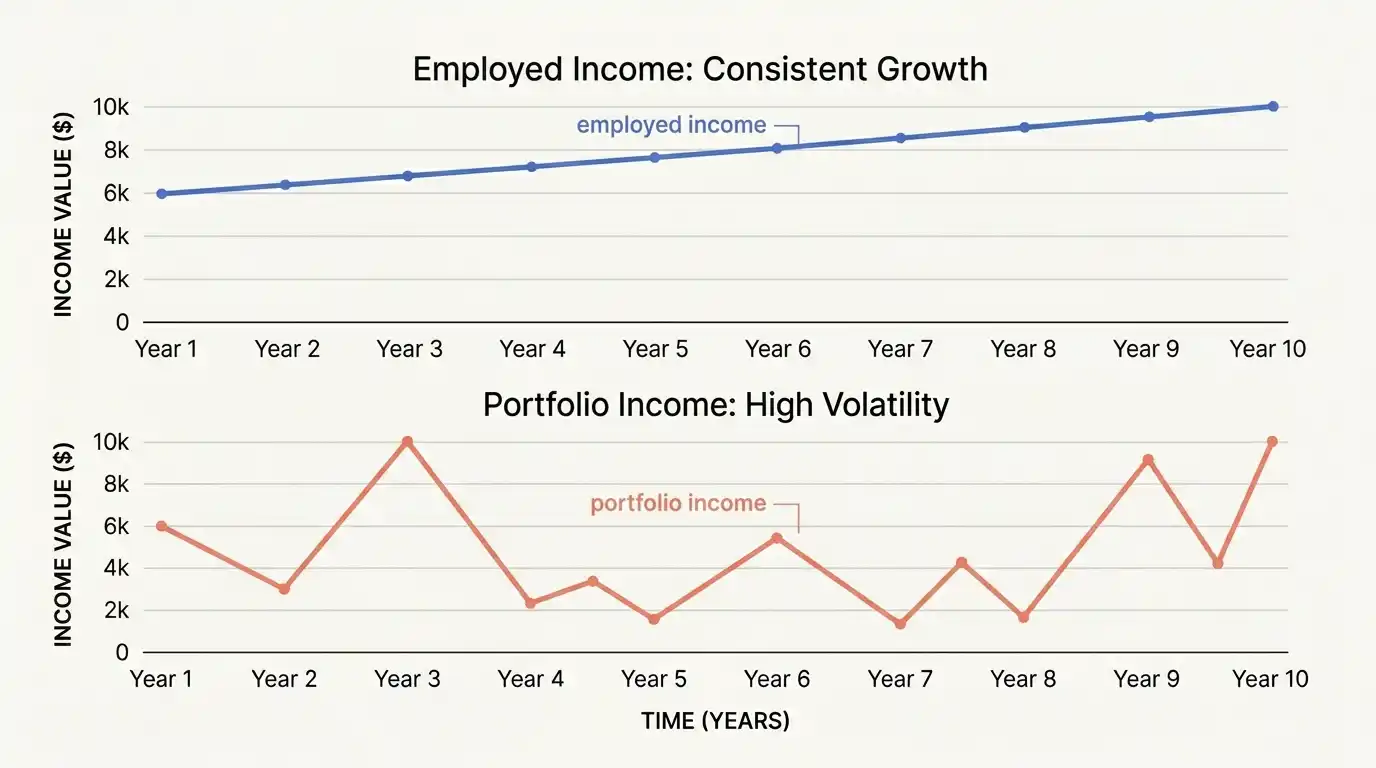
Income volatility is real. Even with an anchor, portfolio income arrives unevenly. The same annual figure feels different when it shows up in twelve neat monthly instalments versus four uneven quarters. Most people underestimate how much that variance costs them in stress, relationship friction, and decision quality during low months.
Identity gets fuzzier. “What do you do?” is a harder question to answer in one sentence when the truthful answer is five. Some people enjoy the ambiguity. Many find it quietly destabilising – especially in cultures and family contexts where a single clear title is treated as a measure of seriousness.
Admin overhead compounds. Multiple income streams mean multiple contracts, invoices, tax forms, expense categories, and accounting flows. The first portfolio career runs on Notion and goodwill. The second one usually needs an accountant.
Some basic life infrastructure gets harder. Mortgages, rentals, visas, and loans were designed for single-employer paystubs. Portfolio careers can usually clear these hurdles, but they take more paperwork and more patience, and some lenders will simply refuse.
Loneliness is a tax. Office work has lots of problems, but it solves the “where are the other humans” problem by default. Portfolio careers don’t – and the people who thrive in this shape long-term tend to deliberately rebuild the connective tissue (coworking, peer groups, regular collaborators) that a single employer used to provide for free.
None of this means a portfolio career is a bad bet. It means it’s a different bet, with a different set of costs that need to be priced in honestly before you commit.
When a single-title career is still the right move
Portfolio thinking is not a universal upgrade. Some careers compound best with depth, not breadth, and the people who go deep on a single skill set inside a single institutional structure produce work that no portfolio composition could match.
A non-exhaustive list of when single-track depth beats portfolio composition:
- High-stakes specialist work – surgeons, structural engineers, pilots, judges. Reps inside a tight environment matter more than breadth.
- Research careers with long compounding curves – academic research, certain kinds of scientific work, advanced craft. The years are the asset; fragmenting them is the cost.
- Roles where institutional trust is the product – senior executive paths, regulated industries, long-term client work. Continuity is the skill.
- Stages of life where stability matters more than optionality – young children, caregiving for parents, recovery from a hard period. Volatility is expensive when bandwidth is already low.
The honest test isn’t “does the portfolio model sound exciting?” – it’s “does my work compound faster in one structure or in many?” Both answers are valid. Both are common. The trap is doing one when the other would have served you better, because the cultural script (in either direction) made the alternative invisible.
A faster way to see your own skills portfolio
The audit above works. It also takes a quiet weekend to do honestly, and most people stall around pass 2 – the translation from title vocabulary to skills vocabulary is the hardest move, because it requires seeing your own work from outside your industry’s language.
This is the gap CareerSeeker AI was built for. The free quiz takes about ten minutes and surfaces a first read on your strengths, traits, and the skill clusters that show up most strongly in your profile – the early shape of a portfolio rather than a list of job titles.
The paid Career Plans go further: they take your personality plus your work history and translate them into specific career directions with reasoning attached, including the skill combinations that would let you compose a portfolio shape if you want one. (For a side-by-side view of what the free quiz produces versus the paid tiers, see What Changes When Career Advice Actually Knows You).
The shape of work is changing whether or not you compose deliberately – the difference between the people who land well in this market and the people who get pushed around by it is mostly whether they thought about their own skills portfolio before someone else did it for them.
Stop describing yourself by your title. Start describing yourself by the skills doing the work. The rest follows from there.