

You took the test. You got four letters and a flattering nickname. You read the profile and thought, that’s genuinely me. Then you closed the tab, and Monday arrived, and nothing about your actual situation had changed.
So: is MBTI accurate? The honest answer is that it’s accurate at the thing it does and useless at the thing you wanted it for. It will describe you in a way you recognize. It will not tell you what to do next, and when you retake it and the letters move, it has no way of telling you which version to believe.
That second part is the real problem, and it gets discussed far less than the usual “MBTI is pseudoscience” argument. This isn’t that argument. MBTI has real uses. Career decisions just aren’t one of them, and it’s worth understanding precisely why before you let four letters steer a decade.
What MBTI Actually Is
The Myers-Briggs Type Indicator was built in the 1940s by Katharine Briggs and her daughter Isabel Briggs Myers, adapting Carl Jung’s theory of psychological types into a questionnaire. Neither was a trained psychologist; both were serious, and the instrument was genuinely well-intentioned – the original goal was helping women entering wartime industrial work find roles that suited them.
It sorts you on four dichotomies:
- Extraversion (E) or Introversion (I) – where your attention goes
- Sensing (S) or Intuition (N) – how you take in information
- Thinking (T) or Feeling (F) – how you decide
- Judging (J) or Perceiving (P) – how you handle structure
Four binary choices gives you sixteen types. ENFP. ISTJ. And so on.
That structure is why it spread. Sixteen types is a memorable number, the labels are vivid, and “I’m an INFJ” is a sentence you can say at a party. No trait model has ever produced anything that shareable. The popularity is earned.
The trouble is that the same design choice that made it memorable is the one that breaks it.
The Problem: Your Type Doesn’t Hold Still
This is the finding that matters most and gets cited least accurately, so it’s worth being precise.
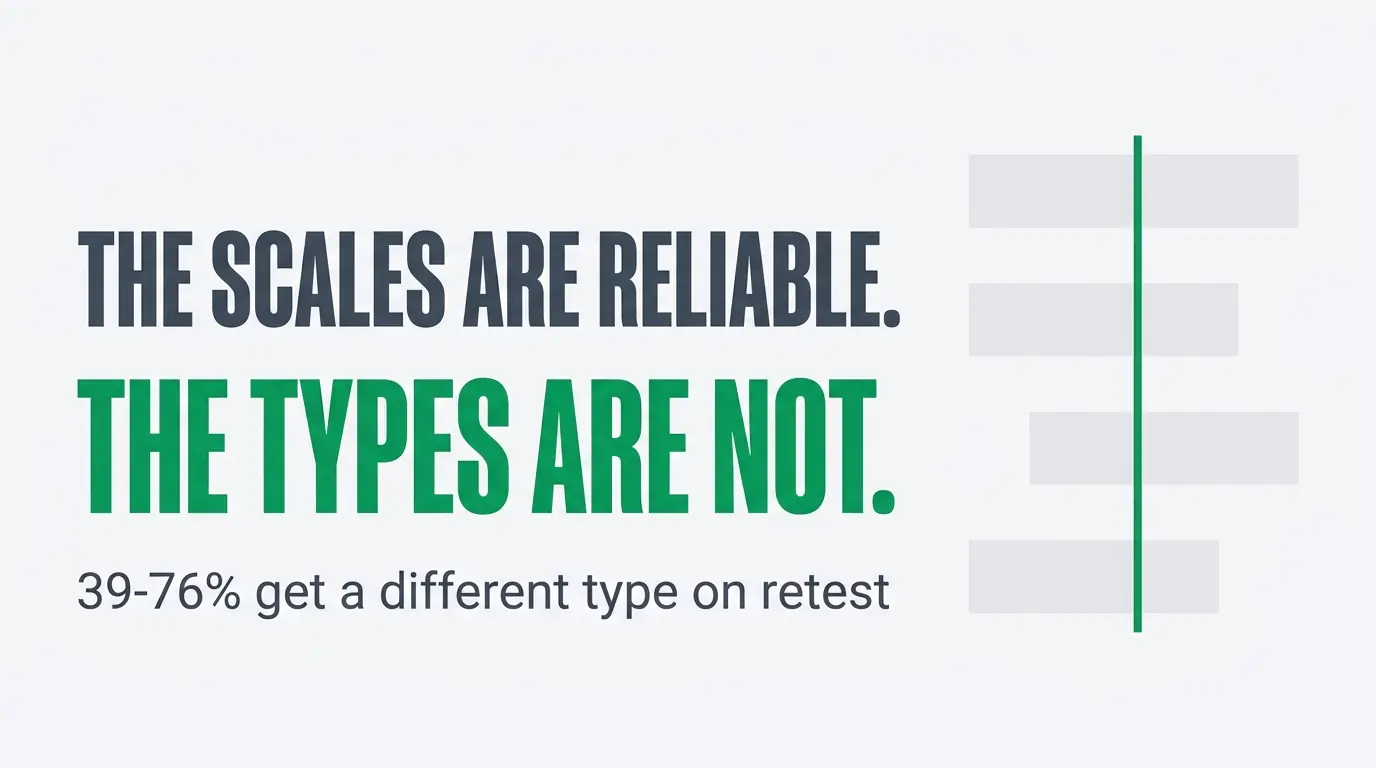
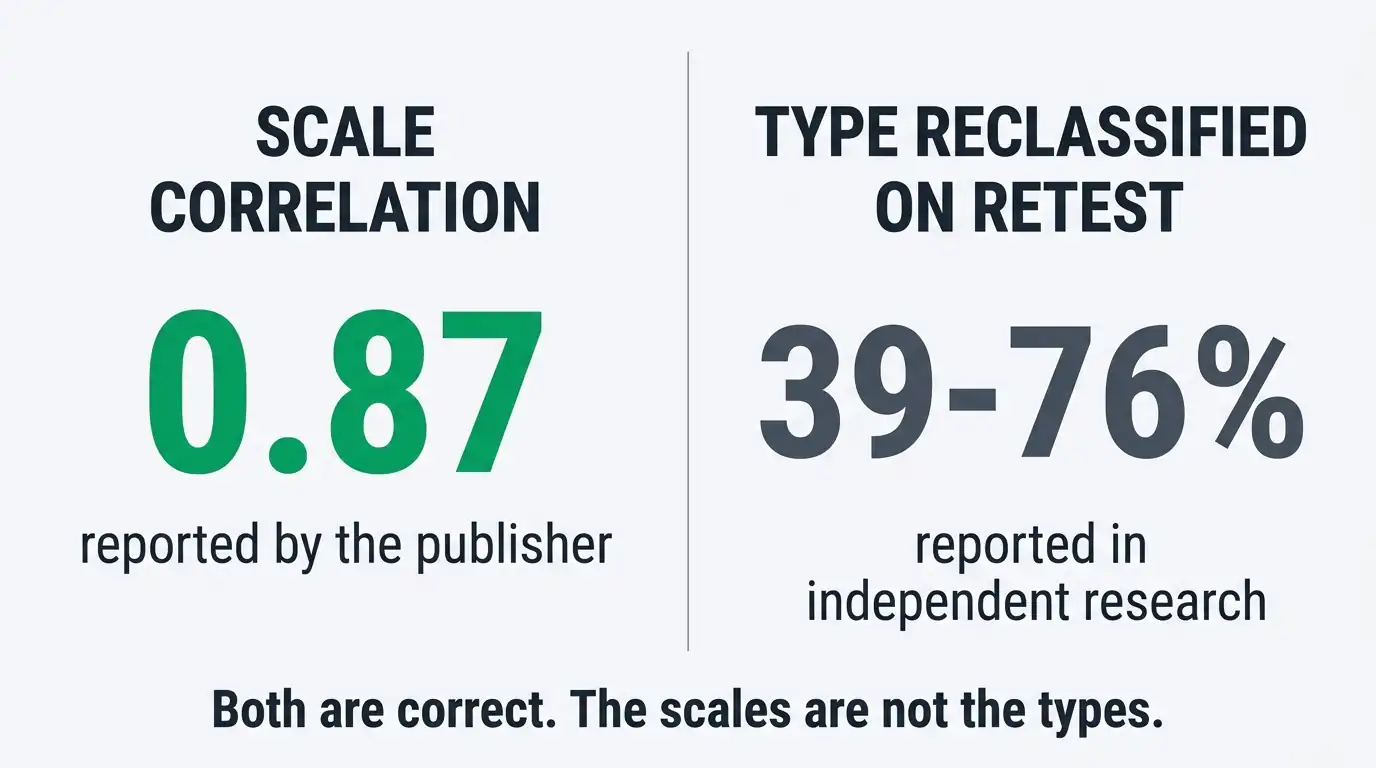
Psychologist David Pittenger reviewed the MBTI literature and reported that roughly half of people get a different four-letter type when retested about five weeks later. Across the wider body of independent research he surveyed, the reclassification rate ranged from 39% to 76%.
Five weeks. Your personality did not change in five weeks. The measurement did.
Now, here’s the part most critiques skip, and it’s the part that makes the whole thing make sense.
The Myers-Briggs publisher is also right. The Myers-Briggs Company reports test-retest correlations averaging around .87 across the four scales for recent versions of the instrument. That’s a solid number, and it isn’t spin.
Both things are true at once, and the reason is the design.
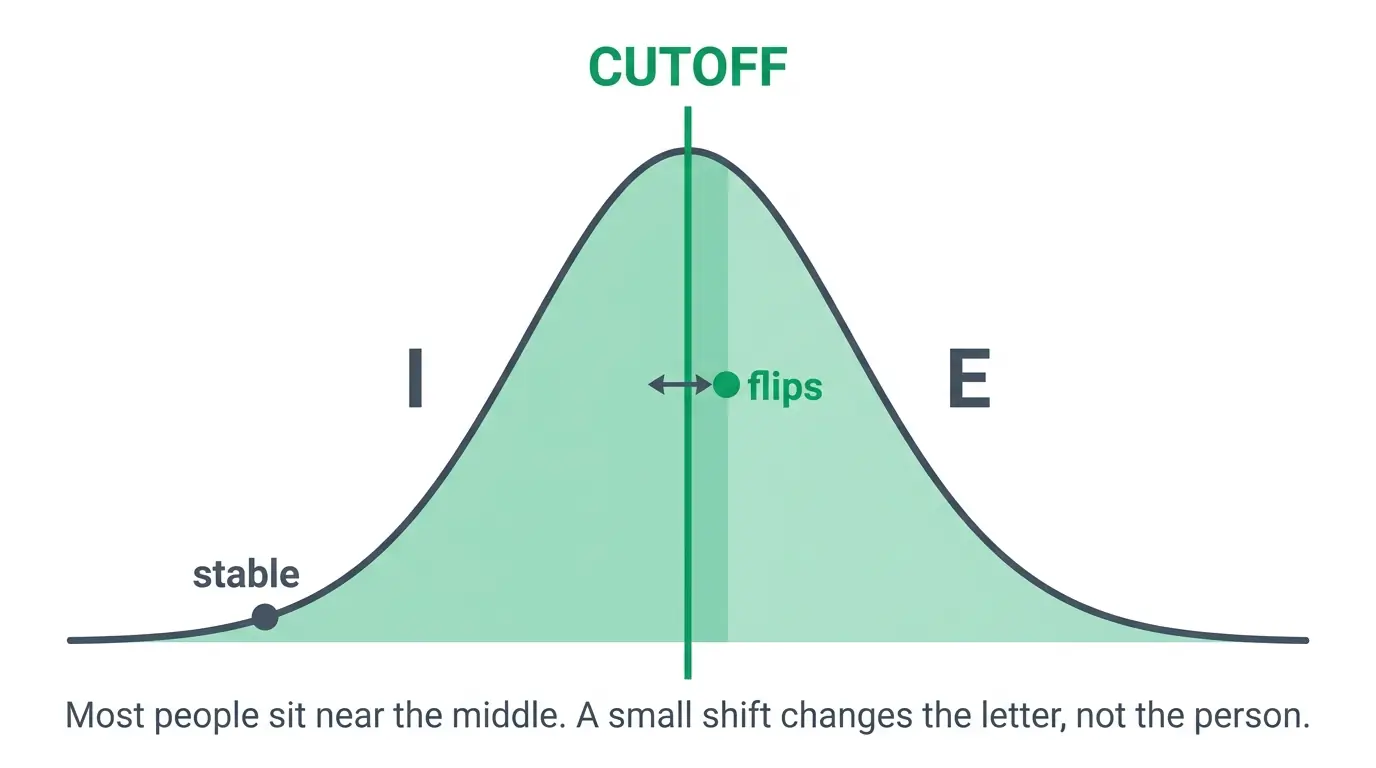
Each of the four MBTI scales measures something continuous – how strongly you lean one way – and then cuts that distribution near the middle to produce a letter. If you land far from the cut, your letter is stable. If you land near it, which a great many people do, a small amount of ordinary measurement noise pushes you across the line and your letter flips. The underlying score barely moved. The category moved completely.
So the scales are reliable and the types are not. The instability isn’t a flaw in the questions. It’s what happens when you take a spectrum and force it into a box.
That’s also why the same person can come out ISTP on one MBTI-style test and INTJ on another. Different implementations put their cutoffs in different places and word their questions differently. There’s no referee. You’re left holding two results and no method for deciding between them.
Why It Still Feels Accurate
If the types are that unstable, why does almost everyone read their profile and feel seen?
Partly because the descriptions are well-written and mostly flattering. But mostly because of something psychologist Bertram Forer demonstrated in 1949: people rate vague, broadly applicable personality descriptions as highly accurate portraits of themselves specifically. Forer gave his students what they believed were individual personality assessments, all of them actually identical, and they rated the accuracy at about 4.3 out of 5.
Read an MBTI profile carefully and you’ll find statements that almost nobody would reject. You value close relationships but need time alone. You can be decisive but sometimes second-guess yourself. True of you. Also true of most people reading it.
This isn’t a reason to sneer at anyone who found their type meaningful. Recognition is a real experience and it can genuinely prompt useful reflection. It just isn’t evidence that the categorization is correct, and it certainly isn’t evidence the attached career list applies to you.
The feeling of accuracy and the fact of accuracy are two different things. MBTI reliably delivers the first.
What the Career Research Found
On the specific question of using MBTI to guide career choices, the evidence has been examined directly.
In 1991 the National Academy of Sciences convened a committee to review the research on techniques for enhancing human performance. Its report, In the Mind’s Eye, concluded there was not sufficient, well-designed research to justify using the MBTI in career counseling programs.
The committee’s objections were specific rather than rhetorical. Types overlapped so heavily across occupations that knowing someone’s type barely narrowed the field. The research base paid little attention to normative data. And – the one that should settle it – no evidence had been presented linking type to actual performance in those occupations.
Three decades later, that hasn’t been overturned. Meta-analytic work continues to find type showing little to no relationship with job performance, and only a weak relationship with which occupation people end up in.
Which is worth pausing on. Every “best careers for your type” list you’ve read is built on a link that the research has repeatedly failed to find.
The Deeper Failure: It Never Produces a Decision
Everything above is psychometrics. Here’s the practical version, which matters more.
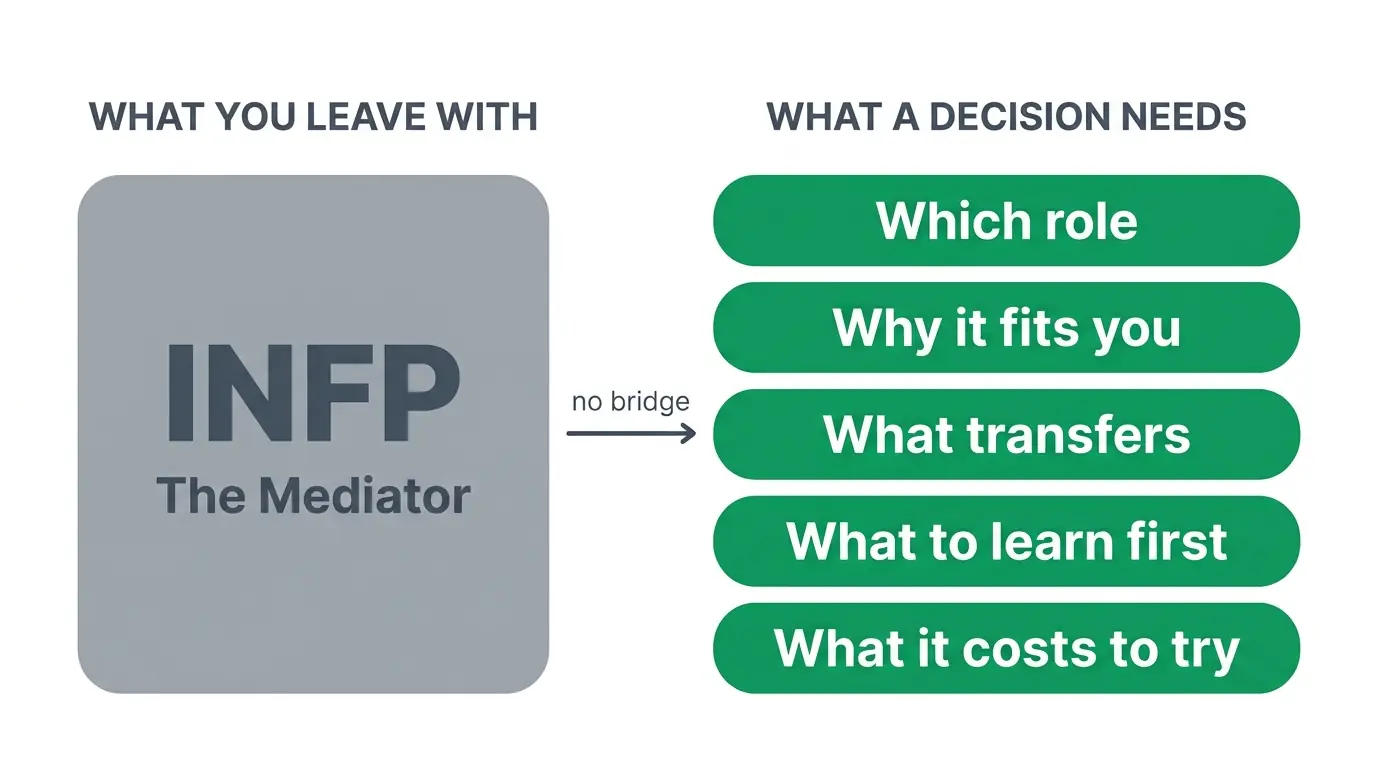
MBTI hands you an identity, not a decision. You learn you’re an INFP. You read that INFPs suit counseling, writing, and nonprofit work. And then – what, exactly? You still don’t know whether to leave your job. You don’t know whether the counseling route is worth three years of retraining at your age with your savings. You don’t know whether the version of “writing” that pays is the version you’d enjoy.
You have a category and a career list, and no bridge between them and your actual life.
Worse, the framework has no mechanism for being wrong. If the career list doesn’t appeal to you, there’s no procedure for revising the result – you’re told you might have mistyped, so you retake it, possibly get different letters, and start again. A framework that can’t be falsified can’t correct you. It can only keep describing you.
This is where people end up genuinely stuck. Not wrong about themselves, exactly. Just holding an answer to a question they weren’t asking, with no way to convert it into a Monday morning that looks different from the last one.
Confusion and no answer is a bad place to leave someone who came to you because they were confused and wanted an answer.
What MBTI Is Genuinely Good For
Being fair about this matters, and the wholesale dismissal you see online is its own kind of sloppiness.
MBTI works well as shared vocabulary. Teams that have a common language for “I need to think before I talk” versus “I think by talking” communicate better, and it barely matters whether the underlying categories are psychometrically sound.
It works as a prompt for self-reflection. Reading a description and noticing which parts feel wrong is a legitimately useful exercise. Sometimes the disagreement teaches you more than the agreement.
It works as an entry point. Plenty of people first became curious about how personality shapes work through MBTI, then went looking for something more rigorous. That’s a real contribution.
What it doesn’t support is consequential decisions – which career to pursue, and certainly who to hire. On that last point the publisher agrees: The Myers-Briggs Company explicitly advises against using the instrument for hiring or selection. If an employer ever screens you on a four-letter code, they’re using it against their own vendor’s guidance.
Use it for conversation. Don’t use it for commitments.
What to Use Instead
If you want the same self-knowledge with something behind it, two things do the job MBTI is usually asked to do.
Trait measures – the Big Five – keep the scores continuous instead of cutting them into categories. You come out as somewhat above average in conscientiousness, not as a Conscientious Person, which is both more accurate and more useful. Openness, conscientiousness, extraversion, agreeableness and neuroticism have decades of evidence linking them to job performance and job satisfaction, and they stay reasonably stable across adult life. The Big Five career guide covers what each trait means for work.
Interest measures – Holland codes, RIASEC – were designed for career matching from the start and produce output that maps directly onto real occupations.
They pair well, and neither is a replacement for the other. Big Five vs MBTI vs Holland codes works through which one answers which question and how to stack them. If you want the broader view of what actually predicts fit, the most accurate career test covers what the evidence supports and what no assessment can do.
And a caution that applies to all of them, Big Five included: a trait profile is still just a description. It’s better-founded than a type, but on its own it has the same problem – it tells you about yourself without telling you what to do. The value is in what gets built on top of it.
How CareerSeeker Handles This
CareerSeeker’s analysis runs on Big Five rather than type, for the reasons above: continuous scores don’t flip, and the evidence linking traits to work outcomes actually exists.
But the framework is the input, not the output. A trait breakdown by itself would leave you exactly where MBTI leaves you – accurately described, still undecided.
The quiz takes about ten minutes and needs no account. The Start report gives you the diagnosis: the pattern running through your answers, the tension you’re carrying, and one direction worth taking seriously. The Pro report is the part MBTI has no equivalent of – three ranked career recommendations with fit scores, each with why it suits you specifically, which of your existing strengths transfer, what you’d need to learn, what a day in that role actually looks like, and the likely obstacles with how to handle them. It includes a section on paths that look like a fit but aren’t, with the honest reason why. And it includes a full Big Five breakdown where every trait is rated with a confidence level and explained from your own answers, not from a stock profile.
That’s the difference worth caring about: not which framework sits underneath, but whether you finish with a decision or just a label. See what the reports contain.
Key Takeaways
- MBTI’s four scales are reasonably reliable, but the four-letter type is not – roughly half of people are reclassified on a retest about five weeks later, and independent studies range from 39% to 76%.
- The cause is structural: each scale is cut near the middle, so anyone scoring near the cutoff flips category on ordinary measurement noise.
- Profiles feel accurate largely because of the Forer effect – broad descriptions read as personal. Feeling accurate and being accurate aren’t the same thing.
- The National Academy of Sciences found insufficient evidence to justify MBTI in career counseling in 1991, and the link between type and job performance still hasn’t been established.
- MBTI is useful as team vocabulary and as a reflection prompt. It shouldn’t drive career commitments, and its own publisher says not to use it for hiring.
- Trait and interest measures do the job better, but any framework only earns its keep once something is built on top of it.
A description you recognize isn’t a decision you can make. MBTI is very good at the first thing. It was never built for the second.
Frequently Asked Questions
Partly. The four scales measure something real and correlate reasonably well on retest. The sixteen types have weak support – the categories don’t predict job performance, and the boundaries between them are statistical artifacts rather than natural divisions. Validity depends entirely on which claim you’re testing.
Almost certainly because you score near the midpoint on at least one of the four scales. The test converts a continuous score into a letter by cutting the distribution near the middle, so scores close to that line flip between tests while the underlying score barely moves. It’s a scoring artifact, not a change in you.
Almost certainly because you score near the midpoint on at least one of the four scales. The test converts a continuous score into a letter by cutting the distribution near the middle, so scores close to that line flip between tests while the underlying score barely moves. It’s a scoring artifact, not a change in you.
As a conversation starter, it’s harmless. As the basis for a decision involving retraining, relocation, or a pay cut, no – the research linking type to occupational performance has repeatedly come up empty. Use a trait or interest measure for anything you have to live with.
No. Three of the Big Five traits correlate with MBTI scales, so there’s overlap in what’s being measured, but Big Five keeps scores continuous, includes emotional stability (which MBTI has no equivalent of), and was built from statistical analysis of how personality language actually clusters rather than from a theory applied downward.
Yes. For giving a team shared language about working styles, for prompting reflection, and as a first doorway into thinking about personality and work. The failure is specifically in using it to predict outcomes or make selections, which is also what its publisher advises against.
From Description To Decision
Four letters describe you. They don’t tell you which role to aim at, what transfers from the work you’ve already done, or what it would cost to try. CareerSeeker’s quiz takes about ten minutes, runs on traits rather than types, and ends with three ranked careers and the reasoning behind each one.