

Best AI Career Tests in 2026: 6 Tools Compared
Type “AI career test” into Google and almost every result makes the same promise: about ten minutes, a few dozen questions, careers that fit you.
We took the free tests on October 2026, and timed them. They took between 5 and 24 minutes. Some showed named careers for free; others locked them behind a payment. One asked for an email inside its AI chat. One stopped working halfway, after asking about ethnicity and parents’ income.
So the promise is similar. What each test asks from you, and what you get back, is not.
We compared six AI career tests on the things that decide which one is right for you: the kind of questions, how personal the result is, what you have to share, and how long it takes.
We make CareerSeeker, one of the six. Every fact about the other tools comes from their own site and from taking their free test on October 2026, so you can check each claim yourself.
The short answer
For career suggestions that are about you, not about the boxes you ticked, we recommend CareerSeeker. It asks mostly written questions, reads how you write as well as what you write, and needs no account or email. In our tests, every other tool that reached a result gave suggestions that were generic or far from what we had told it. None of them asked us to agree to terms or a privacy policy first.
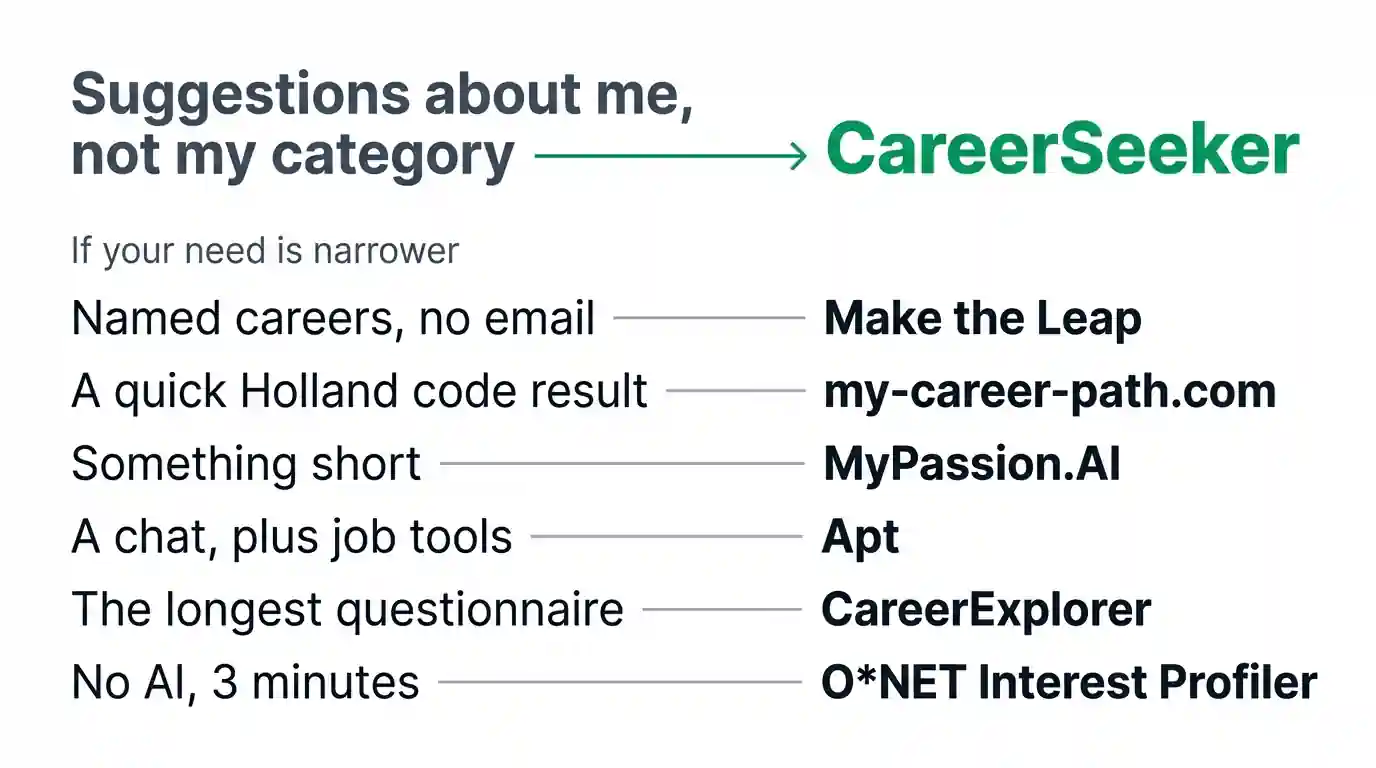
If your need is narrower, another tool may fit:
- You want named careers in the free result: Make the Leap.
- You want a quick Holland code (RIASEC) result with no sign-up: my-career-path.com.
- You want a short multiple-choice quiz and don’t mind giving an email: MyPassion.AI.
- You prefer a chat with an AI and plan to pay for job-search tools: Apt.
- You want the longest questionnaire and are fine sharing family details: CareerExplorer.
And if you don’t want AI at all, the US government’s O*NET Interest Profiler takes about 3 minutes and works as a neutral baseline.
What is an AI career test?
An AI career test is a career quiz where an AI model reads your answers and suggests careers, instead of a fixed scoring key. A classic test adds up points and returns the list for your category. An AI test looks at the whole pattern of your answers, so two people in the same category can get different results.
That difference matters most when your answers don’t fit a type. “I like writing” plus “I hate working alone” sends a classic test toward “writer.” An AI reading the same answers can see that the second fact changes the first, and suggest something like content strategy or communications work instead.
The AI is only as good as the answers it gets. Multiple-choice answers are quick to give but carry little detail. In our test of my-career-path.com, choosing “I like working with data” put accountant at the top of the list. The answer could not say which kind of data, or what we wanted to do with it. Written answers about past jobs, values, and what you want from work give the model much more to read. That’s why the tools below differ so much, even though they all say “AI.”
Think of two career counselors. The first hands you a form with boxes to tick, goes to make coffee, and reads the totals when you’re done. The second asks you questions and listens: to what you say, how you say it, and what you leave out. A multiple-choice test works like the first counselor. Written answers make the second one possible. Of the five other AI tests we took, none asked us to say in our own words what we enjoy doing.
If you want to know which classic frameworks hold up best, we cover that in the most accurate career test, and how they differ in Big Five vs MBTI vs Holland codes.
AI career tests compared
Competitor facts come from our tests on October 5, 2026. “Stated time” is what each tool’s own page says; “our time” is what it took us.
| Tool | Stated time | Our time | Questions | Email or account | Best for |
|---|---|---|---|---|---|
| Apt | ~10 min | 24 min | About 40, in an AI chat | Email, asked in the chat | A chat-style test plus a job-search subscription |
| CareerExplorer | ~30 min | Could not finish | Long; measures 150+ traits | Name, email, and birth date, asked mid-test | The longest questionnaire |
| CareerSeeker | ~10 min | Our own tool | 25, mostly written, some multiple choice | None | Suggestions built from who you are |
| Make the Leap | ~10 min | 20 min | 40+, mostly multiple choice | Email, to see the result | Named career paths, free |
| my-career-path.com | 10–15 min | 5 min | 5 sections, all multiple choice | None | A quick Holland code result |
| MyPassion.AI | Under 10 min | 6.5 min | 26, mostly multiple choice | Email, to see the result | A short quiz with an archetype result |
Tools are listed alphabetically.
Why Google Career Dreamer is not in the table. It often appears in lists like this one. Google describes it as an experiment for users in the US.
Best AI career test by situation
Here is the reasoning behind each pick, so you can check whether your situation matches.
You want career suggestions that are about you. Our pick: CareerSeeker. It starts from the Big Five personality model, then asks mostly written questions about past jobs, values, skills, and what you want from work. The AI reads both what you write and how you write it, so two people who would tick the same boxes still get different reports. You don’t create an account or give an email, and you agree to the terms and privacy policy before your answers are sent. An optional question on neurodivergent traits is taken into account in the analysis.
You want named careers in the free result. Make the Leap’s free result named three career paths with income ranges, after you give an email. The cost is time: 20 minutes in our test, twice what its page states, with no progress bar to show how many questions are left.
You want a quick Holland code result. my-career-path.com took 5 minutes, needed no sign-up, and showed a RIASEC profile, three career types, and three careers. Every question is multiple choice, so the careers follow your Holland code more than your situation.
You want something short and don’t mind an email. MyPassion.AI took under 7 minutes. You give an email to see the result, and the career names are in the paid reports.
You like talking to an AI and want job-search tools. Apt runs the whole test as a chat, about 40 questions in our test. The free preview showed personality labels and 2 of 10 career titles; the full list comes with a subscription that also covers resume, interview, and job tools.
You want the longest questionnaire. CareerExplorer states about 30 minutes and measures more than 150 traits. It also asks for more personal data than any other tool here, and in our test it stopped working before the final result.
The tools, one by one
Apt
Apt is an AI career test run as a chat: about 40 questions and 24 minutes in our test, with full results in a subscription.
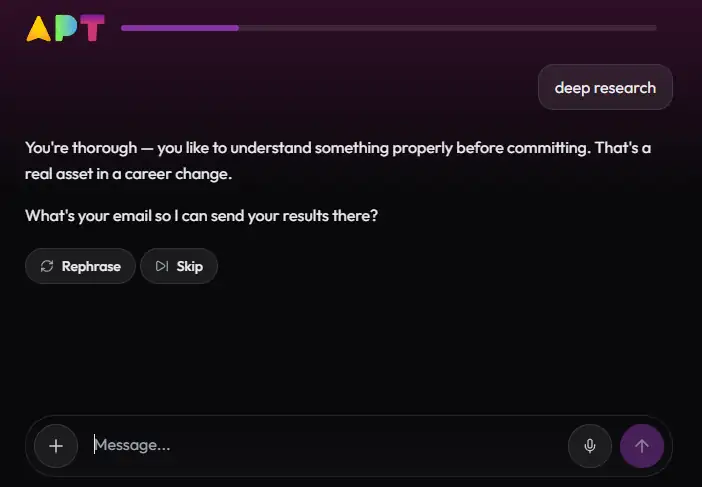
Apt’s page says about 10 minutes and mostly multiple choice. In our test, the whole test was a conversation with an AI. Partway through, the chat asked for our email, so the email is typed into the same conversation the AI processes. The chat also offered to read a CV or LinkedIn profile (optional); we did not see an explanation of how that data is used. We were not asked to accept terms or a privacy policy before the chat.
The free preview showed personality labels from four frameworks (Big Five, MBTI, Enneagram, and DiSC) with one short paragraph about them, plus 2 of 10 career titles. It also listed five jobs in the country we named, with match scores from 80% to 90%. In our test, the suggestions were far from what our answers described, and none of them felt personal. The rest of the career list is locked, and the paid offer came with a countdown timer. Career results, along with Apt’s resume, interview, and job tools, are part of a monthly, quarterly, or annual subscription.
Fits you if you prefer a conversation to a form and plan to pay for job-search tools anyway.
CareerExplorer
CareerExplorer is a machine-learning career test that states about 30 minutes and scores 150+ traits using Big Five and Holland codes.
CareerExplorer is older than most AI tools here. It trains its matching on a large set of past responses and draws career data from O*NET and the US Bureau of Labor Statistics. Its page says matches and reports are free.
Partway through, it asks for your name, email, and date of birth (or a Google sign-in) before you can continue. Other questions ask about your gender, ethnicity, past jobs, and your parents’ income and education. CareerExplorer states it does not use race or gender to generate matches. Under EU privacy law (GDPR), ethnicity is sensitive data with stricter rules for collecting it. We were not asked to accept terms or a privacy policy before these questions.
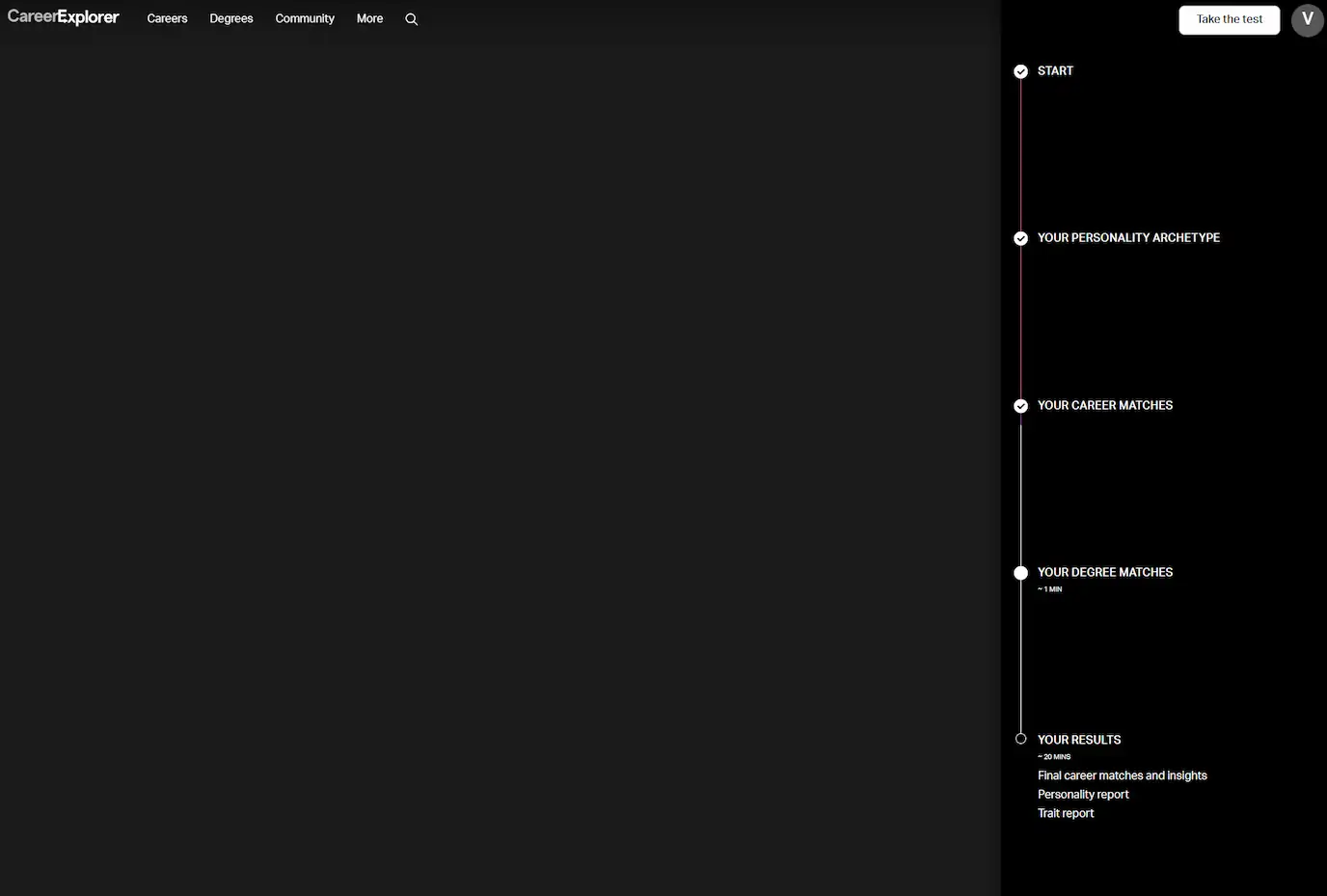
In our test, the page went blank after about 20 minutes, past the career-matches step. Reloading later did not bring the test back, so we could not see the final result.
Fits you if you want the longest questionnaire and are comfortable sharing demographic and family details.
CareerSeeker
CareerSeeker is an AI career test built on the Big Five personality model: 25 questions, about 10 minutes, no sign-up.
The questions cover your personality, what you liked and disliked in past jobs, your skills and interests, and what you want from work. The personality section is multiple choice; most other questions ask you to write a few sentences.
The AI reads those written answers the way a good counselor listens. It looks at what you say and at how you say it: your word choice, your tone, the emotions that come through, and what you describe in detail or leave out. So the report is built from your own words, not from the category your clicks fall into.
An optional question covers neurodivergent traits such as ADHD, autism, or high sensitivity, and the analysis takes them into account.
Before you send your answers, you agree to the terms and privacy policy. You don’t create an account or give an email, and answers are not used to train AI models. Results stay available for 7 days and can be saved as a PDF.
The free report shows your strengths, how your personality shapes the way you work, and one career direction to explore. Paid plans add ranked career matches with transition plans and a follow-up AI chat, available in 10 languages. They are a one-time payment per test, not a subscription (plan details).
Fits you if you want career suggestions that come from who you are, not from the boxes you ticked.
Make the Leap
Make the Leap is an AI career test that gives three named career paths with income ranges for free, after you give an email.
Its page says 30 questions, mostly written, in about 10 minutes. In our test it was more than 40 questions, mostly multiple choice, and took 20 minutes. There is no progress bar, so you don’t know how many questions are left. Some questions ask about your own project or business: a link to it, what you offer, and at what price.
The free result includes three career paths with income ranges, a short profile of how you work, and one free refinement if a path feels wrong. You give an email to see the result. After we did, we received emails selling the paid report, though we had not agreed to marketing. We were not asked to accept terms or a privacy policy before answering.
Fits you if you want named careers in the free result and have 20 minutes.
my-career-path.com
my-career-path.com is a Holland code (RIASEC) career test with an AI summary: 5 minutes in our test, no sign-up, all multiple choice.
The test has five sections: interests, work style, scenarios, skills, and visual picks. The free result shows your RIASEC profile, your top three career types, and three recommended careers. An account is only needed to save results, and two paid reports add more detail.
Because every question is multiple choice, the careers follow your Holland code closely, as the accountant example above shows. We were not asked to accept terms or a privacy policy.
Fits you if you want a fast Holland code result and plan to explore careers on your own from there.
MyPassion.AI
MyPassion.AI is a 26-question AI career quiz, under 7 minutes in our test, that maps you to one of 20 archetypes.
Most questions are multiple choice and change based on earlier answers, plus one location question and one open-text question. Careers come from the 867 occupations the US Bureau of Labor Statistics tracks. The quiz offers to read your CV (optional); we did not see an explanation of how the file is used.
You need to give an email to see the result. The free result showed our archetype (“The Impact Driver”). Career names are in the paid reports, which were offered with a countdown timer. In our test, the free report mostly repeated our multiple-choice answers back as statements about us. After we gave our email for the result, we also received a marketing email, though we had not agreed to marketing.
Fits you if you want a short quiz and an archetype label, and don’t mind giving an email.
Not AI, but worth knowing: O*NET Interest Profiler
The O*NET Interest Profiler is a free US Department of Labor test: 30 questions, about 3 minutes, no account, scored on six Holland types.
It doesn’t use AI and doesn’t measure personality or how you work, only which activities interest you. The result shows your scores on the six RIASEC types and links to matching occupations in O*NET. Because it is short and neutral, it is a useful baseline to compare other results with.
Fits you if you want a quick, free second opinion on your interests.
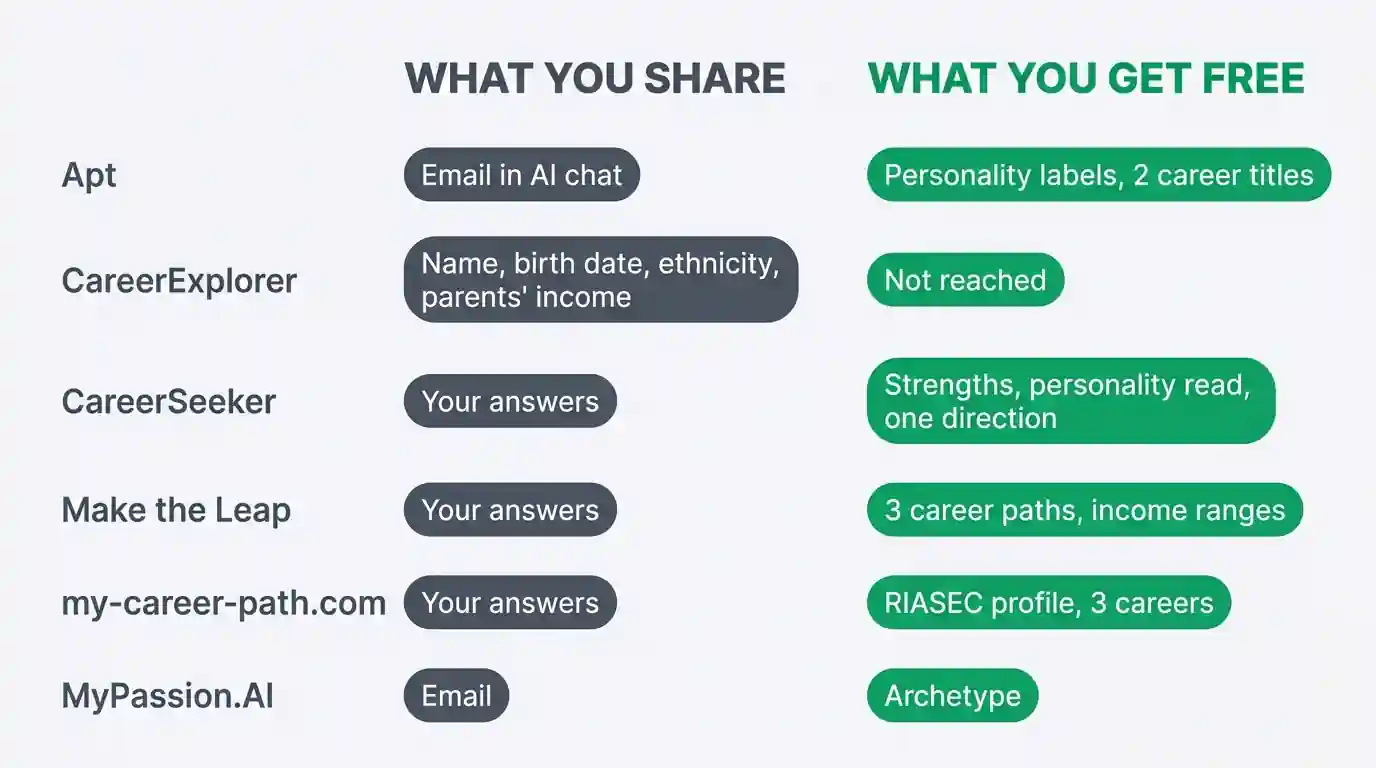
What each AI career test asks for, and what you get free
“Free” means something different on each tool. This is what you get before paying, and what you share to get it.
| Tool | Free result | What you share | Asked to accept terms and privacy policy | Paid upgrade |
|---|---|---|---|---|
| Apt | Personality labels, 2 of 10 career titles, 5 job listings, not matched to our answers | Email (typed in the AI chat); CV or LinkedIn optional | No | Subscription |
| CareerExplorer | Not reached (test stopped) | Name, email, birth date; gender, ethnicity, parents’ income and education | No | Not reached |
| CareerSeeker | Strengths, personality read, one career direction | Your answers | Yes, before you send answers | One-time, per test |
| Make the Leap | 3 career paths with income ranges, work profile | Email; your answers, including business details | No | One-time, two tiers |
| my-career-path.com | RIASEC profile, 3 career types, 3 careers | Your answers (account only to save) | No | Two paid reports |
| MyPassion.AI | Archetype | Email; CV optional | No | One-time, two tiers |
| O*NET Interest Profiler | 6 interest scores, matching occupations | Your answers | – | None |
“No” means the test did not ask us to accept terms or a privacy policy before collecting answers or details, on October 5, 2026. A policy may still be linked somewhere on the site.
The biggest difference is not the result but the step before it. Check what a test asks you to share before you start. If you are in the EU, GDPR lets you ask any company what data it holds about you, and ask it to delete that data.
Can’t I just ask ChatGPT?
You can, and for some questions it works well. But a chatbot answers what you ask it. A career test asks you the things you wouldn’t think to mention: how you react under pressure, what drained you in your last job, what you need from the people around you.
Without that, a chatbot fills the gaps with averages, and the advice sounds right for almost anyone. We tested this in detail in Can ChatGPT replace a career test?
What to do with your results
A result is a starting point, not a decision. Three steps make it useful.
- Check the reasoning, not the job title. Read why a career was suggested. If the reason describes you accurately, the suggestion is worth exploring, even if the title surprises you. If it only repeats your answers back, look further.
- Compare two tools. Take one personality-based test and one interest-based test (for example, CareerSeeker and the O*NET Interest Profiler). Careers that appear in both are worth exploring first.
- Talk to one person in the job. A 20-minute conversation with someone who does the work will tell you more than any test about what a normal day is like.
If you want to understand the personality side first, our Big Five careers guide lists strong fits for each trait.
Frequently asked questions
For career suggestions built from who you are, we recommend CareerSeeker, our own tool. It asks mostly written questions on a Big Five personality base and needs no account or email. For narrower needs, Make the Leap gives named careers free after you give an email, and my-career-path.com gives a quick Holland code result.
They are as accurate as the model and the answers behind them. Tests built on researched frameworks like the Big Five or Holland codes give the AI a solid base. Written answers add detail that multiple-choice answers can’t. Treat any result as a suggestion to explore, not a verdict.
Yes. CareerSeeker and my-career-path.com showed a free result without an email or account in our test in October, 2026. Make the Leap shows three career paths and MyPassion.AI an archetype, both after you give an email. Apt’s free preview shows personality labels and two career titles; the full list needs a subscription.
CareerSeeker and my-career-path.com need neither. Make the Leap and MyPassion.AI ask for an email before showing results,, Apt asks for one inside its AI chat, and CareerExplorer asks for your name, email, and date of birth partway through the test.
Most ask only for your answers. Some also ask for an email (Make the Leap, MyPassion.AI, Apt) or offer to read your CV (MyPassion.AI, Apt). CareerExplorer asks for your name, email, birth date, gender, ethnicity, and your parents’ income and education. Check what a test asks before you start.
Most pages say about 10 minutes. In our test on October 5, 2026, they took 5 to 24 minutes: my-career-path.com 5, MyPassion.AI under 7, Make the Leap 20, and Apt 24. CareerExplorer states about 30 minutes. A longer test is not automatically more accurate.
A personality test describes you, for example as more introverted or more organized than average. An AI career test uses that kind of profile, adds your values, skills, and experience, and turns it into specific career suggestions. The personality profile is the input; the career direction is the output.
Conclusion
Every test promises about ten minutes. What you share, and what you leave with, is different on each one. Pick the test that answers the question you actually have.
If that question is “what kind of work fits who I am?”, start the CareerSeeker test. No account, no email, about 10 minutes.