

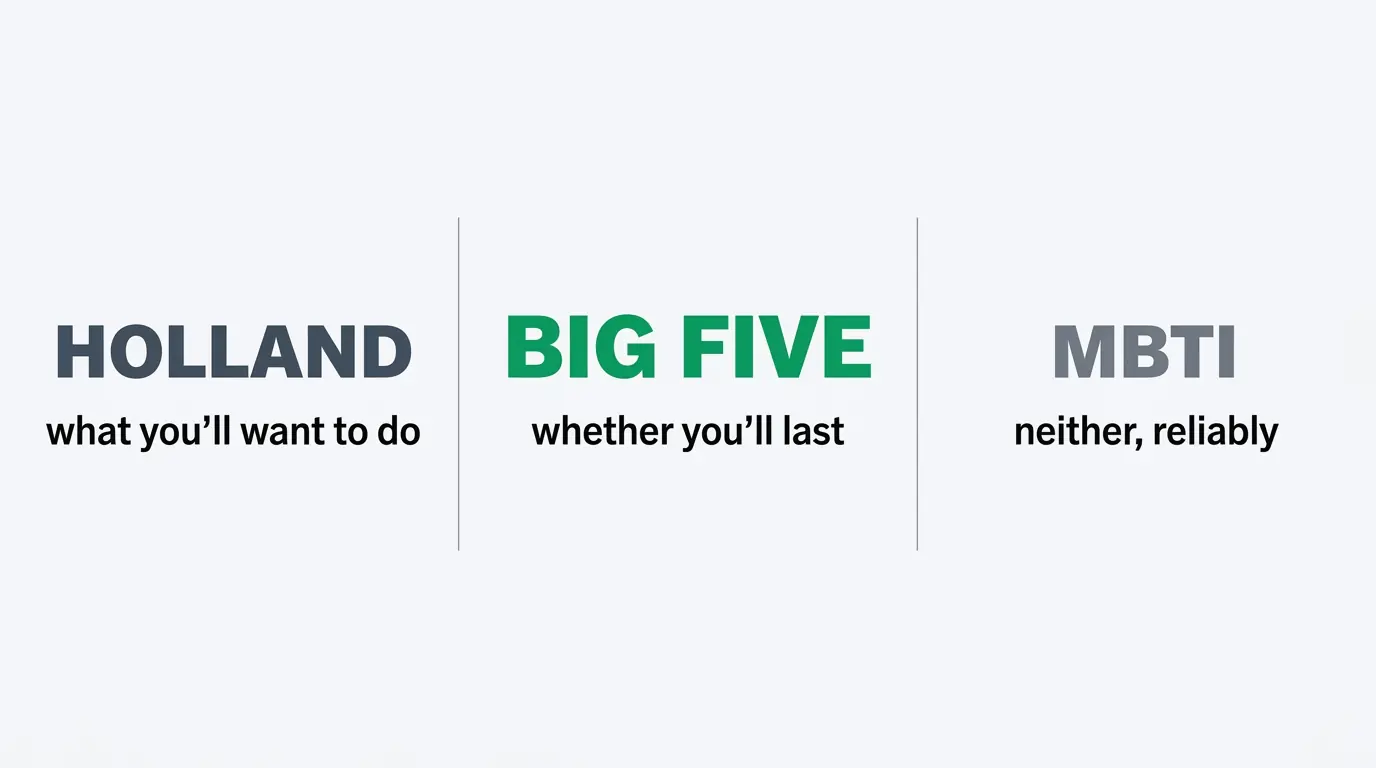
You can take all three of these in an afternoon. Big Five gives you five scores. Holland gives you three letters. MBTI gives you four letters and a nickname. Then you sit there holding twelve pieces of information about yourself, and you still don’t know whether to take the job.
That’s the real experience of comparing Big Five vs MBTI vs Holland codes, and it isn’t because the tests are bad. It’s because they answer three different questions, and nobody tells you which question you were asking.
This guide separates them by the question each one is built to answer, shows what the research actually supports for each, and gives you a rule for picking the one you need. There’s a clear winner for career decisions – but it’s narrower than most comparisons make it sound, and it isn’t the one with the biggest fanbase.
What Each One Actually Measures
Start here, because most of the confusion is definitional.
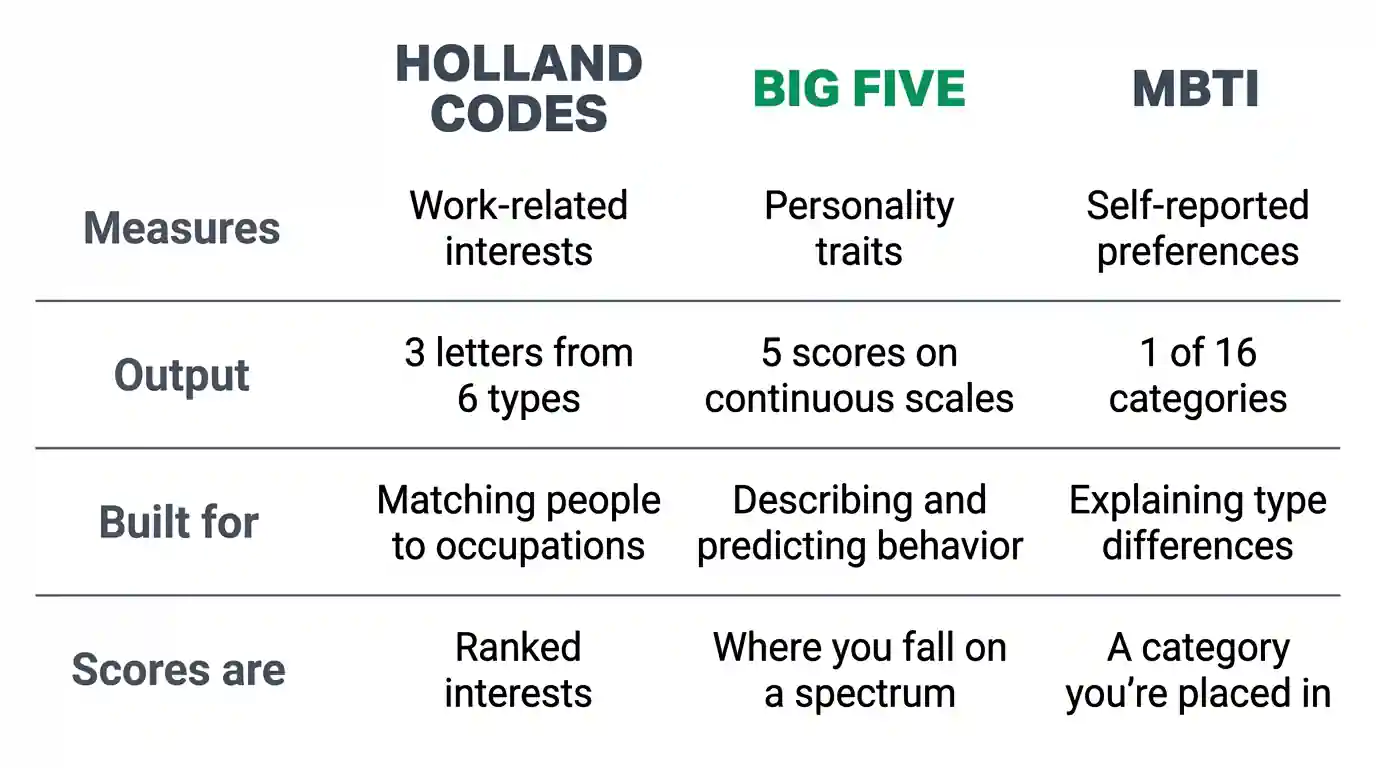
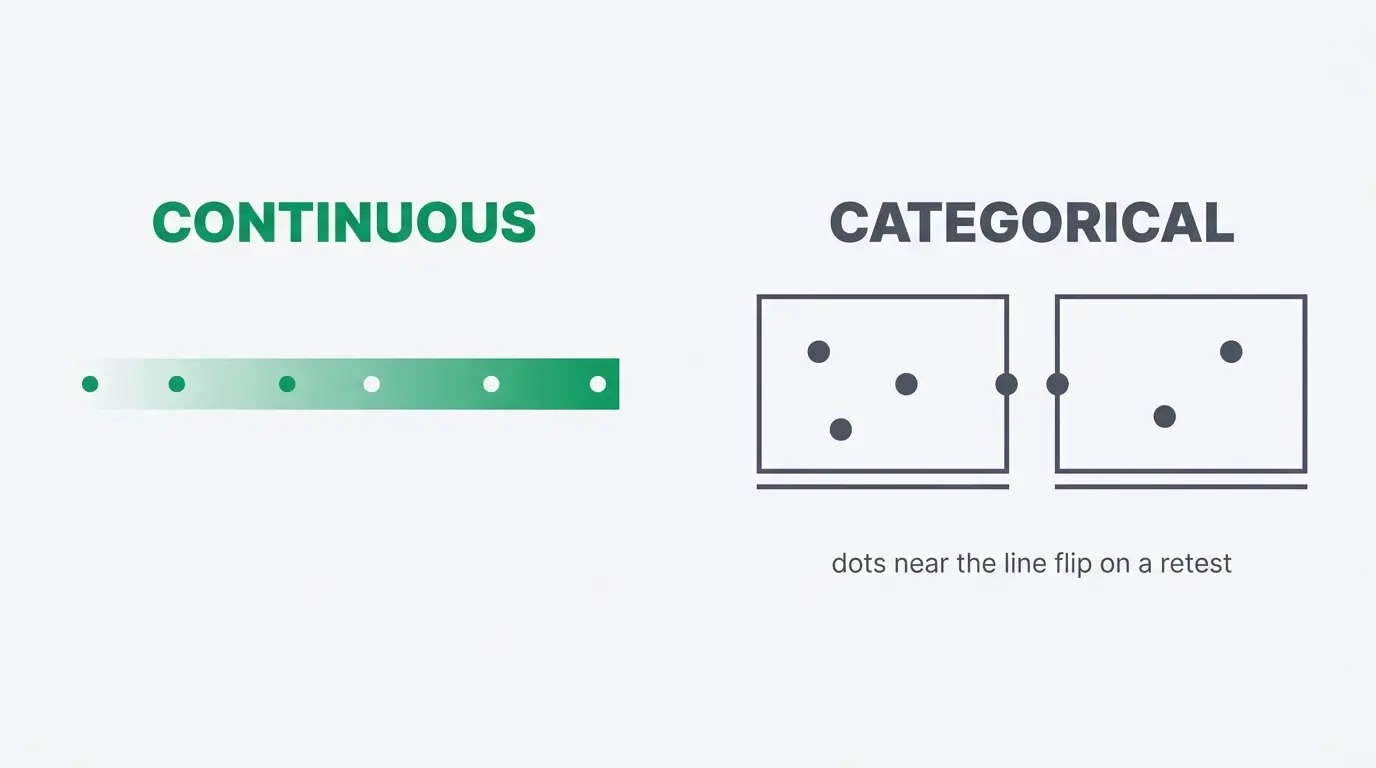
The structural difference at the bottom of that table matters more than anything else on it. Big Five and Holland both put you somewhere on a range. MBTI puts you in a box.
That sounds like a stylistic choice. It has consequences, and we’ll get to them.
The Three Questions
Strip the psychometrics away and each framework is trying to answer one thing.
Holland asks: what will I want to be doing all day? Six interest categories – Realistic, Investigative, Artistic, Social, Enterprising, Conventional – and your top two or three form a code. It was designed from the start to point at occupations, and the US Department of Labor’s O*NET Interest Profiler still runs on it.
Big Five asks: how will I behave, and will this still fit me in three years? Openness, Conscientiousness, Extraversion, Agreeableness, Neuroticism. It doesn’t name jobs. It describes tendencies that stay fairly stable across your adult life, which is exactly what you need when you’re committing years to something.
MBTI asks: which of sixteen types am I? Notice that this isn’t a career question. It’s a classification question. The career advice that gets attached to MBTI types was bolted on afterward, by other people, and that’s where most of the trouble starts.
What the Evidence Supports
This is where the three separate properly. Fair warning: the answer is less dramatic than “one is science and two are horoscopes.”
Big Five: strongest on predicting outcomes
The landmark work here is Barrick and Mount’s 1991 meta-analysis in Personnel Psychology. It found conscientiousness predicted job performance consistently across every occupational group they examined – professionals, police, managers, sales, skilled and semi-skilled work. Extraversion predicted performance specifically in roles built on social interaction, like sales and management.
Those relationships are real but modest. Conscientiousness came in around r = .13 across occupations in the original study, with later work putting corrected estimates nearer .20. That’s a low-to-moderate effect, not a crystal ball. What it means in practice: traits shift the odds, they don’t determine the outcome.
Holland: strongest on pointing you somewhere
Nye, Su, Rounds and Drasgow’s 2012 meta-analysis pulled together more than sixty years of research on whether interests predict performance. They do – modestly on their own, and more strongly when you measure congruence, the fit between a person’s interests and the work they’re actually in. A 2017 update put congruence-performance around .32.
Holland’s advantage isn’t that the numbers are bigger. It’s that the output is directly usable. A three-letter code maps onto occupational databases. Five trait scores don’t.
MBTI: weakest exactly where you’d want it strongest
In 1991 the National Academy of Sciences reviewed the available research for its report In the Mind’s Eye and concluded there was not sufficient, well-designed research to justify using the MBTI in career counseling programs. The committee’s specific complaints were that types overlapped too much between occupations to discriminate usefully, and that no evidence had been presented linking type to performance in those occupations.
Later work didn’t rescue it. The deeper problem is that forcing continuous traits into binary categories throws away the information that made them predictive – and for a large share of people, produces a type that doesn’t hold still. Why MBTI gets careers wrong covers that mechanism properly, including what the instrument genuinely is good for.
The Two Halves of a Career Decision
Here’s the frame that makes the choice easy.
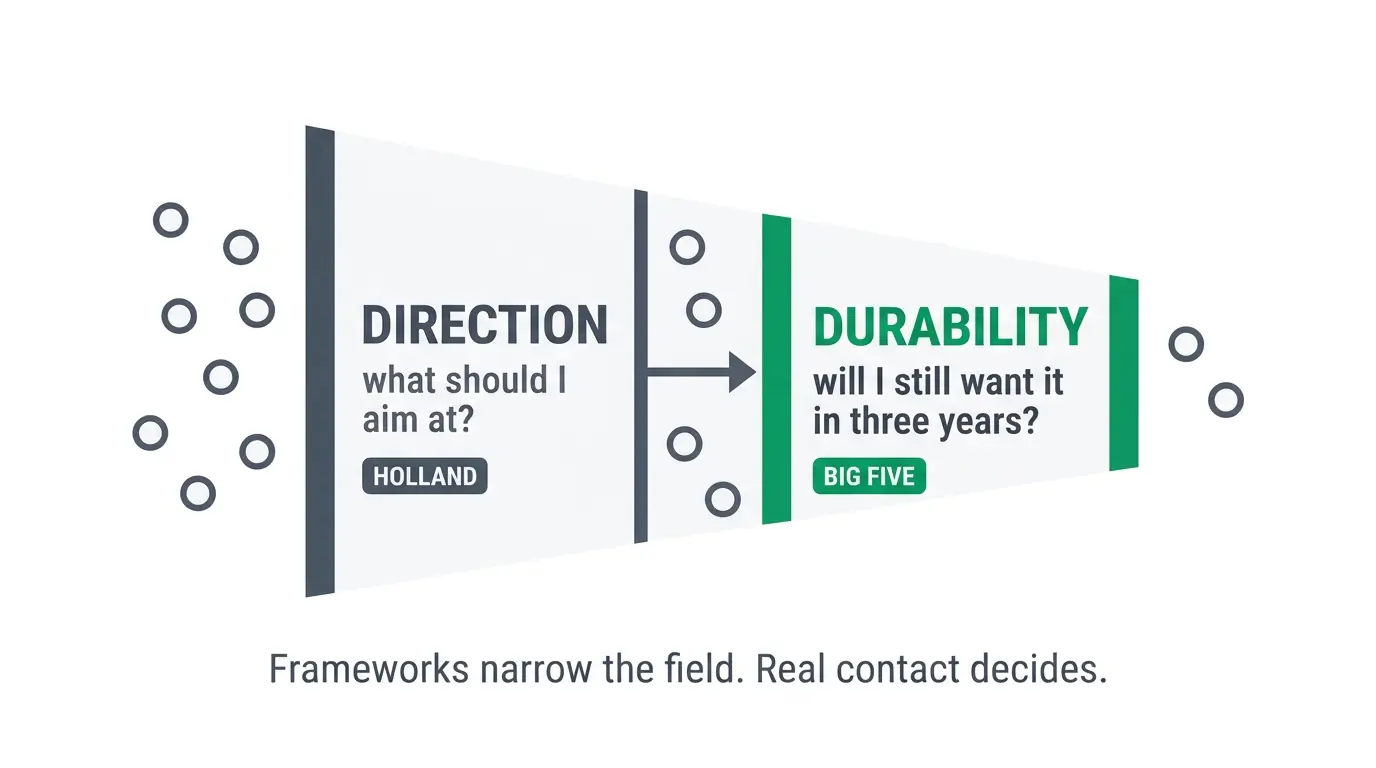
Any real career decision has two parts. Direction: what should I aim at? And durability: once I’m there, will I still want it in three years, on an ordinary Tuesday, when the novelty is gone?
Most people only consciously ask the first one. The second is what actually decides whether the move worked.
- Holland is built for direction. It converts a vague sense of “something else” into a shortlist of occupational families.
- Big Five is built for durability. It tells you whether a high-ambiguity, high-stakes, heavy-collaboration role is going to energize you or slowly grind you down.
- MBTI is not reliably built for either.
That’s the split verdict, and it’s the honest one. Anyone telling you Big Five is simply the best career test is overselling it – Big Five doesn’t name a single job. Anyone telling you Holland is enough on its own is skipping the part where two people with identical codes have completely different experiences in the same role.
Why Big Five Carries More Weight for Career Decisions
Given that split, we still lean on Big Five at CareerSeeker, and it’s worth saying why rather than asserting it.
Interests move. What you find fascinating at 24 is often not what you find fascinating at 38, and exposure changes them – people frequently develop an interest because they got good at something, not the other way round. Holland captures a snapshot of a moving target.
Traits move much less. The stability is the whole point. When you’re choosing something you’ll live inside for years, the more stable measure carries more of the weight, because it’s still describing you after the excitement of the switch wears off.
There’s also a practical asymmetry. Get the direction wrong and you find out in a few months of research and conversations – it’s recoverable and relatively cheap. Get the durability wrong and you find out two years in, after you’ve retrained, taken the pay cut, and rebuilt your network. That’s the expensive mistake, and traits are what predict it.
So: Holland to generate options. Big Five to stress-test them. If you only have the appetite for one, make it the second, because that’s the half most people skip.
Using Two of Them Together
The frameworks stack better than they compete. A worked example:
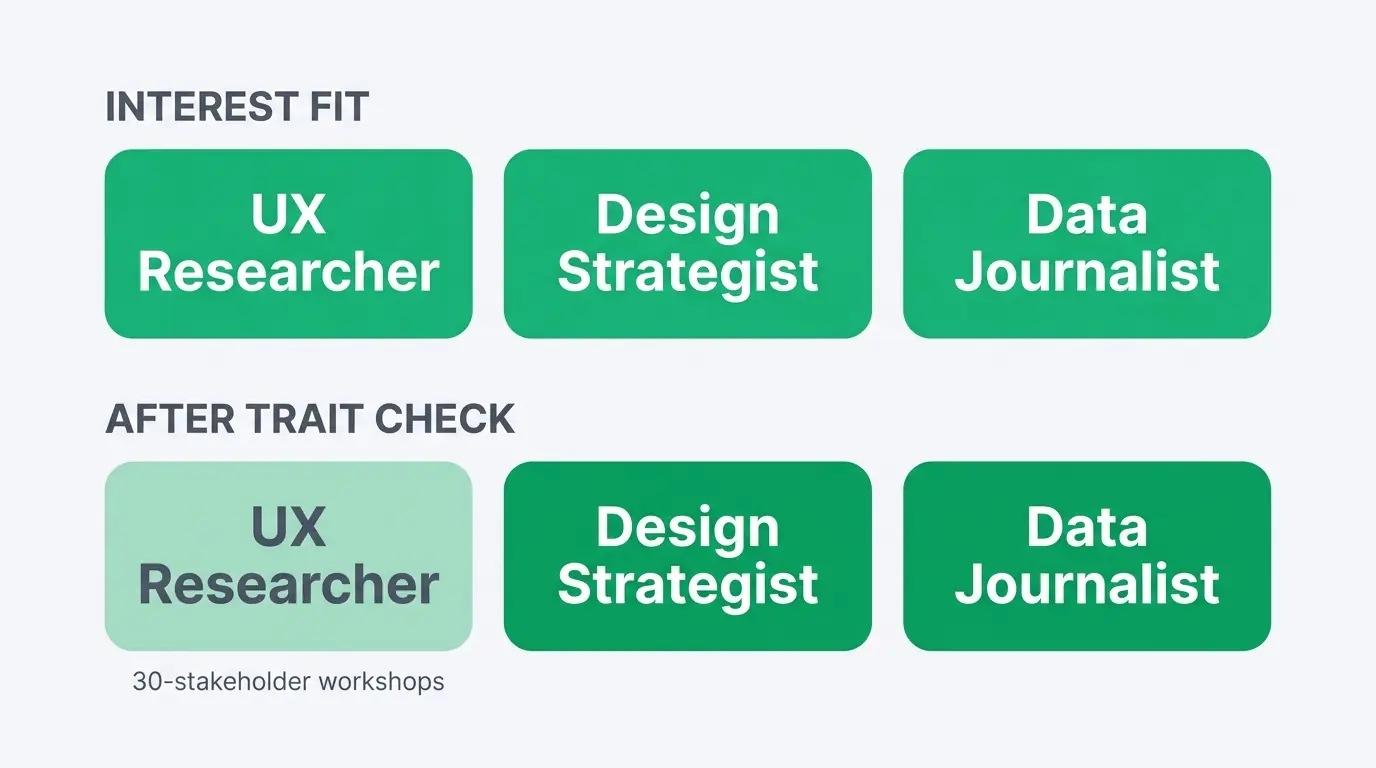
You come out Investigative-Artistic on Holland. That points at UX research, design strategy, data journalism, a cluster of roles where analysis meets making things. Good – you have a direction.
Now run Big Five over that shortlist. High openness means ambiguous briefs will suit you rather than frustrate you, which is most of what UX research is. Low extraversion means a role built on thirty-stakeholder discovery workshops will cost you more than the job description implies, even though the work itself fits. Same shortlist, very different recommendations inside it.
That second pass is the one that separates “this job matches my interests” from “I will still be doing this job in 2029.” Practically:
- Use Holland to build a shortlist of five to eight roles. Don’t filter yet.
- For each one, find out what the daily reality is – pace, how much of it is people, how much ambiguity, how much repetition. Job postings hide this; people doing the job will tell you.
- Check that reality against your traits, not your aspirations.
- Cut anything where the fit depends on you being someone you’ve never been.
Step four is where most shortlists get honest.
If you want the trait side in depth, the Big Five career guide works through each trait and the roles that suit it. For the interest side, Holland codes careers covers all six types and how the letter combinations behave.
What None of Them Do
Worth saying plainly, because every comparison of these three quietly implies that one of them will hand you an answer.
None of them measure ability. Wanting Investigative work and being good at it are unrelated facts. The test can’t tell you whether you’ll survive the training.
None of them know the job market. A perfect trait-and-interest match for a role that’s contracting in your city is still a bad move.
None of them account for your constraints. Money, dependents, visa status, how many years you can afford to earn less. These usually decide more than personality does.
None of them can see how you’d actually feel doing the work. Two weeks of real contact – shadowing, a side project, talking to five people who do it – will tell you more than any assessment. The tests are for narrowing what you bother to test.
A framework’s job is to cut a field of five hundred options down to five worth investigating. It was never supposed to pick one.
How CareerSeeker Uses This
CareerSeeker’s analysis runs on Big Five, for the reason in the section above: traits stay put, and the expensive career mistakes are durability mistakes.
The quiz takes about ten minutes and doesn’t ask you to create an account. The Start report gives you the diagnosis – the pattern running through your answers, the tension you’re carrying, and a direction worth looking at. The Pro report is the prescription: ranked career recommendations with fit scores, an honest section on the paths that look right for you but aren’t, and a full Big Five breakdown where each trait is rated with a confidence level and explained from your own answers rather than from a generic type description.
That last part is the difference between a framework and a recommendation. A trait score on its own is trivia. A trait score attached to three specific roles, with the reason each one fits and what would have to change for it not to, is something you can act on. You can see what that looks like here.
Key Takeaways
- The three frameworks answer different questions: Holland asks what you’ll want to do, Big Five asks how you’ll behave over time, MBTI asks which category you belong to.
- For career decisions, Holland is best at generating direction and Big Five is best at predicting durability. Use both if you can.
- MBTI is weakest where it matters most here – the National Academy of Sciences found insufficient evidence to justify it in career counseling, and categorical scoring discards the information that makes traits predictive.
- Big Five carries more weight for big commitments because traits are more stable than interests, and durability mistakes cost far more than direction mistakes.
- No framework measures ability, market conditions, or your actual constraints. They narrow the field; real-world contact decides.
Pick the test that answers the question you’re actually stuck on. If you don’t know what to aim at, start with interests. If you know what to aim at but not whether you’ll last, start with traits. If you just want a word for yourself, any of the three will do – and none of them will help.
Frequently Asked Questions
For predicting work-related outcomes, yes – Big Five has decades of meta-analytic support linking traits to job performance and satisfaction, and MBTI does not. For casual self-description and team conversation, MBTI is more engaging and does less harm than its critics suggest. The mistake is using it to make a decision it was never validated for.
Yes, and it’s the best use of either. They measure different things, so there’s no conflict to resolve. Holland narrows what to consider; Big Five tests whether the shortlist survives contact with your actual temperament.
Reputable employers using assessment for selection generally use Big Five-based instruments, because those have the validity evidence to defend a hiring decision. The Myers-Briggs publisher explicitly advises against using MBTI for hiring. If an employer screens you on a four-letter type, that’s a signal about the employer.
Not necessarily. You can estimate your Holland code by listing the last five times work made the hours disappear and labeling the dominant activity in each. Traits are harder to self-assess accurately, because the thing you’d need to be objective about is the thing doing the assessing.
Big Five scores are fairly stable across adulthood, drifting slowly rather than flipping. Holland interests shift more, particularly after significant exposure to new kinds of work. MBTI type changes most – for a large share of people, on a retest only weeks later.
See Which Direction Holds Up
A framework can tell you which question to ask. It can’t answer it for you — that takes your answers, your experience, and what you’re actually willing to live with. CareerSeeker’s quiz runs on Big Five, takes about ten minutes, and ends with specific roles rather than a score.