


How do you completely change careers in your 40s, with no degree and no experience in the new field? Several people asked online career forums exactly that this month. One of them, almost 40 and around 20 jobs in, most of them in hospitality, said they felt like the only person their age in that situation.
They aren’t. But the feeling deserves a real answer, because it pushes people toward the most expensive mistake in a career change at 40.
Here is the short version. At 40, you probably have more working years ahead of you than behind you. What changes is not whether you can switch. It’s how much a wrong guess costs. That’s why the order matters: choose a direction first, then pay for training. Most people do it the other way around.
Is 40 too old to change careers?
Short answer: No. With a retirement age of 67, a 40-year-old has about 27 working years left. Someone who started full-time work at 22 has worked 18. So the part of your career still ahead is about one and a half times as long as the part behind you.
The 67 in that sum is not a guess. In the US, the Social Security full retirement age is 67 for anyone born in 1960 or later. In the UK, the State Pension age is rising from 66 to 67 between 2026 and 2028.
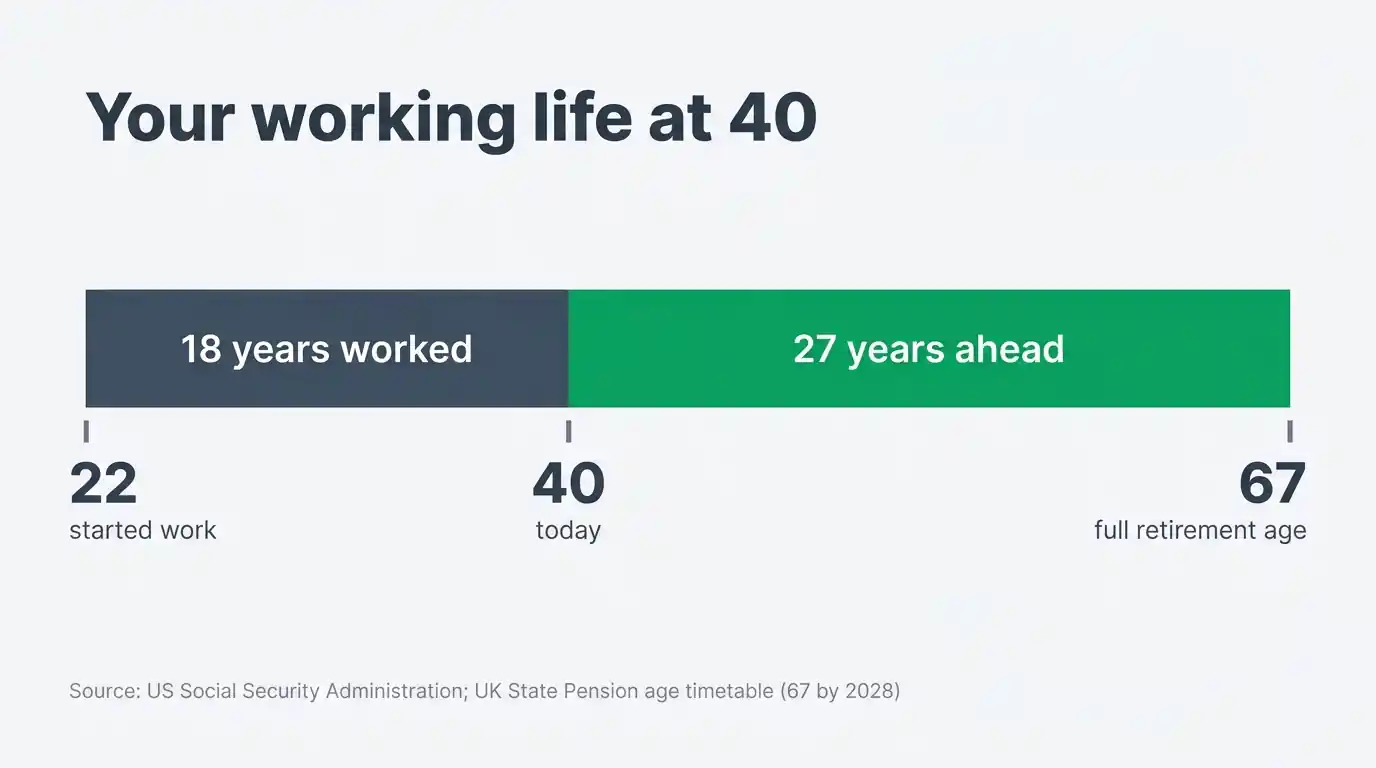
Change the inputs and the result mostly holds. Start at 25 and retire at 65, and you’ve worked 15 years with 25 still ahead. It only flips if you started very young and plan to stop early, for example working from 18 and retiring at 60.
People also keep changing employers well past 40. The US Bureau of Labor Statistics followed Americans born between 1957 and 1964 for decades. They held an average of 12.9 jobs between ages 18 and 58. That includes an average of 2.9 jobs started between 35 and 44, and 2.2 started between 45 and 54.
One limit on that data: BLS counts employers, not careers. A new job in the same field counts the same as a move from accounting to nursing. No official source tracks career changes as such.
What makes a career change at 40 harder
The working-years count answers “is it too late?” It doesn’t answer “is it easy?” Four things really are harder at 40.
Money has less room to move. At 25, a year on a lower salary is uncomfortable. At 40, the same year may have to cover a mortgage, children, or parents who need help. Most career changes include a period of lower pay while the new field decides how much of your experience it will count. The longer that period lasts, the more your fixed costs make the decision for you. If the honest answer for now is to stay where you are, there’s a way to do that without losing the year, which we covered in our piece on job hugging.
Long retraining costs more. A four-year degree started at 40 ends at 44. That still leaves 23 working years. But four years of reduced income and tuition is a large amount to spend on a field you haven’t tested.
Age bias is real. In the US, the Age Discrimination in Employment Act protects workers aged 40 and over, which tells you where the law sees the problem starting. The best survey data covers people ten years older. In AARP’s 2025 research, 64% of workers aged 50 and over said they had seen or experienced age discrimination at work. In a separate AARP survey of people over 50, 74% believed their age would make it harder to get hired. At 40 the effect is usually smaller. It isn’t zero, and it shows up most at entry level, where you may compete with people who are 24.
Starting junior feels different. Reporting to someone 15 years younger, being the person who asks the basic questions: many people underestimate how this will feel. It passes. Plan for it anyway.
None of these says “don’t.” Together they say that a wrong guess costs more at 40 than at 25. That’s the argument for knowing your direction before you spend.
What’s easier at 40 than at 25
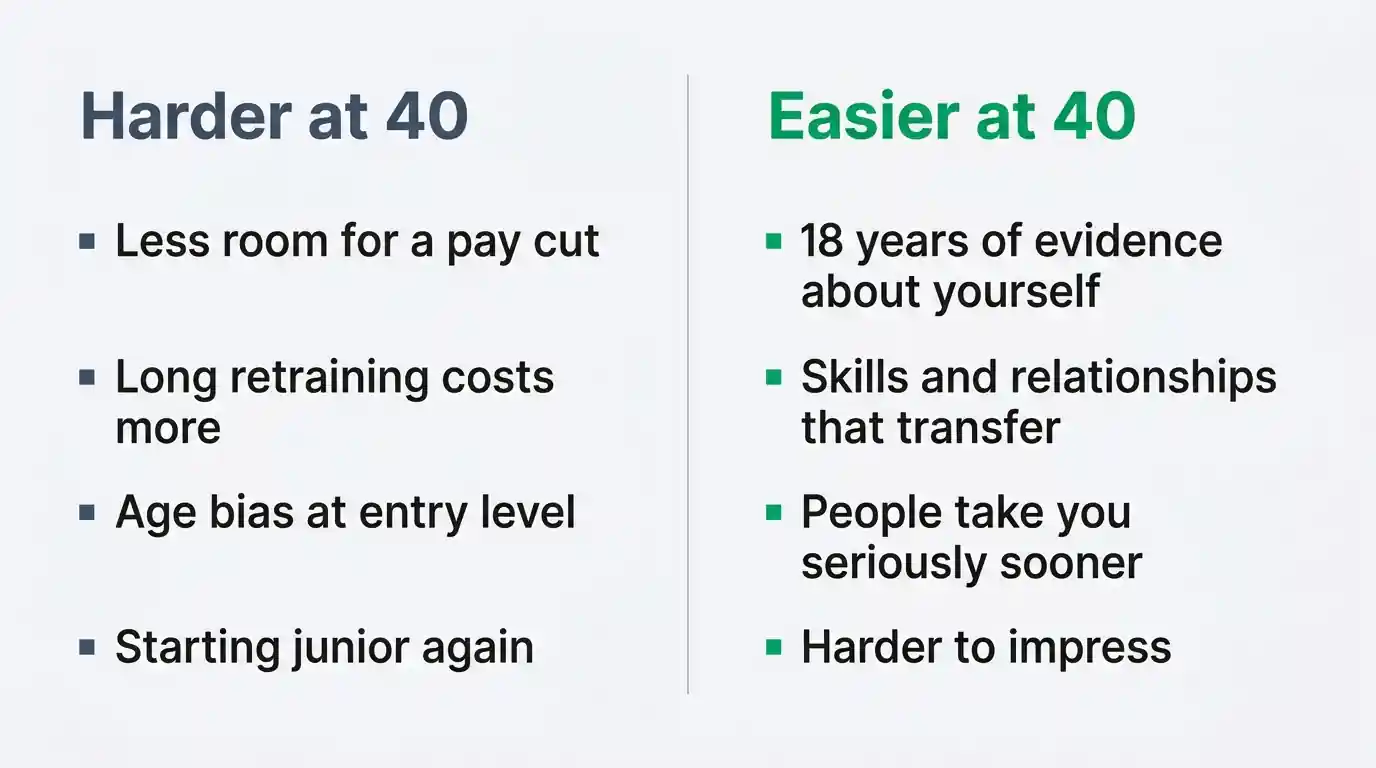
You have evidence about yourself. At 22 you guess what you’ll like. At 40 you have 18 years of records: which tasks drained you, which ones made you lose track of time, which kind of manager got your best work. That is the most useful input for choosing a direction, and younger career changers don’t have it yet.
Much of what you built moves with you. Your job title stays behind. Your judgment, your relationships and the way you handle a difficult client come along. We wrote a full guide to identity capital and how to take stock of it, so we won’t repeat it here. The short version: you are not starting from zero.
People take you seriously sooner. A 40-year-old who asks for 20 minutes to learn about someone’s job usually gets them. Your network is also larger, and some of it now has the power to hire you or introduce you.
You’re harder to impress. At 25, it’s easy to believe what a job ad promises. At 40, you know to ask what an ordinary Wednesday in the role looks like.
Do you need a degree to change careers at 40?
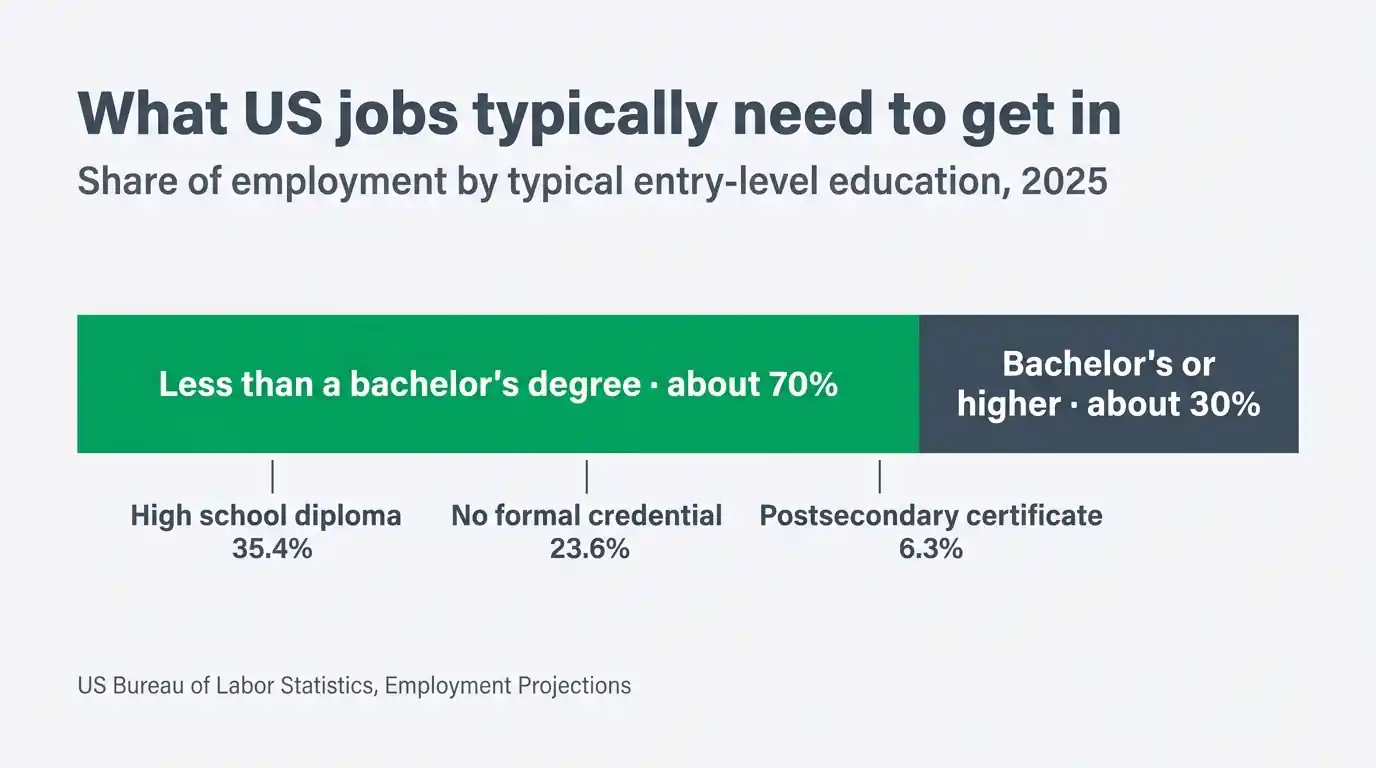
Usually not. In BLS data for 2025, about 70% of US jobs were in occupations where the typical entry-level education is less than a bachelor’s degree, and about 30% where it’s a bachelor’s or higher. The 70% includes 35.4% that typically need a high school diploma, 23.6% that need no formal credential, and 6.3% that need a post-secondary certificate. Those are the short, non-degree programs that train people for work like HVAC repair, medical assisting or truck driving.
Two caveats. The 70% includes many low-paid jobs, so “no degree needed” doesn’t mean “no pay cut.” And “typical” means what most entrants have; some employers in those fields still ask for more. For any specific occupation, O*NET shows the education, training and licenses that people in it actually have.
If a short credential is your route, the next question is who pays for it. Employers, apprenticeships and public workforce funds all can, and we went through which ones and what each one asks in return.
The degree question also has an order problem. That’s the main point of this article.
Direction before training: the most expensive mistake
Another post this month, on Reddit: “Career change at 32: find work now or go back to school?” The poster was laid off from marketing two years ago and has been bartending since. They know they don’t want to go back to marketing. They don’t yet know what they want instead.
Both options in the title skip that question. “Go back to school” assumes you know what to study. “Find work now” assumes you know what work. The real question is toward what, and neither option answers it.
This matters more with every year you add. At 32, a wrong degree costs time you can recover. At 40, a two-year program in the wrong field takes two of your 27 remaining years, plus the tuition, plus the income you didn’t earn while studying. Paying for training before you know your direction is the most expensive way to discover you guessed wrong.
The alternative costs very little: test a field before you commit to it, while you still have your current income.
How to test a new field while you’re still employed
Each test should answer something a job ad can’t: what the work is like day to day, what kind of people do it, and whether you’d still want it after the novelty is gone.
- Talk to three people who do the job now. Not recruiters and not online career coaches, but people in the role. Ask what they did yesterday, which part of the work they would drop if they could, and what surprised them in their first year. Three conversations show a pattern that one can’t.
- Do a small piece of the real work. A paid freelance task, a volunteer project, a weekend helping someone who does it. The goal is not income. It’s finding out whether the actual tasks hold your attention.
- Spend a day where the work happens. Ask to shadow someone for a shift. A day in a workshop, clinic or office shows you the pace, the noise level, and how much time you’d spend alone or with people. Those details decide whether you’ll be content there in five years.
- Take the shortest course first. If the field needs training, find a short introductory course before you sign up for a long one. Treat it as a test. If you dread the homework by week three, you’ve learned something useful cheaply.
- Write down what you expect, then compare. Before each test, note what you think you’ll find. Afterward, note what was different. The differences tell you more than the confirmations do.
A field that passes two or three of these tests is worth paying for. One that fails early has cost you a few evenings instead of a few years.
If you’re neurodivergent and changing careers at 40
Some people get an ADHD or autism diagnosis, or recognize those traits in themselves, only in their 30s or 40s. Often that comes after years of jobs that looked right and exhausted them anyway. If that’s you, the years behind you are a specific kind of evidence. They show the conditions you work best in: noise, interruptions, structure, autonomy, how much contact with people.
That turns the question from “what am I bad at?” into “which environment fits how I work?” Our guide to being neurodivergent at work covers how to use that when you choose.
Where CareerSeeker fits
Testing a field works well once you have two or three candidates. Finding those candidates is the harder step, and job lists don’t help much. They tell you what exists, not what fits you.
CareerSeeker starts from you instead of from the job market. You answer questions about what you liked and disliked in past work, your traits, your values and, if you choose, your neurodivergent profile. It suggests career directions and explains why each one fits, including ones you might not have considered. At 40 you have more work history to describe than most people, which gives the analysis more to work with. It’s anonymous and takes about 10 minutes. Treat the suggestions as the shortlist for the tests above, not as a final answer. See the career plans.
Key points
- At 40, with a retirement age of 67, you have about 27 working years ahead and around 18 behind.
- Harder at 40: less financial room, more expensive retraining, and real age bias at entry level.
- Easier at 40: years of evidence about yourself, skills and relationships that transfer, and faster credibility.
- About 70% of US jobs are in occupations that typically don’t need a bachelor’s degree to enter, though many of them pay less.
- The costly mistake is paying for training before you’ve tested the direction.
There is time. The real question at 40 is what you spend the first two years of it on.
Frequently asked questions
No. With a full retirement age of 67 in the US, and in the UK by 2028, you have about 27 working years left at 40. That’s usually more than you have already worked. People keep starting new jobs at this age too: BLS data shows an average of 2.9 new jobs started between 35 and 44. Age bias exists, mostly at entry level, but it doesn’t make a change impossible.
Many. About 70% of US employment is in occupations that typically don’t require a bachelor’s degree to enter. Electricians usually start through an apprenticeship after high school. HVAC technicians and medical assistants usually complete a short postsecondary certificate. Still, a list is the weakest place to start. Choose by fit first, then check the entry requirements on O*NET.
It depends mostly on whether the new field requires a license or credential. A move that uses your existing skills in a different industry can happen within one job search. A field with required training takes as long as that training, from a short certificate to a multi-year apprenticeship. Testing the direction first adds a few months and can save you years.
Only after you’ve tested the direction. A degree at 40 makes sense when the field legally requires one, as nursing and teaching do. When it doesn’t, start with conversations, a small project and a short course. If the field still fits after that, a degree is a much safer investment, and an employer or public program may help pay for it.