

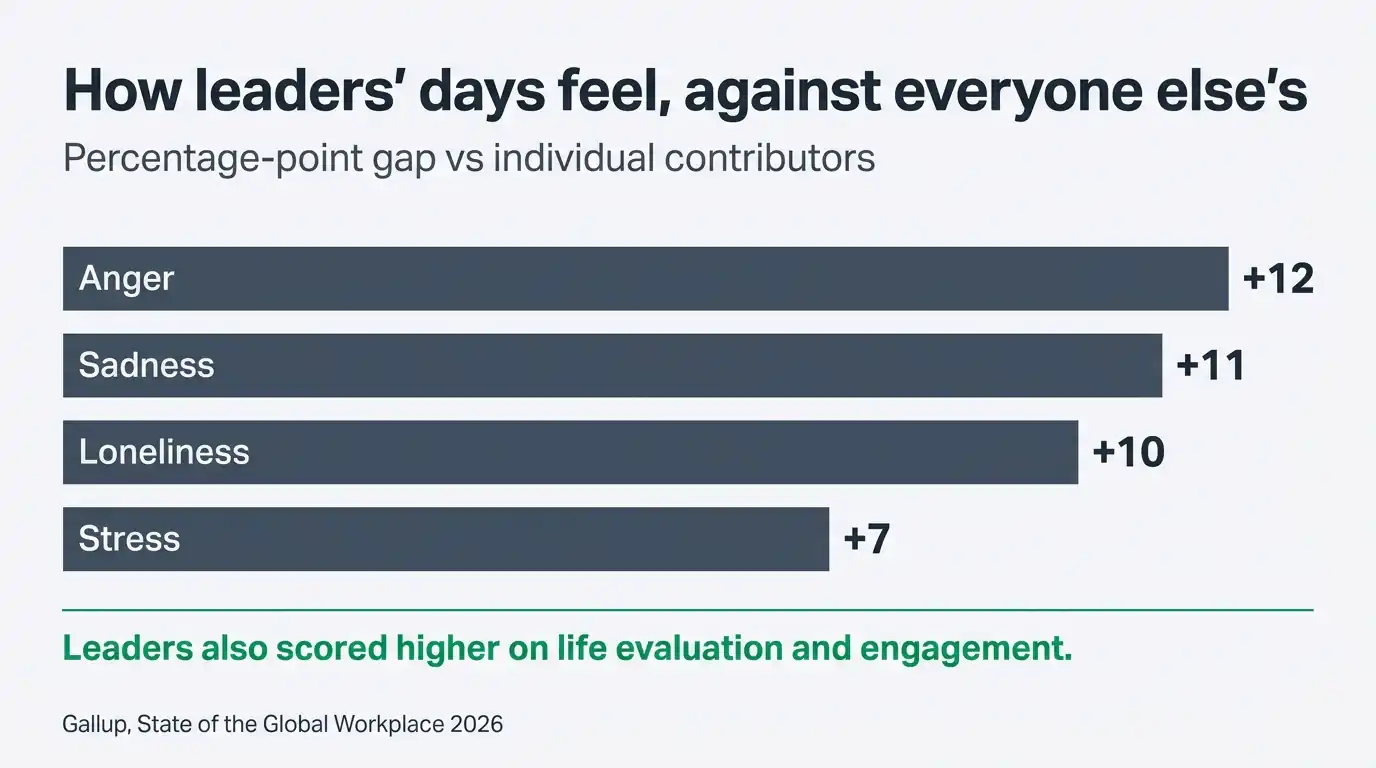
Gallup’s 2026 workplace report does something most research on management doesn’t. It splits leaders from individual contributors and asks how their days actually felt.
Leaders reported more anger, by 12 points. More sadness, by 11. More loneliness, by 10. More stress, by 7. The same report has leaders scoring higher than their teams on life evaluation and engagement.
Both are true at once. That’s the difficulty. Should I become a manager has no general answer, and anyone handing you one is answering a different question, which is theirs.
Search it and you’ll get a dozen comparison tables. Manager: scope, strategy, influence. Individual contributor: craft, focus, autonomy. Then the closing line, in nearly all of them: it’s a personal decision. True. Personal to what, though?
That’s the part that would help, and it’s the part everyone leaves out. This is an attempt at it. Most of what follows is US or global-workforce data drawn from white-collar settings, which is a real limit on how far it travels.
What the job actually consists of
Skip the job description and look at the task inventory. O*NET, the US Department of Labor’s occupational database, lists the work activities for general and operations managers. Near the top: “Getting Information.” “Communicating with Supervisors, Peers, or Subordinates.” “Making Decisions and Solving Problems.” “Establishing and Maintaining Interpersonal Relationships.”
Further down, the detailed activities get concrete. Prepare staff schedules or work assignments. Monitor performance of organizational members or partners. Direct organizational operations, projects, or services.
Not one of them is making the thing.
That’s the change, and it’s bigger than the title suggests. Three parts of it are worth naming plainly.
Your output stops being yours. On a good week the team ships and you can’t point at a piece of it and say you did that. Some people find this a relief. Others find it a slow, disorienting loss they can’t quite explain to anyone.
Your calendar fragments. The work arrives as interruption because you are, structurally, the interruption handler. Deep focus becomes something you schedule and defend rather than something you have.
Conflict routes to you by design. Someone underperforms, two people can’t work together, a decision from above lands badly – all of it comes through you, and you deliver it in your own voice to people who will still be there on Monday.
Gallup’s emotion numbers make more sense in that light. The loneliness gap especially. It isn’t that managers are isolated by accident; it’s that a chunk of what they know can’t be shared with the people they spend the most time around.
What the evidence says about who’s good at it
There is real research here, and it says less than people claim.
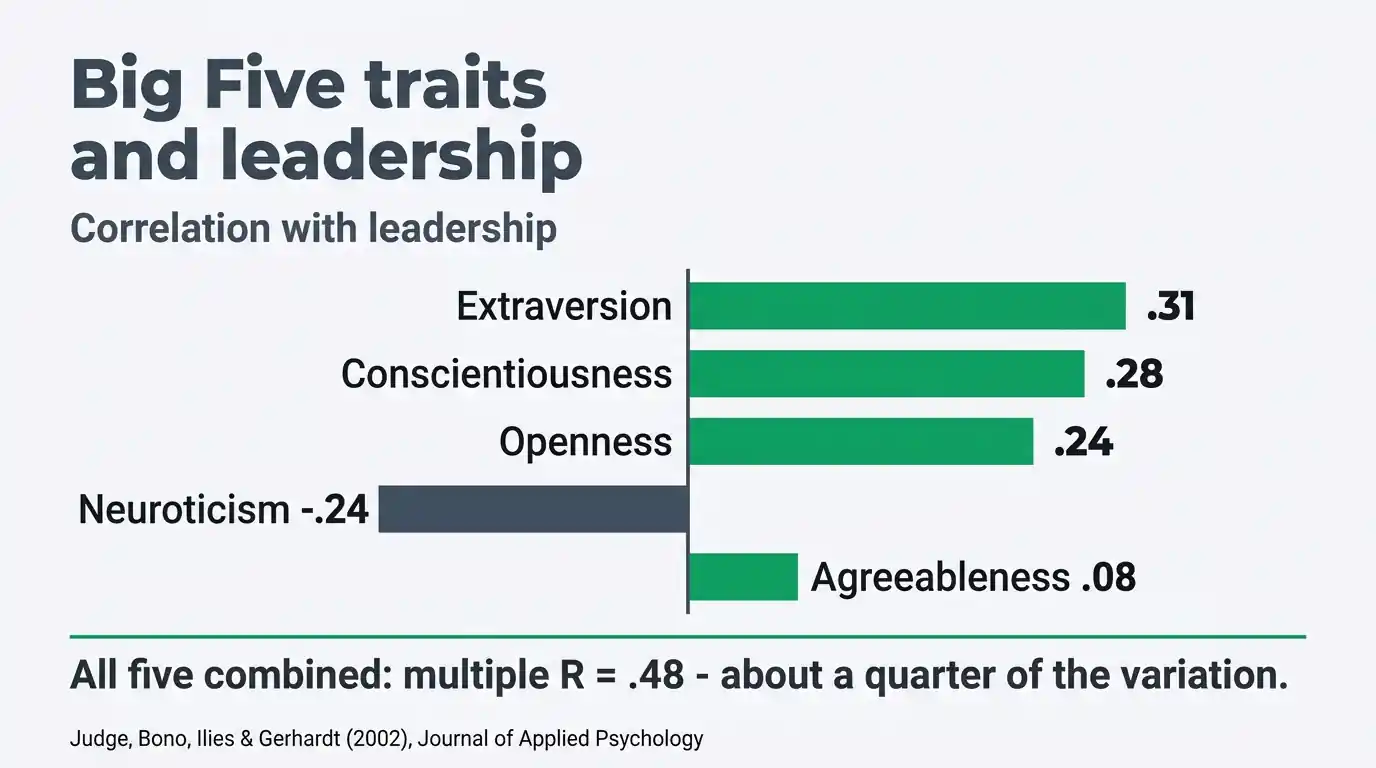
The canonical study is Judge, Bono, Ilies and Gerhardt’s 2002 meta-analysis in the Journal of Applied Psychology, pooling 222 correlations across 73 samples. Their results for the Big Five traits and leadership: extraversion .31, conscientiousness .28, openness .24, neuroticism −.24, agreeableness .08.
Now the part that gets dropped in the retelling. Those five traits together reached a multiple correlation of .48, which works out to somewhere near a quarter of the variation in leadership explained. Three quarters of it is something else: situation, organization, training, luck, the specific people involved.
The single strongest trait, extraversion, accounts for under a tenth on its own.
And agreeableness sits at .08, effectively nothing. Being warm and easy to get along with has almost no measured relationship with leading. Which is worth knowing if you’ve been told you’d make a good manager because you’re nice to people. That is not what the evidence says the job runs on.
The 2002 paper is also old, so it’s fair to ask what’s happened since. Quite a lot: Javalagi, Newman and Li published a much larger meta-analysis in the same journal in 2024, drawing on 120 samples and over 32,000 people for one outcome and 116 samples and over 42,000 for another. Two things in it matter here.
The first is those two outcomes. The field measures leader emergence – who ends up in charge – separately from leader effectiveness, because they are not the same question and never have been. The traits that put someone at the front of a room are studied apart from the traits that make them any good once they’re there.
The second is that trait honesty-humility predicted leader effectiveness beyond the Big Five entirely. Not a trait any personality-based career tool tends to surface, and not one that shows up in the folklore about who should be promoted.
So: real relationships, modest sizes, and a research literature that quietly distinguishes getting the job from doing it well. If you want the trait detail, our guide to careers by Big Five profile covers each trait at length, including the combination usually described as the manager profile.
Why you’re being offered it anyway
Here’s the awkward part. The offer on your desk probably has very little to do with any of that.
Benson, Li and Shue’s Promotions and the Peter Principle, published in the Quarterly Journal of Economics in 2019, tested it directly using sales data – a rare case where individual performance is measured cleanly enough to check. Their finding: firms promote on current job performance at the expense of characteristics that better predict how someone will do as a manager.
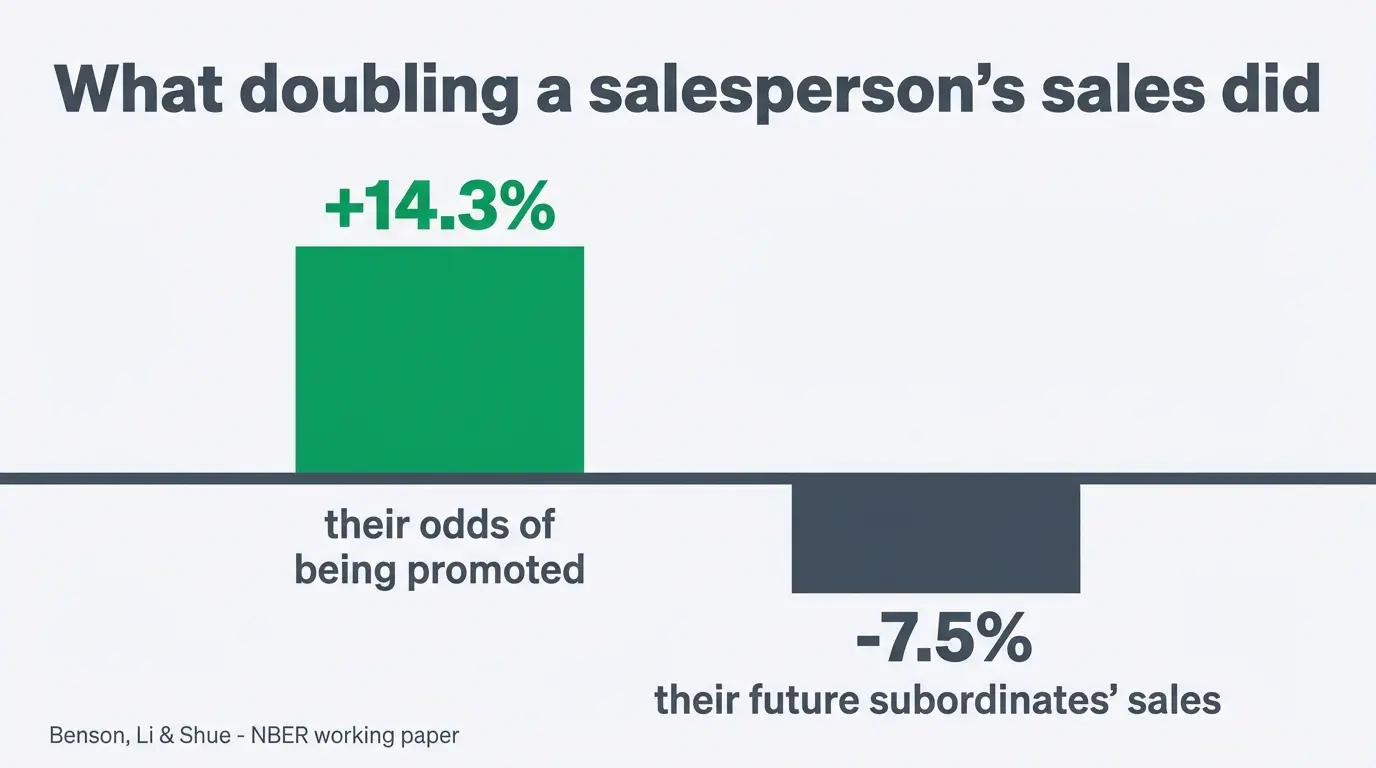
The working-paper version put figures on it. Across 214 firms, 156 million sales transactions and more than 1,500 people promoted into management, doubling a salesperson’s sales credits raised their promotion probability by 14.3%. Doubling their pre-promotion sales was associated with a 7.5% decline in the sales of the people who then reported to them.
Being excellent at the work was the qualification. It also predicted the cost.
That isn’t malice, and it usually isn’t stupidity either. In most organizations management is the only ladder that exists. There’s one route to more money, more say, and a title that reads as progress, and it happens to require a change of occupation. So the promotion gets used as a reward for the old job rather than a match for the new one, and everybody involved knows this and does it anyway.
Which means the offer is not a verdict on your fit. It’s a verdict on your last two years.
If it feels flattering, notice that, because flattery is doing real work in this decision. We went into that pattern separately in choosing a career that fits your core values – the roles that damage people quietly are rarely the obviously bad ones. They’re the ones that look like wins. And if the honest reason you’re considering it is that you can handle it and nobody else can, that’s worth reading alongside the hidden signs of burnout, because “capable, so overloaded” is the standard route in.
Why this is easier to talk about in tech than anywhere else
Software has a vocabulary for this. Dual ladders. Staff-plus tracks. Charity Majors’ engineer/manager pendulum, which argues that management is a lateral move onto a parallel track rather than a step up, and that moving between the two over a career is a reasonable thing to plan for.
Whatever you make of that argument, look at what having it available does. A tech worker who dislikes managing has a word for what they are, a track to move onto, and a well-known essay to point at. The situation is legible.
A charge nurse doesn’t have that. Neither does the teacher who became a department head, the technician running a shift, or the senior associate now managing juniors. They took the same deal – more money, more say, less of the work they were actually good at – and they hit the same wall. What they don’t have is a name for it.
So the experience arrives as a private failing. Everyone else seems to want this. I got the promotion I was supposed to want and I’m worse off. Something must be wrong with me.
Nothing’s wrong with you. You changed occupations and nobody described it that way.
That changes what the problem is. A personal failing needs fixing. A mismatch between a person and a set of tasks needs identifying, and then a decision.

Can you go back?
This is usually the real question underneath the other one, and it deserves a straight answer rather than reassurance.
First, honestly: there’s no good dataset on it. Nobody appears to have tracked what happens to people’s earnings, seniority or prospects after they step back from management. If someone quotes you a percentage here, ask where it came from.
What exists is community reporting, and it’s remarkably consistent. On engineering forums and in threads like the one asking whether a manager promotion had ruined a career, which drew 686 upvotes, people who moved back describe the same two things: it’s more common than they expected, and the dominant feeling afterward was relief. That’s self-selected and it’s not evidence of outcomes. It is evidence the move happens and that people survive it.
Reversible is not the same as free. What determines the cost is checkable before you accept anything:
Whether a senior track exists to land on. In an organization with no path above your current level that isn’t management, stepping back means stepping down. In one with a genuine senior specialist track, it’s a sideways move.
Whether anyone has done it. Ask. If someone has stepped back in the last two years and is doing fine, that’s a real answer. If nobody can name a single case, that’s also a real answer.
How the move gets framed. “Moved into a role better suited to their strengths” and “was removed from management” can describe the same event.
How long you stay. Eighteen months of management reads as range. Six years reads as a career, and unwinding it takes longer.
So: personal to what?
Back to the question the comparison tables refuse to answer. Here’s what “personal” actually consists of.
The shape of your day. Not the responsibilities. The hours. Interruption-driven versus protected. Whether you’d rather absorb a hard conversation or spend that hour finishing something.
Where your satisfaction comes from. Some people get it from a finished thing they made. Some get it from watching someone become good at something. Both are legitimate; they are not interchangeable, and the second one is the entire compensation for losing the first.
What you’re willing to carry. Managers hold information they can’t share and make decisions that cost people things. Gallup’s loneliness gap is the measurable trace of that. There is no version of the job without it.
Your trait profile, read carefully. The evidence is real and weak, so it belongs as one input rather than a verdict. Low on the traits that correlate with leadership doesn’t mean you can’t manage. It means it’ll take more deliberate effort, and you should know that going in rather than discovering it in month four.
| What to check | On the manager track | On a senior specialist track | How to test it this month |
|---|---|---|---|
| Day shape | Fragmented, interruption-led, calendar owned by others | Longer blocks, output you control | Log every interruption for one week and note how each one felt |
| Source of satisfaction | Someone else’s growth and a team’s result | A finished thing with your fingerprints on it | Recall the last three times work felt good – who did the work? |
| Conflict | Routed to you by design, repeatedly | Present but usually escalated elsewhere | Volunteer for one genuinely difficult conversation and notice the recovery time |
| Trait signal | Correlates with extraversion, conscientiousness, emotional stability | Fewer constraints, wider viable range | Read your Big Five profile as an input, not an answer |
| Interest type | Strong overlap with Holland’s Enterprising | Varies by field; often Investigative or Realistic | Check your Holland code against the work, not the title |
If you’ve already got a Big Five profile, the specific pairings that tend to struggle on visible leadership tracks are set out in our piece on Big Five personality combinations.
Where this stops being useful
A few limits worth stating, because the analysis above can be pushed further than it holds.
Correlations of .24 to .31 describe tendencies across thousands of people. They say close to nothing about you specifically. Plenty of quiet, introverted people manage well, and some of the best do it precisely because they don’t enjoy the performance of it.
Organization quality probably matters more than personal fit. A well-run team with a competent manager above you makes management survivable for almost anyone; a badly run one makes both tracks miserable and no amount of self-knowledge fixes that. Gallup’s own finding points the same way: in its best-practice organizations, 79% of managers were engaged, against a global average of 22%.
The pay and ladder realities differ sharply by field. In some, the specialist track genuinely pays as well. In others that’s a comforting story with nothing behind it, and you should check rather than assume.
And the Gallup emotion figures are global averages comparing groups, not predictions about individuals. Engaged managers in that same data reported lower negative emotions than individual contributors did. The role isn’t the whole story.
How to test it before you say yes
- Shadow a manager’s calendar for a week. Not their job. Their week. Ask someone to walk you through what actually filled it. Most of the surprise in this decision is in the hours.
- Ask what happens if you decline. If the honest answer is that you stall permanently, that’s a fact about your employer worth knowing, and it may be a bigger finding than the promotion itself.
- Ask who has stepped back, and how it went. Names, not policy. This is the fastest available read on whether the move is reversible where you work.
- Run one hard conversation. Ask to handle a real performance discussion before you commit. It’s the most representative single hour of the job and the one people most consistently underestimate.
- Count where your good days came from. Over the last quarter, how much of what felt good was work you finished yourself? Losing that is the actual trade, and it’s the one people notice too late.
- Take the interim role if it’s offered. Acting positions are the only honest trial available, and they’re far easier to leave than a permanent title.
If what’s really unresolved is the bigger direction – whether this field is right at all, not just this rung of it – that’s the thing to settle first, because the promotion question is much easier once it’s answered. It’s what we built CareerSeeker for. It works from your traits, values, past experience and, if you want, your neurodivergent profile, then suggests directions with the reasoning shown. Anonymous, about ten minutes, no account. Suggestions, not verdicts – it can’t tell you whether you’d like managing, and no assessment can.
The bottom line:
- Gallup’s leaders report more stress, anger, sadness and loneliness than individual contributors, and higher life evaluation and engagement. Both, at the same time.
- Personality traits do relate to leadership, but the five together explain roughly a quarter of the variation, and agreeableness explains essentially none.
- The offer usually reflects how well you did the last job, not how well you’d do the next one – and the research finds a measurable cost when firms promote that way.
- Stepping back happens and people report relief. Whether it’s cheap depends on facts you can check before accepting.
- Management isn’t a promotion so much as a different occupation with a better salary attached.
The promotion is a job offer for a different job. Read it like one.
Frequently asked questions
It’s usually paid and titled as one, but the work is a different occupation. O*NET’s activity list for managers is dominated by gathering information, communicating, deciding, and maintaining relationships – not producing the output you were promoted for being good at. Some organizations now run senior specialist tracks that pay comparably without the people-management component. Whether yours does is a concrete question worth asking before you accept anything.
Yes, and it’s more common than it looks from outside. There’s no reliable published data on what it costs, so treat any confident percentage with suspicion. What determines the cost is checkable: whether a senior specialist track exists to land on, whether anyone at your employer has done it recently and how they were treated, how the move gets described, and how long you’ve been managing. Reversible is not the same as free.
No. Extraversion is the strongest single trait correlate of leadership in the research, at around .31, which accounts for under a tenth of the variation. Most of what makes someone effective is elsewhere. Introverted managers are common and often good, particularly where the job rewards preparation and one-to-one attention over visible presence. It may cost you more energy, which is worth planning for rather than discovering later.
It depends entirely on the employer, and their answer is informative. Ask directly what your progression looks like if you decline. If there’s a genuine senior track, declining is a normal choice. If management is the only route upward, then saying no does cap you there, which is a fact about that organization rather than about you, and it may be the more useful thing you learn from the conversation.
Get as close to the real thing as you can. Ask to run one difficult performance conversation. Take an interim or acting role if one is available. Shadow a manager’s week and pay attention to the interruptions rather than the meetings. Then check the honest question underneath: over the last few months, how much of your satisfaction came from finishing something yourself? That’s what you’d be trading.