


You hand in your notice, and your company comes back with a 35% raise and a better title if you stay. Do you take it? This month, one person in exactly that position asked an online career forum, and the thread passed 1,000 comments.
The money isn’t the interesting part. The interesting part is how many people had a firm opinion on whether money is a good enough reason to stay. That question has a name this year: job hugging.
Job hugging means holding on to your job mainly because leaving feels too risky, not because you want to be there. In 2026, staying is often a reasonable choice. The trouble starts when you stay without a reason you could name and without a plan for the time.
What is job hugging?
Job hugging is staying in a job you’ve outgrown or no longer want, mainly out of fear of what’s outside it: layoffs, slow hiring, AI, or being the newest hire when cuts come. The term spread in 2025. It describes the reason for staying, not how long you’ve stayed.
How common is it? ResumeBuilder surveyed 2,188 US workers in February 2026. 57% described themselves as job huggers, up from 45% in August 2025. Among them, 70% worried about AI affecting their job security, and 63% worried about layoffs in the next six months.
Treat those figures as a direction, not a precise measurement. It was an online survey run through Pollfish, and the published results don’t show how the question was worded. “Are you a job hugger?” can mean very different things to different people.
Why staying makes sense in 2026
If it feels like a bad time to move, the labor data agrees with you.
US employers added 29,000 jobs in September 2026, and the July figure was revised down to a loss of 10,000. Unemployment has stayed between 4.1% and 4.3% since March. Few people are losing jobs, and few are being hired.
Turnover data shows the same picture from the workers’ side. In August, 3.1 million people quit their jobs, a quits rate of 1.9%. The hires rate was 3.3%. When fewer roles open up, each one tends to attract more applicants, and finding the next job takes more effort.
So the caution isn’t cowardice. In a market like this, keeping a steady income while you think is sensible.
But switching pays more again
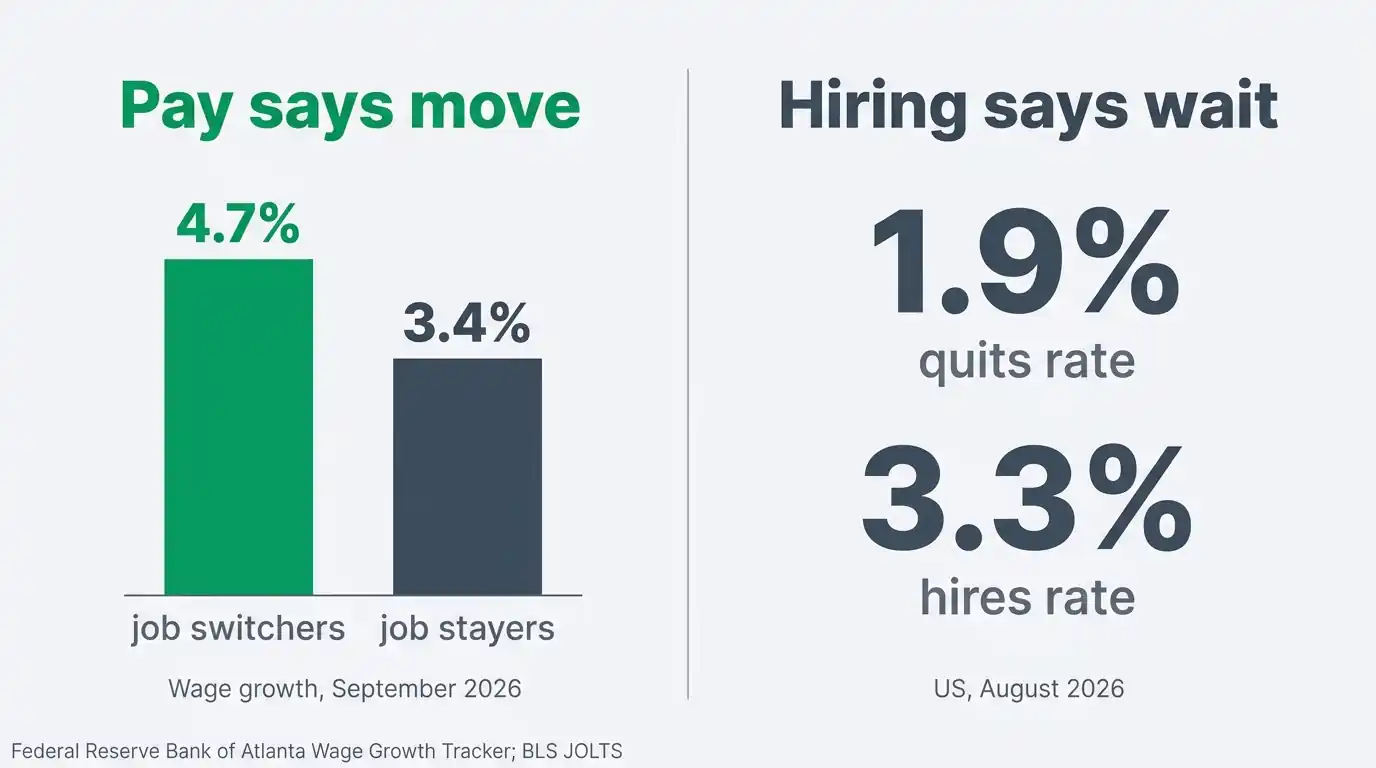
Here’s the complication. Moving is harder right now, yet the people who do move are earning more for it.
The Federal Reserve Bank of Atlanta tracks median wage growth separately for people who change jobs and people who stay. During the 2022 wave of resignations, switching paid far more than staying. Then the advantage disappeared. In May 2025, switchers’ and stayers’ wage growth was equal for the first time since 2010, according to the Bank of America Institute’s reading of the Atlanta Fed data.
Now the gap is back. In September 2026, wages for job switchers were growing 4.7% a year, against 3.4% for people who stayed. Both are three-month averages, and “switchers” includes people who changed occupation or industry, not only employer.
So the data points in two directions at once. Pay says moving is worth more. Hiring says moving is harder to do. Neither one decides it for you, which is why “should I stay or leave?” is rarely only a money question by the time you’re asking it.
What job hugging costs you
Staying has costs. The ones that matter most build up slowly enough that you don’t notice them.
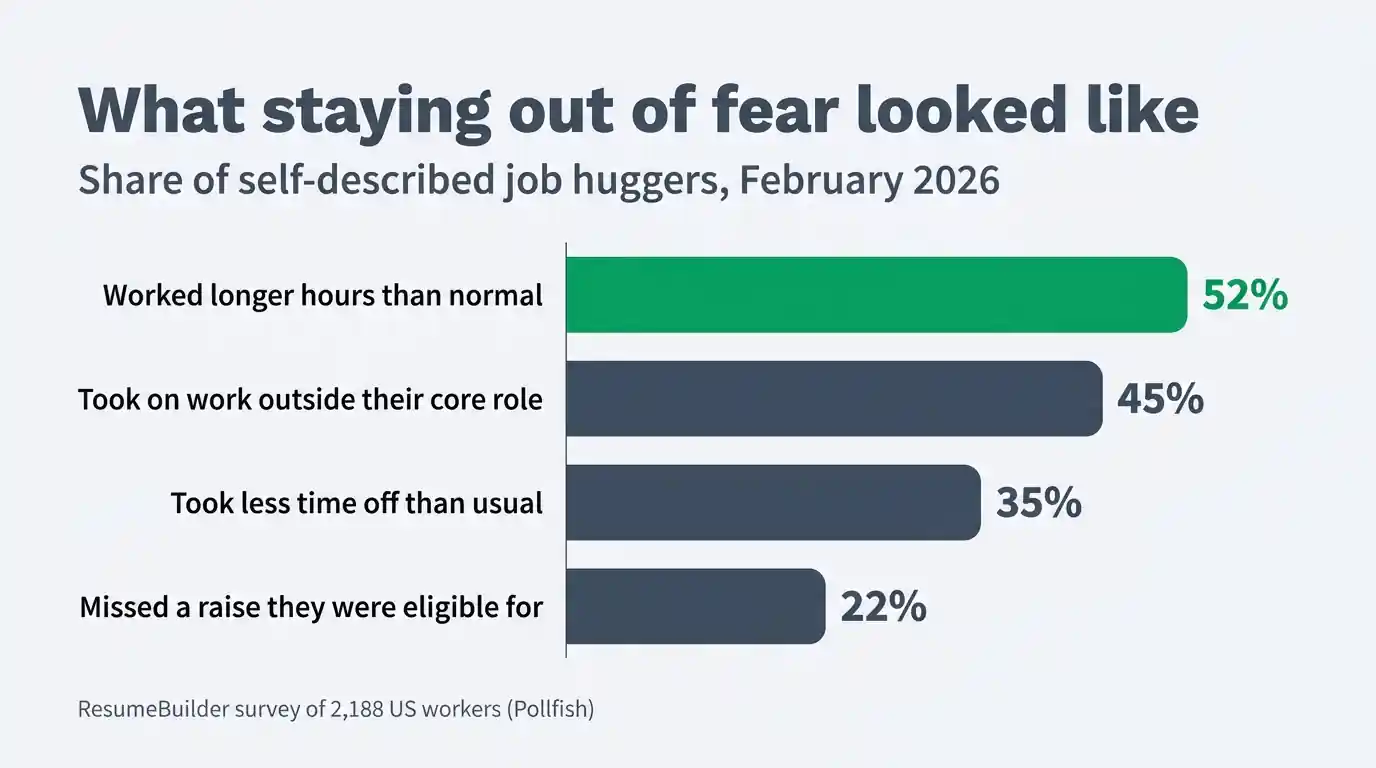
The ResumeBuilder respondents named some directly. 52% were working longer hours than normal. 45% had taken on work outside their core role. 35% took less time off than usual. And 22% said they hadn’t received a raise they were eligible for.
That’s the visible part. The less visible part is what fear does to the way you work. If the main reason you’re there is that leaving feels dangerous, you’re less likely to say no, to ask for the project you want, or to take a full week off. The job gets bigger and you get quieter. That pattern is a common route into burnout, and it’s much easier to stop early than to recover from later.
Then there’s the time itself. A year spent waiting for the market to improve could also be a year of learning what you’d move toward. If the market improves and you still don’t know, the waiting gave you nothing.
Job hugging or staying on purpose?
Same job, same salary, same desk, and two very different situations. Five questions show which one you’re in.
- Can you say why you’re staying, in one sentence, without the word “market”? “I’m staying until my bonus pays out in March” is a reason. “Now isn’t a good time” is a feeling.
- Do you know what you’d move toward? Not “something better,” but a field, a kind of role, a type of work.
- Is there a review date? Staying on purpose has a point where you check again. Hugging continues by default.
- Are you using the time? Learning something, testing a direction, building skills you’d take with you.
- Has your workload grown while your control over it shrank? If so, fear may already be making decisions for you.
| Job hugging | Staying on purpose | |
|---|---|---|
| Main reason | Fear of what’s outside | A named reason: money, timing, something to learn |
| Direction | Unknown, or “anything but this” | At least one field or role in mind |
| Time frame | Open-ended | A review date in the calendar |
| Use of the time | Waiting | Testing and building |
| Workload | Keeps growing, and you accept it | You still negotiate it |
If most of your answers fall in the “Job hugging” column, that doesn’t mean you should quit. It means you’re staying without a plan, and that part you can fix.
What to do while you stay
Write down your reason and a review date. One sentence, one date, somewhere you’ll see it. When the date arrives, check whether the reason still holds.
Find out what you’d move toward. Most people skip this step, and it’s the one that makes everything else useful. If you have no idea yet, start with what this job has taught you about yourself: what drains you, and what you’d keep doing even if nobody asked.
Test that direction in small ways. Conversations with people who do the work, a small project, a day of shadowing. Our guide to career change at 40 sets out a step-by-step method for testing a field while you still have a job. It works at any age.
Keep building what you’d take with you. The projects, judgment and relationships that move across fields are what we call identity capital. A year of staying is worth more if you leave it with more of that.
Keep your workload honest. Taking on extra work because you’re afraid to say no was the most common cost in the survey. You can stay and still negotiate.
Should you accept a counteroffer?
Back to the thread. A 35% raise is a large amount of money, and no general rule says that accepting ends a career.
The more useful question is what you were leaving. If it was pay, and the pay is now fixed, accepting may be exactly right. If it was the work, the manager, the lack of growth, or a sense that the job doesn’t fit you, a raise changes none of that. It pays you to keep the problem.
Notice what the offer tells you, too. The company was able to pay you 35% more and didn’t, until you resigned. That isn’t automatically bad faith. It is information about how pay decisions are made there.
When staying is the wrong call
Staying on purpose is a good default in this market. It isn’t the right choice in every situation.
- Your health is paying for it. Exhaustion that a weekend doesn’t fix, dread every Sunday evening, getting sick more often. The hidden signs of burnout can help you tell ordinary tiredness from something that needs a change.
- The environment is harmful. Bullying, constant fear, a manager who punishes questions. A slow job market is a reason to leave carefully, not a reason to stay. Here’s how to leave a toxic job safely.
- Your skills are falling behind. If your kind of work is shrinking and the job teaches you nothing new, every extra year may make the eventual move harder. If AI is the worry, look at what the evidence on AI and jobs actually shows before deciding.
- You already know where you’re going. If you’ve tested a direction and it held up, waiting for a perfect market may only delay a move you’ve already decided on.
Where CareerSeeker helps
Most of this article comes back to one missing piece: knowing what you’d move toward. That’s the part CareerSeeker is built for. It asks about the work you’ve done, which parts you enjoyed and which wore you down, your traits and your values, then suggests career directions with the reasons each one fits you. It’s anonymous and needs no account, so you can do it on a lunch break without anyone at work knowing. You come away with something specific to test while you stay. Compare the plans.
In short
- Job hugging is staying mainly out of fear. In February 2026, 57% of surveyed US workers said it described them.
- With a quits rate of 1.9% and weak hiring, staying is often reasonable.
- Switching pays more again: 4.7% wage growth for switchers against 3.4% for stayers in September 2026.
- What separates hugging from staying on purpose is a named reason, a direction and a review date.
- A counteroffer fixes pay. It leaves everything else you were leaving in place.
If you stay, give it a date and a direction to test. That’s the whole difference.
Frequently asked questions
Job hugging means staying in a job mainly because leaving feels too risky, because of layoffs, slow hiring or AI, rather than because you want to be there. The term spread in 2025. In a February 2026 ResumeBuilder survey of 2,188 US workers, 57% described themselves as job huggers, up from 45% six months earlier.
Not on its own. With a 1.9% quits rate and slow hiring in 2026, keeping a steady income is often sensible. It becomes a problem when it has no end: no reason you can name, no direction, no review date. Then the costs grow quietly while you wait, in the form of longer hours, extra work and missed raises.
Possibly, for a set time and a clear reason. Use that time to find out what you’d move toward and to test it in small ways. Leave sooner if your health is suffering, the environment is harmful, or your skills are falling behind. Outgrowing a job is a signal to start planning. It doesn’t always mean quitting right away.
Start with what you were leaving. If it was pay, a counteroffer may solve the problem, and accepting can be the right choice. If it was the work, the manager or the lack of growth, more money leaves all of that in place. It’s also worth asking why the higher pay only became available after you resigned.
“The Great Stay” is a name for the period after the Great Resignation, when far fewer people quit their jobs. In August 2026, the US quits rate was 1.9%, with 3.1 million quits. Job hugging describes the personal side of the same pattern: people staying mainly because moving feels risky.