


Introduction
Have you ever wondered why you feel drained after a day of networking while your colleague seems energized? Or why you crave creative freedom while your desk-mate thrives on strict schedules? The answer likely lies in your personality.
Finding a job that pays the bills is easy; finding a career that fits your psychological makeup is the secret to long-term satisfaction. This is where understanding careers based on big five personality traits becomes a game-changer. Unlike generic advice, the Big Five model (also known as the Five-Factor Model) offers a scientifically validated framework to understand how you interact with the world – and consequently, which work environments will help you thrive rather than burn out.
In this comprehensive guide, we will break down the best jobs based on big 5 personality traits, explore complex trait combinations (like high openness with low conscientiousness), and show you how to leverage this data to build a future-proof career. Whether you are a recent graduate or looking to pivot in your 30s, aligning your work with your wiring is the first step toward professional happiness.

What Is the Big Five Model? (And Why It Matters)
Before we dive into specific job titles, we need to understand the tool we are using. The Big Five is widely considered the gold standard in personality psychology. Unlike other tests that put you in a rigid “box,” the Big Five measures you on a spectrum across five distinct dimensions, easily remembered by the acronym OCEAN:
- Openness to Experience (Inventive/Curious vs. Consistent/Cautious)
- Conscientiousness (Efficient/Organized vs. Easy-going/Careless)
- Extraversion (Outgoing/Energetic vs. Solitary/Reserved)
- Agreeableness (Friendly/Compassionate vs. Challenging/Detached)
- Neuroticism (Sensitive/Nervous vs. Secure/Confident)
Why Use This for Career Planning?
Most career advice focuses on skills – what you can do. The Big Five focuses on traits – you are.
Aligning your career with your personality traits leads to:
- Higher Job Satisfaction: You are working with your natural tendencies, not against them.
- Lower Burnout Rates: You expend less emotional energy forcing yourself to be someone you aren’t.
- Better Performance: We naturally excel at tasks that align with our psychological needs.
If you are interested in a deeper dive into the science, check out our article on Find the Right Career With the Big Five Personality Traits.
1. Careers for Openness to Experience
Openness measures your desire for novelty, variety, and intellectual stimulation.
High Openness (The Creator/The Explorer)
If you score high here, you are imaginative, curious, and open to new ideas. You loathe routine and thrive in environments that allow for abstract thinking and innovation. A strict 9-to-5 with repetitive tasks is your nightmare.
Best Careers:
- User Experience (UX) Designer: This role blends psychology, design, and technology. It requires constant innovation and empathy for the user’s journey.
- AI Ethicist or Researcher: As discussed in our Top AI Careers in 2026 guide, these roles require deep abstract thinking and the ability to navigate uncharted territory.
- Creative Director: Whether in advertising or film, this role demands a constant stream of fresh ideas and the ability to visualize concepts that don’t exist yet.
- Travel Writer / Journalist: Satisfies the itch for novelty and new experiences while allowing for creative expression.
Low Openness (The Preserver/The Pragmatist)
People with lower openness scores prefer routine, practical tasks, and established processes. You value tradition and are excellent at executing known strategies efficiently.
Best Careers:
- Financial Auditor: Requires adherence to strict regulations and a focus on concrete facts rather than abstract theories.
- Database Administrator: Managing data requires precision, routine, and a methodical approach that low-openness individuals excel at.
- Construction Manager: Focuses on tangible results, established building codes, and practical execution.
2. Careers for Conscientiousness
Conscientiousness reflects your level of self-discipline, organization, and drive for achievement. It is often the strongest predictor of traditional workplace success.
High Conscientiousness (The Organizer/The Achiever)
You are reliable, organized, and goal-oriented. You love a good checklist and feel satisfied when a job is done right. You thrive in structured environments where accuracy matters.
Best Careers:
- Surgeon: There is zero room for error. The high discipline and attention to detail required here match high conscientiousness perfectly.
- Corporate Lawyer: This role demands immense preparation, organization, and a relentless drive to win – key markers of this trait.
- Project Manager: You are the glue holding the team together, ensuring deadlines are met and scopes are respected.
- Accountant/CPA: Precision is the name of the game. High scorers naturally gravitate toward roles where “close enough” isn’t good enough.
Low Conscientiousness (The Improviser/The Flexible)
Low scorers are often viewed as disorganized, but they can also be flexible, spontaneous, and able to multitask better than their rigid counterparts. They prefer “big picture” thinking over nitty-gritty details.
Best Careers:
- Emergency Room Nurse/EMT: This environment is chaotic and requires rapid adaptability rather than long-term rigid planning.
- Sales Representative: Success here often relies on adaptability and reading the room in the moment, rather than sticking to a rigid script.
- Firefighter: Long periods of downtime followed by bursts of intense, reactive activity suit this profile well.
3. Careers for Extraversion
Extraversion measures how you gain energy. Do you recharge by being with people (High) or by being alone (Low)?
High Extraversion (The Enthusiast/The Leader)
You thrive on social interaction, stimulation, and being the center of attention. Isolation drains you.
Best Careers:
- Public Relations (PR) Specialist: You are the face of the brand, constantly networking, speaking, and managing public perception.
- Event Planner: High-energy, high-people contact. You are constantly coordinating with vendors, clients, and guests.
- Real Estate Agent: Your income depends on your ability to connect with people, build trust quickly, and network constantly.
- Teacher/Educator: Requires being “on” in front of a group for hours a day, engaging and energizing others.
Low Extraversion (The Introvert/The Thinker)
You prefer solitary work or small group interactions. You are likely a good listener and deep thinker. Note: Introversion is not shyness; it’s a preference for low-stimulation environments.
Best Careers:
- Software Developer: Allows for deep work and focus (often in a flow state) with minimal social interruption.
- Technical Writer: Translating complex info into text is a solitary, focused pursuit.
- Archivist/Librarian: Environments are generally quiet, structured, and focused on information organization rather than socialization.
- Lab Researcher: Focus is on the data and the experiment, often requiring long hours of independent work.
4. Careers for Agreeableness
Agreeableness measures your tendency to be compassionate and cooperative versus suspicious and antagonistic.
High Agreeableness (The Helper/The Peacemaker)
You value social harmony, are empathetic, and generally optimistic about human nature. You struggle in cutthroat environments.
Best Careers:
- Human Resources Manager: Your empathy is a superpower in conflict resolution and employee well-being.
- Social Worker/Counselor: These roles are purely driven by the desire to help others and require immense emotional intelligence.
- Non-Profit Coordinator: aligning work with a cause that helps others is often a primary driver for high scorers here.
- Physical Therapist: Involves direct, compassionate care and encouraging patients through recovery.
Low Agreeableness (The Challenger/The Skeptic)
You place self-interest above getting along with others. You are skeptical, competitive, and not afraid of conflict. While this sounds negative, it is crucial for certain roles.
Best Careers:
- Litigator: You need to fight for your client without worrying about hurting the opposition’s feelings.
- Investigative Journalist: You must be willing to ask uncomfortable questions and dig for truth, regardless of who it upsets.
- Executive Leadership (CEO/COO): Sometimes hard decisions (like layoffs or budget cuts) must be made without letting empathy derail the business strategy.
5. Careers for Neuroticism (Emotional Stability)
In the workplace context, we often look at the inverse: Emotional Stability. This trait measures how you react to stress and negative emotions.
High Neuroticism (The Sensitive/The Passionate)
You experience stress, anxiety, and mood shifts more intensely. While challenging, this often comes with high emotional depth and vigilance.
Best Careers:
- Creative Artist/Writer: Many great artists channel their emotional volatility into their work.
- Quality Assurance Tester: Your natural tendency to worry or look for what could go wrong makes you excellent at finding bugs or flaws.
- Florist/Horticulturist: Low-stress, aesthetically pleasing environments can be very soothing and productive for high scorers.
Low Neuroticism (The Rock/The Stoic)
You are emotionally stable, calm under pressure, and resilient. You don’t get rattled easily.
Best Careers:
- Air Traffic Controller: One of the most stressful jobs on earth. It requires absolute calm and focus under immense pressure.
- Crisis Negotiator: You must remain detached and logical while dealing with highly emotional subjects.
- Surgeon: Panic is not an option when a patient is on the table.
- Pilot: Requires steady nerves and the ability to follow protocol during emergencies.

Trait Combinations: The Nuanced Approach
Rarely are we defined by just one trait. The magic of big 5 personality test careers come when we look at combinations. When two traits conflict, the environment matters more than the job title
1. High Openness + Low Conscientiousness (The “Creative Chaos”)
You have ideas in abundance but struggle with follow-through, deadlines, and admin. This is not a flaw – it is a mismatch with environments built for people who thrive on structure. Avoid roles where success is measured by consistency and process compliance. Lean into roles where a single breakthrough idea outweighs steady output, or where someone else handles the execution layer.
Best fits:
- Creative Strategist or Copywriter – valued for concepts, not timesheet precision.
- Early-stage Founder or “Idea Person” in a co-founding pair – paired with an operator who runs the system.
- Researcher in exploratory fields – where the work is discovering, not delivering.
- Freelance creative in a structured agency – the agency provides the scaffolding you would not build yourself.
2. High Openness + High Agreeableness + Low Extraversion
You are thoughtful, creative, and cooperative – but you draw energy from solitude, not from teams. Open-plan offices and constant collaboration sessions will drain you faster than the work itself ever could. Your sweet spot is creative or human-centred work done in focused, quiet conditions with occasional meaningful collaboration rather than constant social input.
Best fits:
- UX Researcher – empathy-heavy work that happens mostly through reading, analysis, and quiet user interviews rather than group brainstorming.
- Editor or Developmental Editor – shaping someone else’s creative work, largely alone.
- Therapist or Counsellor – one-to-one depth rather than group-facing energy.
- Illustrator or Graphic Designer – creative output with minimal forced socialising.
3. High Openness + High Agreeableness + Low Extraversion + Low Conscientiousness
Creative, warm, introverted, and loose with structure. This is the “sensitive artist” profile in the Big Five – real, and it deserves a real answer. You are at risk of burning out in any role that demands both visible output and constant people-facing energy. The careers that work for you prioritise depth of output over volume, and let you work alone on your own rhythm.
Best fits:
- Freelance Writer, Illustrator, or Photographer – project-based work, flexible pacing.
- Ghostwriter or Narrative Designer – deep craft, minimal public-facing work.
- Art Therapist or Music Therapist – creative + caring + one-to-one.
- Bookseller, Librarian, or Archivist in a specialist niche – quiet, meaningful, low-pressure environments.
4. High Openness + High Agreeableness + Low Extraversion + Low Conscientiousness + High Neuroticism
This is the combination people are typing into search engines most often, which tells us something: it describes a lot of thoughtful, creative, sensitive people who do not see themselves reflected in standard career advice. The high-neuroticism component means emotional reactivity is a real factor – stressful, high-stakes, or chaotic environments will cost you disproportionately. Stability and low ambient pressure matter more for you than they do for most.
Best fits:
- Technical Writer or Documentation Specialist – creative, structured-by-the-template, low-drama.
- UX Researcher in a mature company – creative work inside a calm operational environment.
- Librarian, Archivist, or Curator – meaningful, quiet, predictable.
- Part-time or freelance creative work paired with deliberate protection of your stress budget.
5. Low Openness + High Conscientiousness + Low Extraversion
You are methodical, disciplined, grounded, and prefer doing work that has a clear right answer. Abstract brainstorming and blue-sky sessions frustrate you; clean, well-defined tasks with measurable outcomes energise you. You will outperform more “creative” colleagues in any role where precision and reliability matter more than novelty.
Best fits:
- Accountant or Auditor – the clearer the rules, the better you perform.
- Database Administrator or DevOps Engineer – systems that reward discipline and repeatability.
- Compliance Analyst – regulations are a feature for you, not a constraint.
- Actuary – structured, analytical, low-social, high-trust.
6. High Conscientiousness + High Extraversion + Moderate Agreeableness
The classic “manager profile.” You are organised, energised by people, and able to make decisions that not everyone will like. Careers that match this combination let you drive outcomes through other people rather than through pure individual contribution. Avoid roles where you are measured only on your own output – you will outgrow them quickly.
Best fits:
- Project Manager or Programme Manager – the organisational engine of any team.
- Sales Team Lead or Account Director – people-driven with a clear scoreboard.
- Operations Manager – keeps systems and people moving in the same direction.
- Entrepreneur or Small Business Owner – particularly in services, retail, or hospitality.
7. High Openness + High Extraversion + Low Agreeableness
You are curious, socially confident, and willing to push back. This combination is rare enough to be genuinely valuable, because most organisations are short of people who will both generate new ideas and advocate for them against resistance. The risk is a career built on friction – pick roles where pushing back is rewarded rather than tolerated.
Best fits:
- Founder, particularly in a competitive or contrarian market – the profile of many successful startup CEOs.
- Investigative Journalist – the willingness to be disliked is part of the job.
- Litigator or Trial Lawyer – intellectual conflict as a professional skill.
- Venture Capitalist or Activist Investor – pattern recognition plus the nerve to back an unpopular call.
8. Balanced Profile (Moderate Across All Five Traits)
Not every Big Five profile sits at the extremes. If you score roughly in the middle on most dimensions, the usual career-match logic has to work differently for you. Your advantage is adaptability – you can function in environments that would exhaust people at the extremes. Your risk is that you may not feel a strong pull toward any one direction.
Best fits:
- Generalist roles in smaller organisations – product manager, operations lead, chief of staff.
- Consulting – different client, different context, same adaptable you.
- Teaching or Training – requires the full range of traits in rotation.
- Healthcare, particularly nursing or allied health – rewards reliability across every trait without demanding extremes of any.
For this profile, the right career usually emerges from values and interests rather than personality. A tool like our career quiz can be especially useful here, because it weighs more than just personality in recommending a fit.

A Note on Neuroticism
Neuroticism is the trait most often left out of casual Big Five discussions, partly because the name sounds clinical and partly because people dislike scoring high on it. It matters more than its reputation suggests. High neuroticism is not a disqualifier for any career – it is information about which working conditions will cost you more.
If you score high on neuroticism, prioritise three things regardless of the other four traits: predictable workloads, psychologically safe teams, and managers who communicate clearly rather than dramatically. Any career on this page becomes harder in a chaotic environment and easier in a steady one.
How to Read Your Big Five Test Results for Career Decisions
Taking the test is the easy part. Reading the results in a way that actually changes your career decisions is where most people get stuck – partly because Big Five scores are usually reported as percentiles (not raw personality types), and partly because not every trait carries equal weight in a career decision.
This section covers three things: how to interpret the numbers, which traits matter most, and how to turn your results into a short list of careers worth investigating.
Understanding Percentile Scores (And Why They Matter)
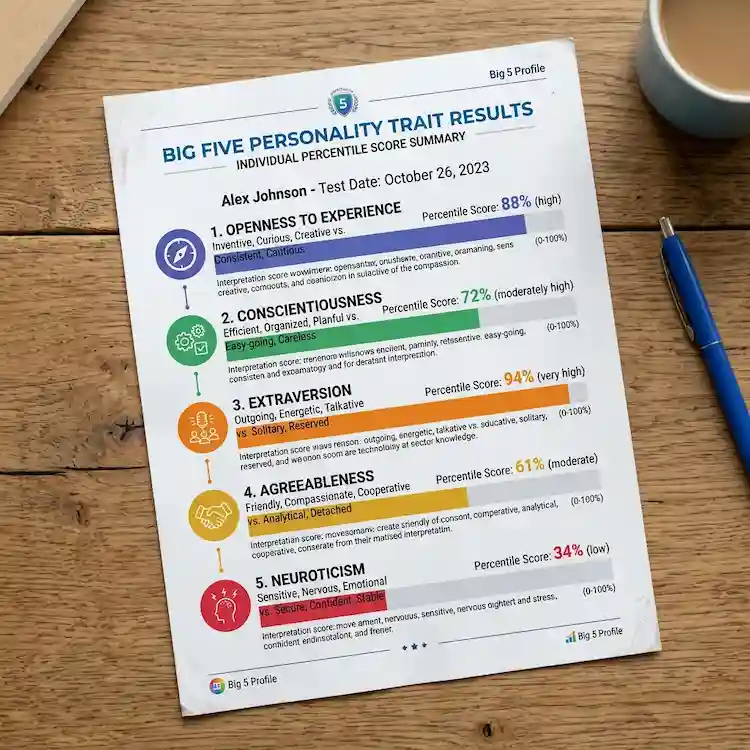
Most Big Five assessments – including ours – return your scores as percentiles against a normed population. A score of 78 on Openness does not mean you are “78% open”; it means you scored higher on Openness than 78% of the people in the reference group.
A few rules of thumb:
- Above 70: clearly high on this trait. Careers built around this trait will feel natural; careers that fight against it will drain you.
- 30 to 70: moderate. You can flex in either direction depending on context. This is the band where people most often mis-read themselves.
- Below 30: clearly low. Don’t force yourself into roles that demand the opposite. A low-Extraversion score isn’t a flaw to fix – it’s information to plan around.
The traps are the middle scores. Someone at the 55th percentile on Conscientiousness is not “a conscientious person” – they are flexible, which is its own profile. Treat middle scores as a third category, not a weak version of “high.”
Which Traits Matter Most for Career Decisions?
Not all five traits weigh equally when choosing a career. Based on 70+ years of organisational psychology research, two traits tend to shape career satisfaction more than the others:
- Conscientiousness is the strongest single predictor of job performance across almost every field. It also shapes which working environments you will thrive in – high-C people generally outperform in structured, outcome-driven roles; lower-C people outperform in exploratory, flexible ones.
- Openness is the strongest predictor of career fit, especially for knowledge work. High-O people find routine work soul-draining; low-O people find abstract, ambiguous work exhausting. Getting Openness wrong is the most common reason smart people end up in careers that look great on paper and feel wrong in practice.
Extraversion matters – but mostly for working-environment fit (team size, customer-facing vs. independent work), not for job title. Agreeableness matters more for team dynamics than career choice. Neuroticism shapes which working conditions will cost you most (see our note on neuroticism in the trait-combinations section above).
The practical implication: if you have limited time, read your Openness and Conscientiousness scores first, then layer in the other three.
What Your Results Are Not
Big Five results are information, not identity. Three common mistakes to avoid:
- Treating scores as fixed. Personality traits shift slowly across a lifetime – usually in predictable directions (most people become more conscientious and agreeable with age; neuroticism declines). A score you have today is not a score you will have in ten years. Don’t rule out a career based on a temporary trait reading.
- Taking a single test as gospel. Test reliability varies. If your results feel wrong, take a second reputable assessment and look at where the two agree. The overlap is more reliable than either test alone.
- Skipping the context. A high-Openness score does not mean “become an artist.” It means you need novelty, abstraction, and intellectual stimulation at work – which can show up in careers from research to strategy to product design to investigative journalism. Read the trait for what it describes, not for the stereotype it evokes.
A Four-Step Framework for Turning Results Into a Shortlist
Once you have your scores, use this process to build a shortlist of careers worth exploring:
- Identify your two strongest traits (scores above 70) and your two weakest (below 30). This is your personality signature.
- Read the relevant sections above – the single-trait sections for your strong and weak scores, plus any combination that matches your top three.
- Cross-reference with your values and practical constraints. Personality determines fit; values and constraints determine feasibility. A perfect personality match in a career that clashes with your ethics or your finances will still make you miserable.
- Pick three to five careers to investigate in depth. Informational interviews, short courses, or a week shadowing someone in the role will tell you more than any assessment – but only if the assessment has pointed you in roughly the right direction first.
If you do not yet have your Big Five results, our paid plans of career quiz deliver them alongside a personalized career shortlist in about 10 minutes – built on the Big Five framework with values and working-style questions layered on top, so you get both the trait scores and the practical translation at the same time.
How to Find Your Match with AI
Reading about these traits is helpful, but seeing exactly how they apply to you is transformative. This is where modern technology bridges the gap.
CareerSeeker AI utilizes the Big Five framework to analyze your unique psychological profile. Instead of a generic quiz, our AI acts as a personalized career consultant.
- It Analyzes Your Mix: It doesn’t just look at one trait; it looks at how your High Openness interacts with your Low Extraversion.
- It Filters for Dealbreakers: It identifies roles that might fit your skills but would drain your battery based on your personality.
- It Suggests “Hidden” Jobs: It finds modern roles (like those in our How to Find the Right Career Path in 2026: A Complete Guide) that you might not know exist.
Action Step: Don’t guess. Take the CareerSeeker AI Quiz to get a data-driven roadmap of careers that fit your personality DNA.
Common Pitfalls to Avoid
When looking for jobs based on big 5 personality traits, avoid these common traps:
- The “Box” Trap: Your personality is a tendency, not a prison. An introvert can be a great salesperson, but it might drain them faster than an extrovert.
- Ignoring Growth: Personality can shift slightly over time. Don’t rule out a career just because you scored 49% on a trait today.
- Overlooking Skills: Personality determines fit, but skills determine competence. You might have the perfect personality for a surgeon, but without medical school, it doesn’t matter.
- Neglecting Values: You might have the personality for Investment Banking (Low Agreeableness, High Conscientiousness), but if your core value is “helping the poor,” you will be miserable.
Future Outlook: Personality in the AI Era
As we move toward 2026 and beyond, soft skills and personality fit are becoming more important, not less. AI can write code and analyze data, but it cannot replace the empathy of a High Agreeableness social worker or the daring creativity of a High Openness director.
Employers are increasingly using personality assessments in hiring. By understanding your own Big Five profile now, you are effectively future-proofing your career. You can articulate not just what you can do, but how you work best – a massive advantage in interviews.
Conclusion
Finding careers based on big five personality traits isn’t about finding the “perfect” job – it’s about finding the path of least resistance to your own success. It’s about giving yourself permission to be who you are, rather than who you think you should be.
If you are High Openness, stop forcing yourself into a spreadsheet. If you are Low Extraversion, stop feeling guilty for hating open-plan offices.
Your ideal career exists at the intersection of your skills, your values, and your personality.
Ready to stop guessing and start knowing?
Take the first step toward a career that feels like you. Use CareerSeeker AI to generate your personalized career profile today. It’s free, fast, and scientifically grounded.