Most career tools give you a starting point. A personality type. A list of jobs that loosely match your answers. Maybe a chart that tells you you’re “analytical” or “creative” – as if you hadn’t already figured that out.
That’s not useless. A starting point is still a point. But if you’ve ever finished a career quiz and thought, “Okay… now what?” – you’ve already hit the ceiling of what most tools are designed to do. They help you think about the question. They don’t help you answer it.
That’s where CareerSeeker AI started. And after almost a year of building, testing, and learning from hundreds of real users, it’s where the new Pro and Ultimate plans pick up.
A Free Tool That Taught Us What Was Missing
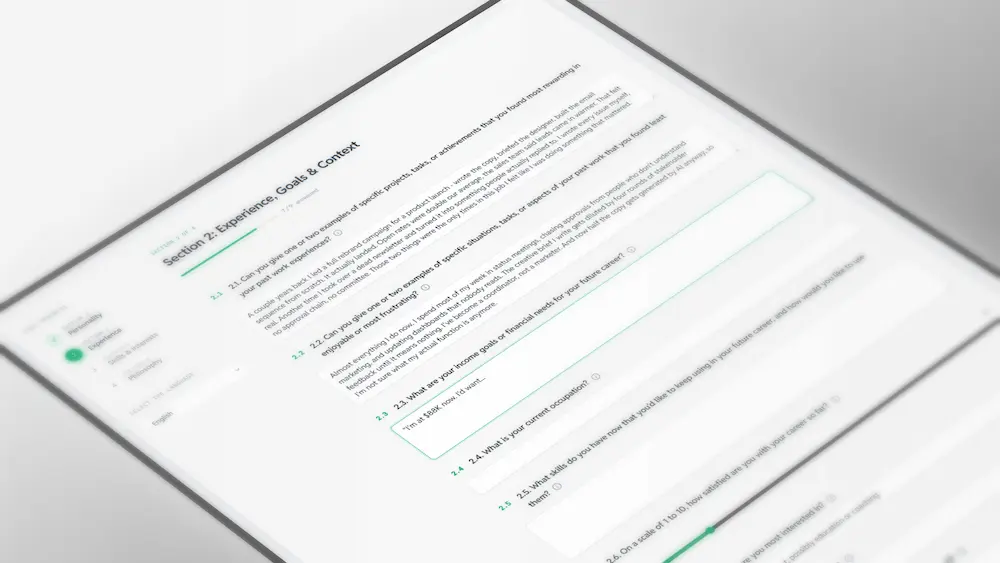
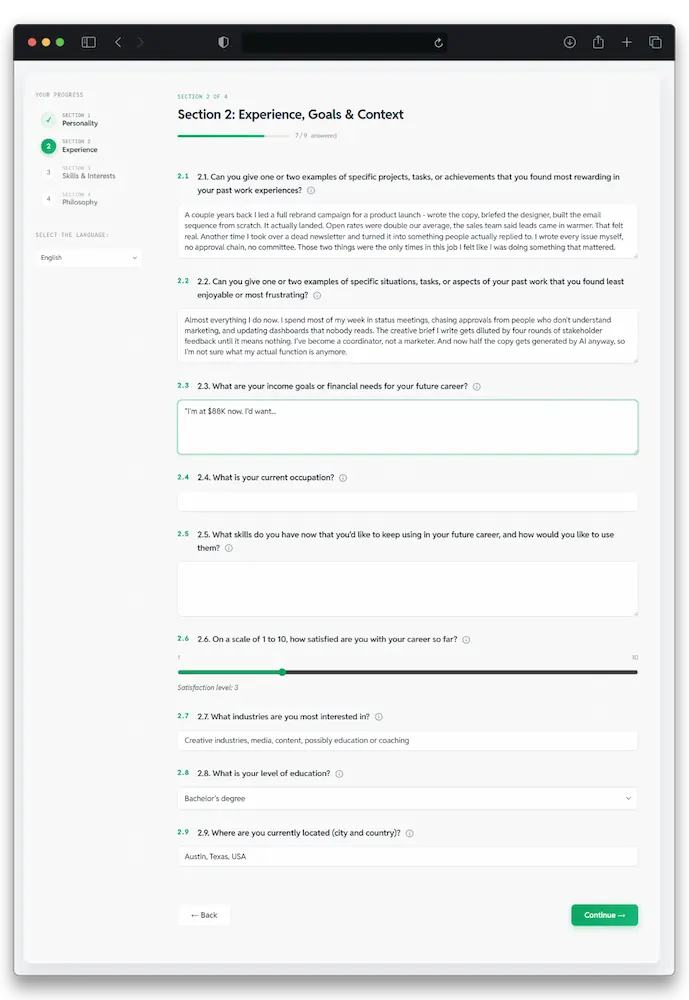
CareerSeeker AI launched its free plan – the Start plan – in mid-2025. The premise was simple: answer a set of questions about your personality, values, work history, and preferences, and get AI-generated career suggestions that actually reflect who you are. No account. No email. No strings.
It worked. People used it. Hundreds of them. And because the platform is anonymous, people were honest – sometimes remarkably so. They wrote about burnout they hadn’t told anyone about. About jobs they took to please their parents. About strengths they didn’t think counted because no employer had ever asked about them.
We paid attention to what came back.
The free reports were doing their job – providing a useful snapshot for zero cost. But patterns emerged in what users clearly wanted and the reports weren’t delivering. More depth on personality analysis. More specificity in career suggestions. Realistic transition paths instead of vague encouragement. A way to compare options side by side. An action plan that went beyond “consider upskilling.”
The free plan went through many major iterations. It got better every time. But some of what was missing couldn’t be fixed with better prompts on a lightweight model. It required a fundamentally more comprehensive framework – more questions, more context, more sophisticated reasoning, and features that simply don’t fit inside a free, 30-second analysis.
So we built the Pro and Ultimate plans from the ground up.
Not the Same Report Behind a Paywall
This is worth saying directly: the paid tiers are not the free plan with a price tag on it.
The underlying system is dramatically more advanced. The framework scaled in every dimension – deeper analysis of every answer, a significantly larger context window, and a more robust set of tools the AI uses to generate your report. The entire architecture was rebuilt and refined over months of testing to cover what a real career decision actually demands.
The result is something closer to a structured consultation than a quiz result – except it’s available instantly, anonymously, and at a fraction of what you’d pay for even a single session with a human advisor.
Here’s the most honest way to show the difference: we’ve published demo reports for all three plans. Open them. Compare them yourself.
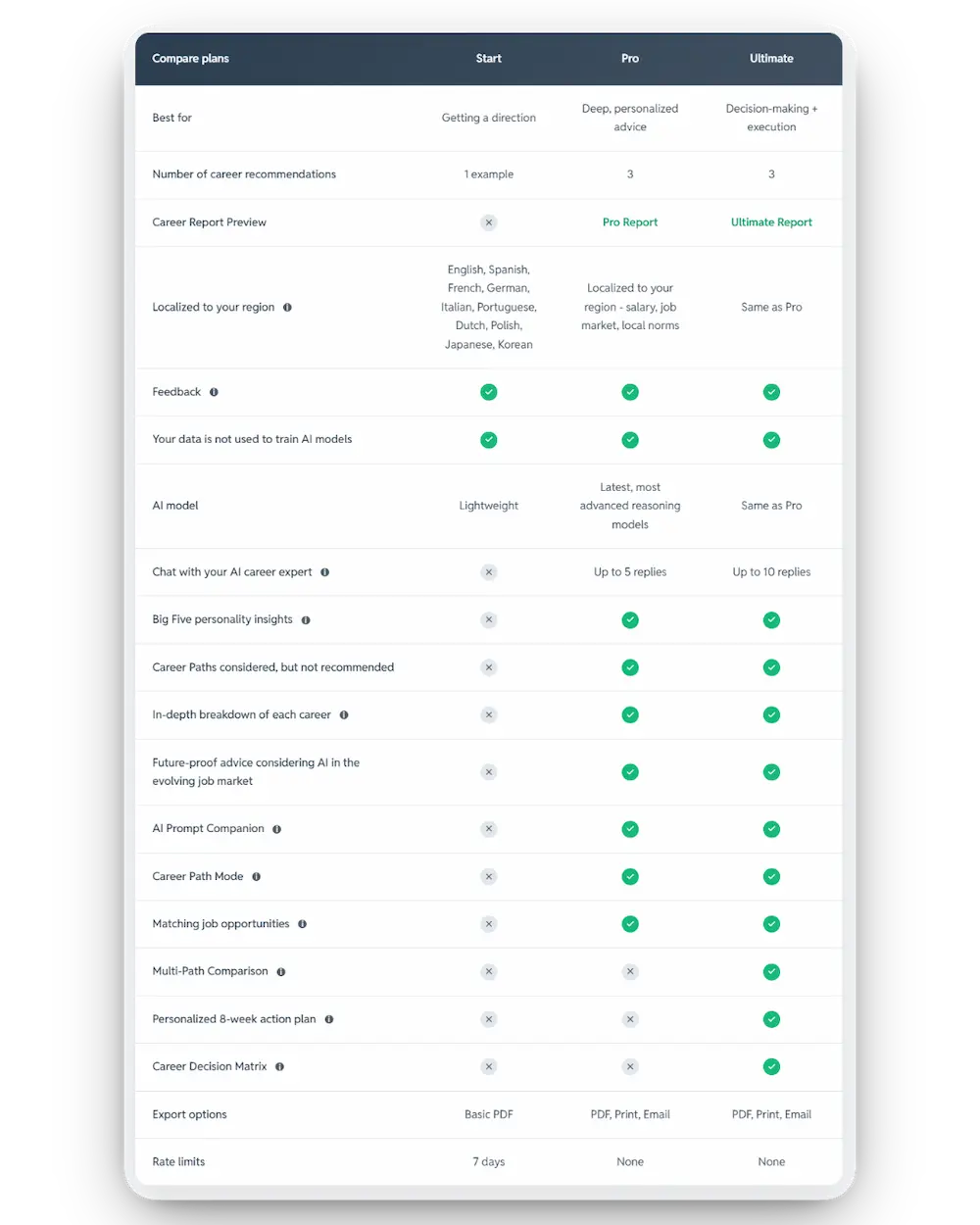
- Pro demo report – A deep, structured career analysis. Holistic personality breakdown, detailed career paths with realistic scenarios, follow-up conversation, Career Path Mode, AI Prompt Companion, and support for 10 languages.
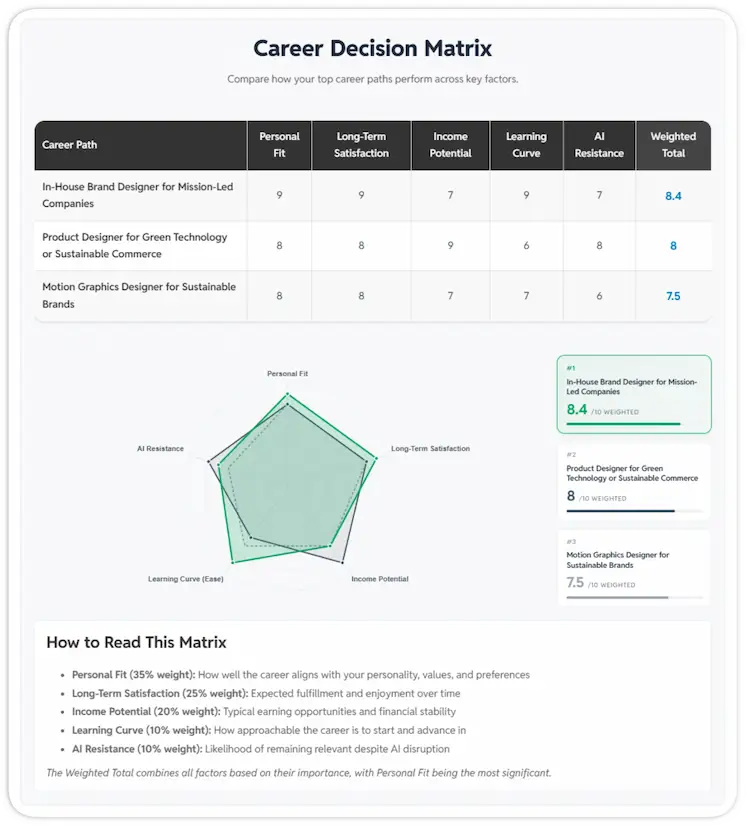
- Ultimate demo report – Everything in Pro, plus Multi-Path Comparison, a personalized 8-week action plan for each career, and a weighted Career Decision Matrix with a radar chart.
The gap between the free and paid reports isn’t subtle. It’s the difference between a sketch and a blueprint.
What the Pro and Ultimate Plans Actually Do
Features lists are useful but they don’t tell the full story. Here’s what the key differentiators mean in practice – and why they matter.
The AI Behind the Report
The free plan runs on fast, lightweight AI models. They’re good enough for a quick analysis, and they deliver results in roughly 30 seconds. That speed is part of the value – it’s a free tool, and it should feel like one: instant and frictionless.
The Pro and Ultimate plans use an entirely different class of AI. These are the most advanced, highest-reasoning models available on the market – the kind that require a paid monthly subscription if you want to access them yourself through services like ChatGPT or similar platforms. That subscription alone can run you up to half the cost of the Pro plan. And even with access, you’d still need to know what questions to ask, how to structure the analysis, and what frameworks produce meaningful career guidance instead of generic suggestions.
With CareerSeeker, that entire framework is built for you. You answer the questions. The most powerful AI available does the rest – guided by a system that was designed and refined specifically for this task over many months.
Follow-Up Conversation With the AI
This might be the single biggest upgrade over the free plan – and over most career tools in general.
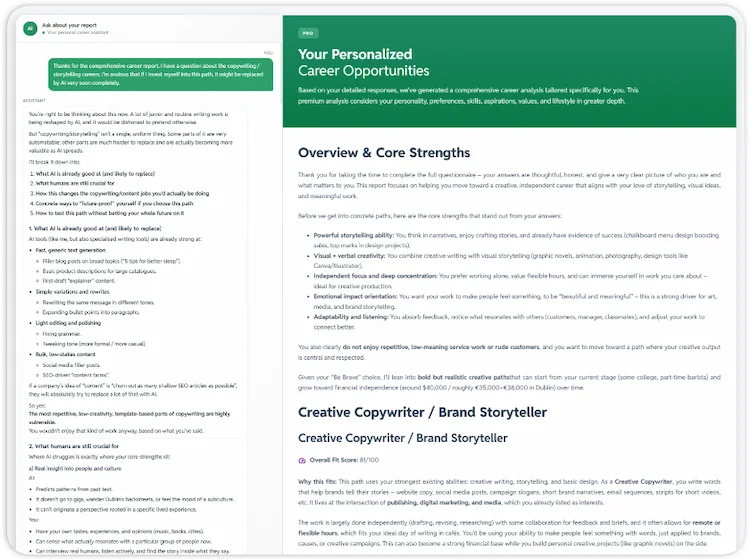
After your Pro or Ultimate report is generated, you can ask the AI follow-up questions. And here’s what makes this different from just opening ChatGPT and asking career advice: the AI already knows everything. Your full quiz responses, your personality profile, every career it suggested and why. It holds the entire context of your report.
So you can ask things like:
- “What if I don’t have a university degree – does that change any of these recommendations?”
- “How does my ADHD factor into the transition timeline for this career?”
- “Which of these three options has the best growth potential in my region?”
- “I liked the second suggestion but I’m worried about salary – can you go deeper on the earning potential?”
This isn’t a chatbot guessing. It’s a continuation of the analysis, with your full profile loaded. It closes the gap between a static report and a live consultation – without the scheduling, the cost, or the awkwardness of explaining your entire life story to a stranger.
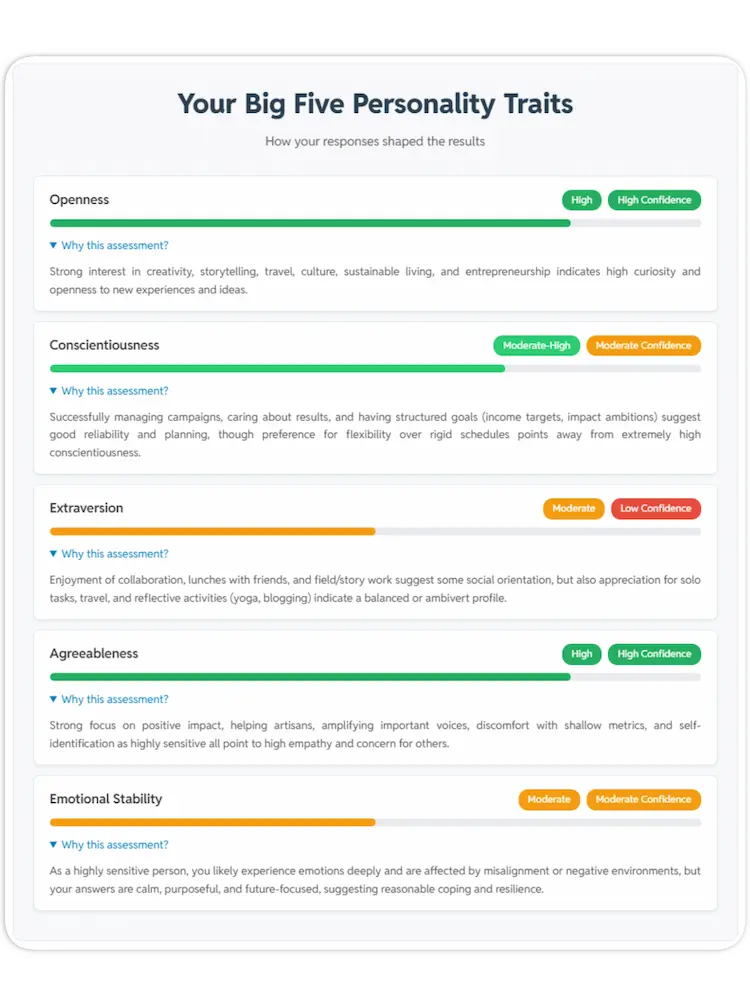
Big Five Personality Breakdown (Pro & Ultimate)
Most career tools treat personality as an input – something you declare at the start and that disappears into the algorithm. In the Pro and Ultimate reports, it comes back out.
The AI performs a Big Five personality assessment based on your quiz responses – mapping your levels of Openness, Conscientiousness, Extraversion, Agreeableness, and Emotional Stability. This was always happening internally to generate better career matches. What’s new is that it’s now visible to you, presented as a clear visual breakdown with a confidence indicator for each trait and an explanation of how that trait influenced your recommendations.
It’s one of those features that’s genuinely useful beyond the career context. Understanding that your Agreeableness scored high and your Extraversion is moderate doesn’t just explain why certain careers were suggested – it helps you understand how you work, how you make decisions, and where you’re likely to thrive or struggle. That self-knowledge has a longer shelf life than any single career recommendation.
Career Path Mode (Pro & Ultimate)
Not everyone taking the quiz is in the same situation. Some people want to pivot gently – they like parts of what they do but need a better fit. Others are ready to blow it up and start something completely different.
Career Path Mode lets you choose: smooth transition or deep dive. The AI adjusts its recommendations accordingly. A smooth transition emphasizes careers that leverage your existing skills and experience, with a realistic bridge from where you are now. A deep dive explores options you might never have considered – roles in different industries, different working models, entirely different trajectories.
Same quiz. Same person. Fundamentally different output based on what you actually want.
8-Week Action Plan (Ultimate)
One of the clearest patterns we saw in free plan feedback was: “Great, I like these suggestions – but what do I actually do now?”
The Ultimate plan answers that directly. For each career it suggests, you get a personalized 8-week action plan. Not “learn to code” or “consider networking.” Week-by-week structure with specific resources, skills to prioritize, milestones to hit, and realistic timelines.
It’s the difference between knowing where you want to go and having a map to get there.
Career Decision Matrix (Ultimate)
When the AI suggests multiple career paths – and it will – you’re left with a decision. The Ultimate plan doesn’t leave you to figure that out alone.
The Career Decision Matrix is a weighted scoring system that evaluates each suggested career across multiple dimensions relevant to you: growth potential, stability, alignment with your values, fit with your lifestyle, income trajectory, and more. The results are visualized as a radar chart, so you can see at a glance where each option is strongest and where the trade-offs are.
It turns “I’m torn between these three” into something you can reason about objectively – not just feel your way through.
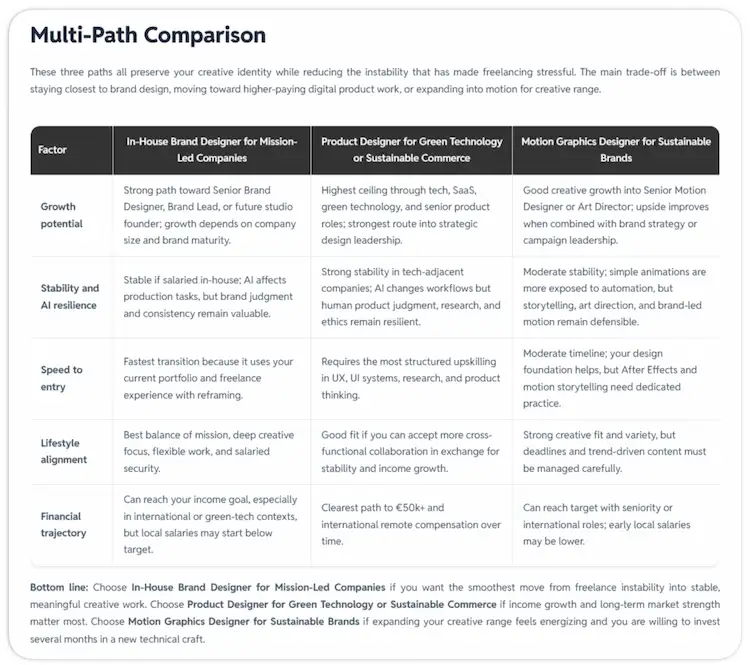
Multi-Path Comparison (Ultimate)
Related but distinct from the Decision Matrix: Multi-Path Comparison is a narrative analysis where the AI evaluates the trade-offs between your top career suggestions in depth. It considers growth potential, market stability, how well each path fits your personality profile, and what the realistic challenges would be for each.
Think of the Decision Matrix as the quantitative comparison and Multi-Path Comparison as the qualitative one. Together, they give you both the data and the reasoning.
AI Prompt Companion (Pro & Ultimate)
This one is practical in a way that’s easy to overlook but hard to overstate.
After your report is generated, you receive a set of professionally written AI prompts tailored to your suggested careers. These are ready-to-use prompts you can take to any AI tool – ChatGPT, Claude, Gemini, whatever you prefer – to dig deeper into specific aspects of your transition. Interview preparation. Skill gap analysis. Industry research. Resume positioning.
It turns your CareerSeeker report from a one-time read into a launchpad for ongoing exploration.
What Stays the Same
The paid tiers are new. The principles behind CareerSeeker AI are not.
Still anonymous. No account required. No email required. Not for the free plan, and not for Pro or Ultimate either. The only data exchange happens through the payment provider at checkout – CareerSeeker itself doesn’t collect or store personal information.
Still private. Your quiz responses are used to generate your report and nothing else. There’s no profile building, no data selling, no “we’ll use your answers to improve our model” fine print.
The free plan stays free. Forever. This isn’t one of those launches where the free tier quietly gets worse to push people toward paid. The Start plan does what it’s always done – provides a useful, honest snapshot for anyone who wants to explore. If that’s enough for you, it will always be there.
Still fast, still accessible. Under 10 minutes for the quiz. Instant results. Available any time, from anywhere. No waiting for an appointment, no commuting to an office, no scheduling around someone else’s calendar.
The paid tiers are an expansion, not a replacement. Everything that made CareerSeeker worth using at zero dollars is still true. The new plans are for people who want to go further.
What It Costs – and What It Costs Elsewhere
Let’s put the pricing in context.
| Plan | Price | What you get |
|---|---|---|
| Start (Free) | $0 | Career quiz + basic AI recommendations. Always free. |
| Pro | $29 | In-depth analysis, follow-up conversation, Career Path Mode, Prompt Companion, 30-day report access. |
| Ultimate | $49 | Everything in Pro + Multi-Path Comparison, 8-week action plan, Career Decision Matrix, unlimited context window. |
Both paid plans are one-time purchases. No subscription. No recurring charges. You pay once, you get your report, it’s yours to download and keep.
Now consider the alternatives:
- A single session with a career advisor typically costs $100 to $300. Most recommend three to five sessions. That’s $300 to $1,500 – and the advisor has never mapped your full psychological profile before the conversation started.
- A career coaching engagement runs $2,000 to $5,000 over several months. Valuable for some people, but inaccessible for most.
- Even the AI models that power the Pro and Ultimate plans require paid subscriptions to access individually – subscriptions that can cost up to half the Pro plan’s price per month, every month. And that gets you the raw model, not a purpose-built career framework.
The Pro plan costs less than a decent pair of headphones. The Ultimate costs less than a single hour with most private career coaches. Neither asks you to sign up for anything ongoing.
Who This Is For
It would be easy to say the paid plans are only for people standing at a crossroads – burned out, laid off, ready to change everything. And yes, it serves that situation well. If you’re staring at a career that stopped fitting a long time ago and you need clarity on what’s next, that’s exactly what this was built for.
But during months of testing, something else kept coming up.
People who already like their careers used the framework – and got genuinely useful results. Not “quit everything and become a marine biologist” suggestions, but insights on how to advance in their current path, expand into adjacent roles, or develop skills that would make them better at what they already do. The system doesn’t assume you need a dramatic change. It meets you where you are.
So the honest answer to “who is this for?” is broader than you might expect:
- People considering a career change who want structured guidance, not guesswork.
- People who are curious – not in crisis, just wondering what else might suit them.
- People who love what they do but want to explore how to grow, specialize, or expand within their field.
- People early in their careers who need more than a personality type – they need a direction and a plan.
- People whose neurodivergent traits are part of the equation and who are tired of career tools that ignore that entirely.
If the free plan already gave you what you needed – great. It did its job, and we’re glad it helped. If it left you wanting more depth, more specificity, more of a plan – that’s exactly what the Pro and Ultimate tiers were built for.
See It for Yourself
We could keep talking. Or you could just look.